
In this Article:
Try Kanbanchi now
Start your free trial

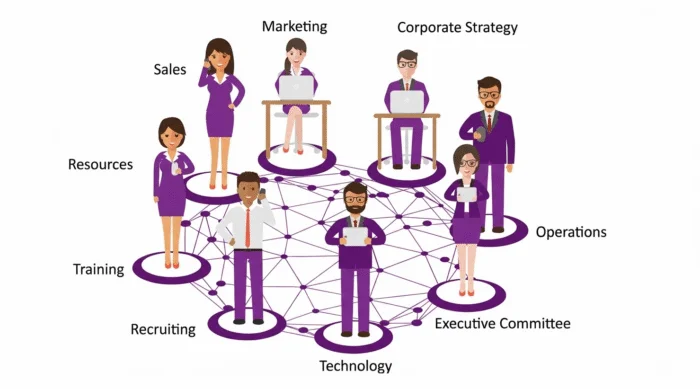
In a busy business landscape, innovation doesn’t happen in a vacuum. It happens when a range of skill sets work together successfully in harmony. This is what we call cross-functional project management. But what is a cross-functional project, exactly?
At its simplest, it’s a venture that requires expertise from multiple departments to reach a single, unified goal. Think of a product launch, you need:
Most organizations treat these teams like separate gears that don’t synchronize. They use different tools, different vocabularies, and different datasets. To lead a cross-functional project team effectively, you need more than just a meeting invite. You need a strategy to break down these silos and a digital hub that speaks everyone’s language.
Whether you are already an experienced lead or a department head wondering why projects are stalling, this guide is your blueprint to managing cross-functional projects with ease.
Why is everyone talking about cross-functional team project management lately? Because the traditional waterfall approach, where one team finishes their part and throws it over the wall to the next, is too slow for a world that moves with fancy algorithms.
When you successfully implement cross-functional teams in project management, you unlock three core advantages that your competitors simply can’t match:
When a developer sits in a room (or a virtual board) with a customer support rep, magic happens. The developer sees the “how”, but the support rep sees the “why”. This friction creates better products that solve real-user problems faster.
Cross-functional project management work eliminates the waiting game. Instead of waiting three weeks for a legal review, the legal team is part of the project from Day 1. They can flag issues in real time, preventing the back-to-the-drawing-board moments that derail timelines.
Nobody likes feeling like a tiny cog in a giant, invisible machine. Working on a cross-functional team gives employees a broader view of the business. It builds empathy across departments and helps team members see how their specific contributions drive results for the entire company.
In short, cross-functional project management isn’t just about getting along. It’s a competitive necessity. It’s about turning a fragmented group of specialists into a streamlined, high-output unit.
Find more project management blogs here
When you bring together people who:
Then friction is inevitable.
In 2024 Gartner survey revealed that 84% of employees experience “collaboration drag” when working across functions. To keep your project from becoming part of that statistic, you must proactively solve these four primary hurdles.
The most common challenge for a cross-functional project manager is leading without formal authority. You are responsible for the project’s success, but you can’t technically fire or promote the people doing the work.
The Solution: Focus on influence rather than power. Build relational legitimacy by involving team members in goal-setting early on. When people help write the Why, they are much more likely to execute the What.
Imagine the Marketing lead is rewarded for brand awareness, while the Developer is measured on system stability. If a project requires a flashy but heavy website feature, they are suddenly at odds.
The Solution: Establish shared OKRs (Objectives and Key Results) that supersede departmental KPIs. The Project Goal must be the primary measure against which everyone, regardless of their home department, is evaluated.
Each department has its own language. A sprint means one thing to a Dev and something entirely different to a Sales rep.
The Solution: Standardize your terminology. Create a shared project glossary and, more importantly, a Single Source of Truth. If half the team is in a spreadsheet and the other half is in a specialized dev tool, information will be lost.
Cross-functional teams in project management often fail because they are overwhelmed by too many platforms. Context switching among five apps to find a single update creates information overload.
The Solution: Consolidate. You need one visual hub where the high-level roadmap and daily tasks live together. This reduces your team’s mental load and ensures no one is working from an outdated version of the truth.
Recognizing these challenges is the first step. The second is choosing a framework and a tool that naturally bridges these gaps without adding more delays and extra work to your day. So, let’s get into how all these issues can be solved easily and without friction as we examine the best practices for cross-functional team management.
Leading a diverse team isn’t about control; it’s about coordination. To turn a group of individuals from different backgrounds into a cohesive unit, you need a repeatable system that can be picked up and learned easily every time a new team member joins.
By implementing these three high-impact strategies, you can transform cross-functional team project management from a chaotic mess into a streamlined system that works well for everyone involved in it.
Ambiguity is the silent killer of productivity. When a task sits in a grey area between departments, it usually falls through the cracks.
Your Task: Create a RACI chart for every major milestone.
Define who is:
Eliminate the “I thought you were doing that…?” conversation forever that wrecks working relationships and causes unnecessary delays.
You cannot manage a cross-functional project if your Design team uses one methodology while your Sales team uses another.
Your task: Use one framework for everything.
Pick a primary framework like Agile or Lean and ensure every department understands the basics of it before pressing it into use for every project you undertake. Review how things are going regularly to make sure that you’re on the right track and that it is the right system for you and your work.
Create a shared rhythm of work, whether it’s weekly syncs or daily stand-up meetings, so everyone knows when and how to communicate progress. Encourage check-ins and for everyone to catch up as regularly as possible
If your project requirements are in a PDF, your timeline is in an Excel sheet, and your feedback is in Slack, you have a visibility problem.
Your task: Find a superior software tool like Kanbanchi that allows you to do all this and more.
Use a digital hub that integrates with your existing tools. Every file, conversation, and deadline should be one click away from the project task itself.
Reduce context switching. When a team member spends less time looking for information, they spend more time creating value.
Cross-functional work can be draining because team members often feel pulled away from their real jobs.
Your task: To make everyone feel a part of the project, and that their contributions are valid.
When a milestone is reached, ensure the entire cross-functional team is recognized, not just the lead department.
Build a unified team identity that transcends departmental labels and ensures everyone feels able to perform at their best for the project’s greater good.
How do you find a software tool that encompasses all this and more? We’ve got some tips to share with you.
If your organization runs on Google Workspace or uses unified Microsoft products, you already have the ingredients for collaboration. But to manage a cross-functional project, you need a chef to bring those ingredients together to deliver results.
Most project management tools act as third-party intruders. They require you to
Kanbanchi is different. It is designed to bridge gaps between Workspace’s silos, making it an ideal platform for cross-functional project management.
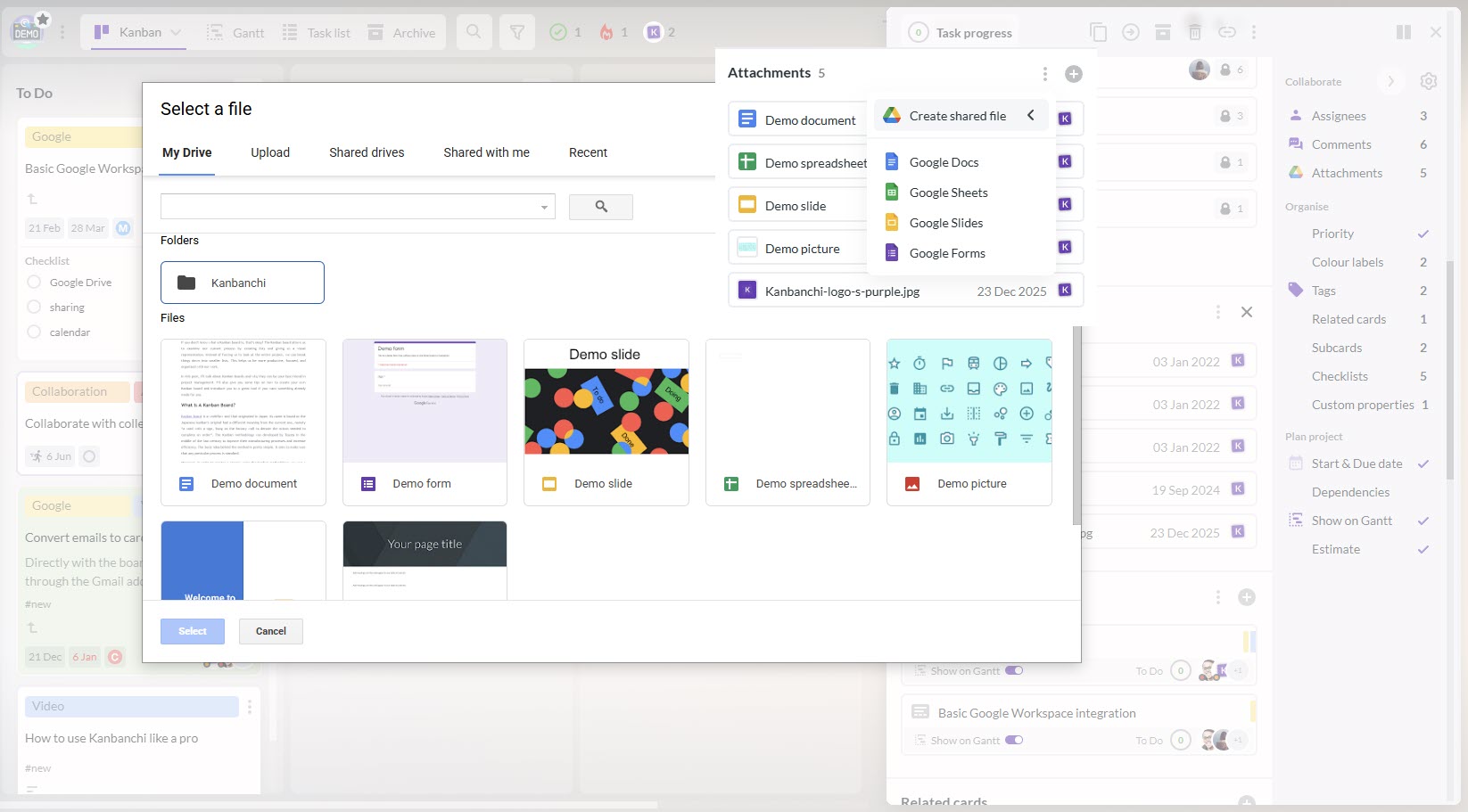
There are lots of reasons why it’s becoming an essential part of many teams’ work structures.
Cross-functional work requires different zoom levels for everyone at different stages of the project. Let’s look at these now.
These give everyone the Big Picture. Gantt charts in Kanbanchi mean you can look at dependencies, such as ensuring the Legal Review is completed before Marketing launches the campaign.
These are ideal for viewing your team’s daily flow. Individual team members need to know what to do right now. The Kanban view breaks a huge project down into easy-to-understand visual cards that move from Doing to Done.
By centralizing everything in one native hub, you eliminate the “where did that file go?” problem and replace it with a transparent, accountable workflow that honors every department’s contribution. That’s why you need it, now, here’s how it can work for you!
Start your free trial with Kanbanchi now
Ready to turn your cross-functional strategy into a reality? Managing a cross-functional project in Kanbanchi isn’t just about making a list; it’s about creating a shared visual language. Follow these steps to set up your multi-departmental command center.
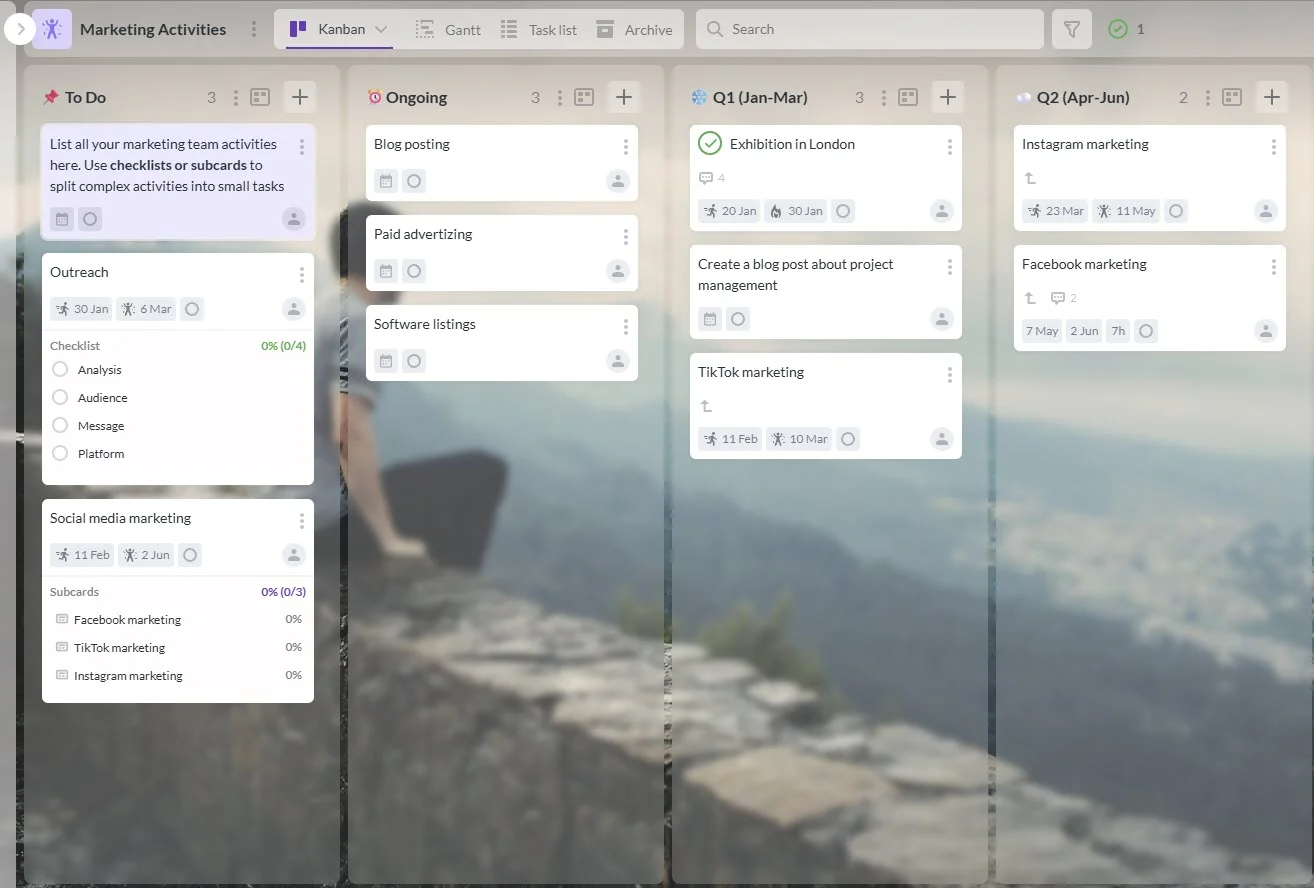
In a cross-functional team project management environment, a single list of tasks is a recipe for too much noise, leading to lots of overwhelm and inaction. Your developers don’t need to see the minutiae of the PR plan, but they do need to know it’s happening.
Your Task: Use Swimlanes to segment your board by department (e.g., Design, Engineering, Legal).
What are the benefits? This keeps the board clean while allowing everyone to see how their work fits into the broader project ecosystem.
Innovation stalls when one team is waiting on another without knowing it.
The Task: Switch to the Gantt Chart view and draw connection lines between cards. For example, link Landing Page Copy to Website Coding.
What are the benefits? If the copy is delayed, the developer sees the shift on their timeline instantly. This visual transparency eliminates the blame game.
While swimlanes organize by who is doing the work, Tags organize by the type of work.
Your Task: Create tags for Priority, Approval Needed, or External Vendor.
What are the benefits? You can filter the board in one click to see every task across all departments that currently needs Legal Approval.
Most cross-functional projects have tasks that overlap.
Your Task: Assign multiple team members from different departments to a single card.
What are the benefits? This creates shared accountability. When a Designer and a Content Writer are both assigned to an Infographic card, they are nudged to collaborate within the card’s comments rather than in separate DM threads.
Don’t waste time in unnecessary status update meetings that waste time and just cause more confusion.
Your Task: Set up Kanbanchi Mobile Notifications or email alerts for card movements.
What are the benefits? When Marketing moves the Social Assets card to Done, the Social Media Manager receives an immediate notification. The workflow moves while you sleep.
By adopting and really using a tool that feels familiar and is Google Workspace or Microsoft 365 compatible, you’ll ensure that;
The best cross-functional project management tool for 2026 is one that can bring everyone together with a shared purpose and perspective. Even better if there’s no downtime for installation!
Does this sound like a winner for you? Try Kanbanchi today
Any remaining questions left? Our FAQ section on cross-functional project management should help guide you in the right direction.
The most frequent roadblocks are:
Addressing these requires a shared project management system and unified project goals.
Leading without a title depends on relational influence. You must provide value by making the team’s work easier. Use visual tools like Kanban boards to provide clarity, remove blockers early, and ensure every contributor sees how their specific task impacts the overall project success.
Conflict usually stems from a lack of transparency. When priorities clash, refer back to the shared OKRs (Objectives and Key Results). If the project is the priority, the board should reflect that. Use data from your Gantt charts to demonstrate the objective impact of delays, removing the personality from the disagreement.
The best software, such as Kanbanchi, will help everyone on your team, no matter which department they work in, gain a deeper understanding of their role and what they need to do to make the project a success. It’ll be easy to install, and there’ll be little to no learning curve to keep it simple.
PM Tools That Help Teams Plan and Deliver Better


In this Article:
Start using Kanbanchi now
Start your free trial