
In this Article:
Try Kanbanchi now
Start your free trial


If you read this article, then you are perhaps facing the question “how to work with freelancers”. It may be tough in terms of time, communication, and budget. When you don’t properly manage these three aspects, you run the risk of failing your project and wasting resources. But at the same time, having all these correctly set makes them work towards your goal and achieve great results.
I first wrote this article in 2021. Since then, I have hired a lot more freelancers: marketing specialists, analysts, Google Ads specialists, writers, SEO specialists, and almost none of it went wrong. Not because we got lucky, but because we slowly built a way of hiring and screening that catches problems before we even enter any agreement.
So I have rewritten this article as the thing I wish I’d had at the start: a practical manual. What follows is not theory. It is what we actually do at Kanbanchi, including the two hires that failed and why, the freelancer who took our money and didn’t deliver, and the writer who has been working with us for more than nine years.
If you are reading this because you want to hire a freelancer but you’re afraid it won’t be worth it, the honest answer is that it usually is. As long as you treat every engagement as a small project with an owner, a deadline, and a definition of done.
When hiring a freelancer to do a job for you, you don’t need to worry about the time when you have no tasks for them. You agree to a particular task and a payment that your freelancer will receive, and that’s your deal.
Whether you plan to hire a freelancer for a small-scale project or a larger one, you may discuss the schedule before entering the agreement. Freelancers are flexible with their work hours and can cover your needs outside of your regular working hours, providing staff support.
Working with freelancers gives you access to a vast pool of talent. You might need a designer today and a good copywriter for another two days. Sometimes it just doesn’t make sense to have all these people in-house.
Freelancing is a business, and freelance professionals are business owners who value their reputation. They strive for the best quality in their work, so you can be sure you are getting highly skilled professionals when you need them, for exactly the amount of time you need.
When you hire freelancers, you can save a lot of money. First, on salary, because you only pay for the time people actually work. Second, you save on office space, supplies, etc., which you would have to cover if you weren’t hiring people with home offices equipped exactly for the job.
The real saving is that you stop paying for idle capacity. A paid ads specialist you need for six hours a month isn’t a job. It is six hours.
One caveat, because I don’t want to oversell this: a good freelancer’s hourly rate is often higher than the equivalent employee’s. Add the platform fee on top. Freelance work is not automatically cheaper per hour. It is cheaper per outcome, because you buy only what you need and you stop when the work is done.
With in-house staff, you invest significant resources in training your employees. Because you care about their professional growth, with freelancers, it’s their expense; they pay for their training, courses, and so on.
Another great advantage of freelancers is that they require less supervision. They have likely done this job many times before and know exactly what to do, especially for work that can be done independently. Similar to creating a website or an agreement template.
Less supervision is not less management. A freelancer needs fewer instructions about how to do the work, and clearer instructions about what the work is.
Legally, freelancers aren’t your employees, which reduces the risk your company may incur. What that means in practice depends on where you and the freelancer are based. In some countries, a “freelancer” who works only for you, on your schedule, for a long period can be reclassified as an employee, so it is worth checking the rules that apply to you rather than assuming. You can easily terminate their contract in case they do not perform as expected.
The rates you agree on when hiring a freelancer are defined by the amount of work to be done, so you don’t risk paying more than the output you get. This is only true for fixed-price contracts. On an hourly contract, you absolutely can pay more than the output you get. I’ll come back to how that happened to us.
Again, having someone who has performed the work you need done a thousand times before provides you with the opportunity to get things done faster. Sometimes, a freelance specialist can perform the task twice as fast as an in-house worker who is not as narrowly specialized.
The process of hiring a freelancer is much faster than that of an in-house employee. You can always start with a small pilot project using a freelancer before involving them in larger projects.
We hire through freelance platforms. Not because there’s nothing else; there are plenty of places to find people now, from Upwork to LinkedIn, niche communities, and plain referrals, but because of one feature that matters more than any of them: the money sits in escrow, and there is someone to appeal to. Here is why that matters.
We once hired a specialist for product placement in YouTube videos. He quoted his price, and he told us the mention would appear in five videos of our choice. We paid. Then he told us he couldn’t do it. Everything had gone through Upwork, so he issued a refund. If we had paid him directly, that money would simply have been gone, and my only recourse would have been unpleasant emails.
The lesson isn’t “freelancers will scam you”. In more than a decade, this is the only time it happened to us. The lesson is that the platform fee is insurance, and it is cheapest exactly when you need it most: on a first engagement with someone you don’t know yet.
A rule we follow: never move a relationship off-platform to save the fee.

The freelance market is currently flooded with people. You need to be prepared before you hire someone. This instruction should help you avoid mistakes that may occur when hiring freelancers and achieve a valuable result.
First of all, you need to clearly understand what the result of posting a job on a freelance platform is. Website, blog article, review, document?
Then, you need to evaluate the best possible understanding of how many hours a freelancer may spend and make preliminary calculations for the cost. Even if the project is based on an hourly rate, it’s possible to discuss the task with a freelancer beforehand to get an estimate of the hours that may be spent on it. This estimated time may be set as a maximum; it’s always possible to extend the contract later.
You may want to consider researching to understand the average cost of the type of work you hire a freelancer for. Also, you may look at how much other freelancers charge for the same kind of work. Check their listed skills. Keep in mind the opportunity cost. There might be a significant difference in the rates of freelancers from different countries. Consider whether you are ready to work with people from other countries.
When posting a job, be precise and clearly explain exactly what you need. If it’s a particular output that can be named (article, document), list it as the desired output. Provide as many details as possible for the right person to identify themselves as suitable for this job. If there are any particular requirements for a freelancer, they should also be listed.
A vague brief feels fast when you write it and expensive when the invoice arrives. I have sent lazy briefs myself, usually when I was busy and wanted something off my plate. The result was always the same: more clarification questions, more revisions, and a freelancer spending billable time working out what I should have explained in the first place.
A brief doesn’t need to be long. It needs to remove guesswork. At minimum:
Compare these two versions of the same request:
The second one is easier to price, easier to estimate, and much harder to get wrong. We keep a reusable brief template so we don’t rewrite this structure every time.
When you have a pool of applicants, check the reviews they have received from other people. How many positive reviews do they have? Is there any specific information in the reviews that you’re interested in? If you don’t mind hiring freelancers new to the platform you are using, and who don’t have reviews yet, ask them to provide examples of their previous work. Check the requirements (skills, certificates, education, etc.). Schedule a call to discuss the details.
A strong portfolio proves someone can produce good work. It doesn’t prove they can produce good work inside your constraints. And in marketing and product work, the constraints usually are the job: legacy messaging, brand rules, missing assets, awkward analytics, a launch date that can’t move.
So I still look at samples, but I pay more attention to how a person thinks. Four questions do most of the work:
Good freelancers answer with trade-offs. Weak ones say yes to everything.
When working with a new person, consider checking their progress regularly to ensure they are claiming a reasonable amount of time for the actual work they are doing. Consider consulting a freelancer if you believe they are spending too much time. As time passes, you will identify trusted individuals with whom you will work more frequently in the future. They will require less, even if no supervision at all.
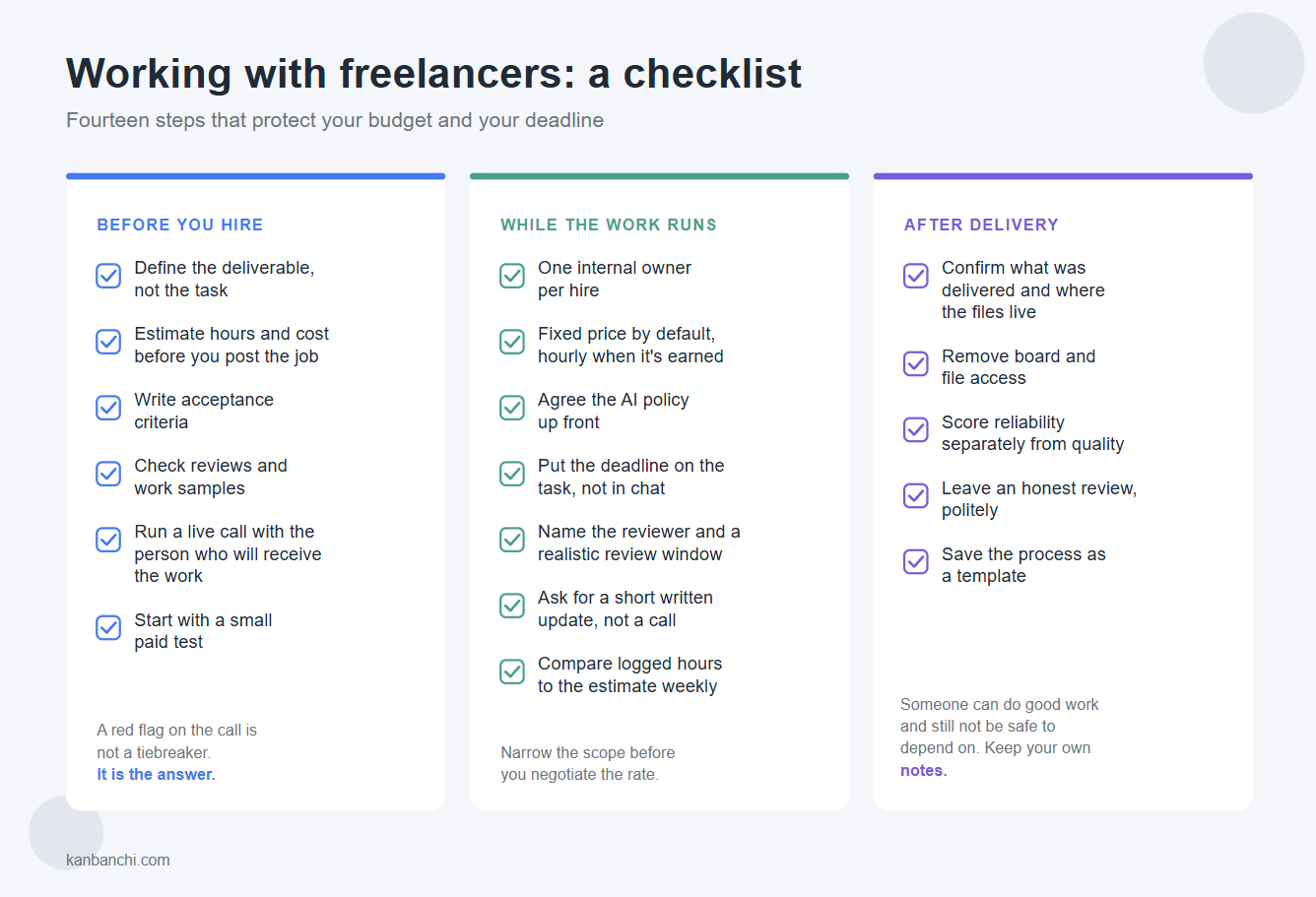
Use this checklist when hiring and working with freelancers
We do not hire anyone without a live call. Not a chat exchange, not a written test on its own. A conversation on Google Meet.
And one detail matters more than the call itself: the person on the call has to be the person the freelancer will report to. Not a recruiter, not whoever happens to be free. The person who will receive the work, review it, and be annoyed if it’s late.
In my experience, this single step catches almost every bad fit. Not because of anything sophisticated, but because you simply hear how someone reasons about the work, whether their questions are about the actual problem, and whether they are comfortable saying “I don’t know.”
One recent writer hire failed, and it failed for an avoidable reason. On the call, the candidate asked questions that had nothing to do with the work. That is a red flag, and it was noticed. But the person doing the interview decided to give her a chance anyway. It didn’t work out.
The rule I took from that: a red flag on the call is not a tiebreaker to be weighed against everything else. It is the answer. If the person who will manage the work leaves the call uneasy, believe them. Generosity in hiring is expensive.
Wherever it is possible, we start with a paid test. Something that looks like the real work but is much smaller: one email instead of a full onboarding sequence, one section of a landing page instead of the whole page, one small fix instead of a full integration.
A paid test shows you four things a CV can’t: communication style, speed, judgment, and how the person handles feedback. It also shows you whether your own instructions were clear, which is useful information even when the test goes badly.
Keep it paid. An unpaid test filters out exactly the people you want, because good freelancers with a pipeline don’t do free work.
But a test isn’t always possible. For analysts, SEO specialists, and marketing roles, the output is judgment rather than a deliverable, and there is nothing small you can carve off that proves anything. There, the setup call carries the weight. We use it to go as deep as we can: what data exists, what we’ve already tried, what our constraints are, what we think the problem is, and why we might be wrong. If someone can push back usefully in that conversation, that is the test.
Whenever possible, prefer fixed-price contracts over hourly rates. In most cases, it’s even easier for a freelancer to identify the exact end cost of a particular task or the scope of functions. Set up milestones if the contract is extended and requires a scope of work that may be split into steps. Five years on since I first wrote this article, and this is still our default, and I’d put it more strongly now: hourly is something a freelancer earns.
The exception in our case is the writer who has been with us for more than nine years. He is on an hourly rate, and it works because his estimates are genuinely predictable. Ask him how long something will take, and he’ll tell you a number, and the number is right. That kind of accuracy is rare, and it is what makes hourly safe.
With someone new, an hourly contract transfers all the scope risk to you. You are paying for time spent understanding the task, and you have no way to tell the difference between thoroughness and drift. Fixed price puts that risk where the expertise is.
Hourly does make sense for genuinely open-ended work: investigation, strategy, debugging, consulting. In that case, set a cap before the work starts, and be explicit that a cap is not a target: it means stop and talk to me before you go past it.
Cost and deadline problems almost never come from the hourly rate. They come from four things: unclear scope, invisible progress, late feedback, and work hidden in chat threads.
This is our own story, and it is the clearest example I have.
Early in our Upwork hiring, we brought in a consultant for some marketing activities and set the contract to hourly. Inside our team, there was a misunderstanding about who was actually responsible for the engagement. Each of us assumed someone else was watching it.
The freelancer logged time. He was paid for that time. And afterward, nobody could say what the time had bought.
He didn’t do anything wrong. We did. Every hire needs exactly one internal owner: one name, written down, whose job it is to know what this person is working on this week. On an hourly contract that is not optional.
If you hire hourly, reviewing logged time is not micromanagement. It’s budget management. But the useful version isn’t watching screenshots; it’s connecting hours to tasks. If something was estimated at five hours, four are logged, and there is no draft yet, that’s a conversation to have today rather than on invoice day. Maybe the task is harder than it looked. Maybe the brief was missing something. Either way, early is cheap.
Deadlines in email, Google Chat, or platform messages are not deadlines. They are memories waiting to contradict each other.
A due date should live where the work lives, so that when it changes, everyone dependent on it sees the change. This matters most when several freelancers touch the same project: a designer waiting on copy, a developer waiting on assets, a marketer waiting on tracking links can lose days because one handoff slipped and nobody noticed.
| Risk | What usually causes it | How to prevent it |
|---|---|---|
| Cost creep | Unclear scope, open-ended research, repeated revisions | Write acceptance criteria, cap hours, split the work into smaller pieces |
| Missed deadline | Dependencies invisible, review time not planned | Put tasks on a timeline, name reviewers, set handoff dates |
| Low-quality output | Freelancer lacks context or good examples | Share source material, brand rules, customer context, examples of good work |
| Duplicate work | Decisions made in private messages | Keep comments, files, and approvals on the task |
| Lost momentum | No clear next action after delivery | Add a review step with a named owner and a decision date |
| No accountability | Nobody knows who owns the hire | One internal owner per freelancer, written down |
Going through this table with your team takes five minutes and regularly saves five billable hours.
The longest relationship we have is with a writer who started as an ordinary blog hire and is still writing for us occasionally, more than nine years later. Nothing about how he works is complicated, but almost nobody does all of it:
That last one sounds trivial and isn’t. Knowing in March that someone is away in July is the difference between planning and improvising.
This is also why he is the one on an hourly rate, and why he gets first refusal on anything we need. Reliability compounds. If you are a freelancer reading this looking for the trick to getting repeat work: it’s this list, and it has nothing to do with talent.
I want to be honest about this, because most articles on hiring freelancers are written as if the client is always the reasonable party.
We are bootstrapped. Our team is small. And that means we are sometimes slow. Slow to review a draft, slow to supply media assets for a campaign, slow to make a decision that a freelancer is waiting on. I have absolutely been the reason a deadline moved.
A freelancer cannot protect a deadline that depends on a review process they don’t control. If a draft arrives Wednesday, is discussed internally until Friday, and the final version is expected Monday morning, the schedule was never real.
Four things that help, all of them on our side of the line:
We hired a video creator who promised a video in four days. Then he disappeared for a week. Then he reappeared, said he’d had some difficulties, and finished the job. The work was good. The project wasn’t time-sensitive, so we accepted it and paid. I also never hired him again.
Three things came out of that:
If you’re on the other side of this: going quiet is the single most damaging thing you can do to a client relationship, and it costs almost nothing to prevent. One message saying “I’ve hit a problem, here’s my new date” would have kept him on our list.
The received wisdom is that AI has made freelancers cheaper. That is not what happened to us. We now hire more qualified freelancers than we used to, because what we need has changed. Producing a competent draft is no longer the scarce skill. Knowing what to ask for, spotting when the output is confidently wrong, and taking responsibility for the final result – that is the scarce skill, and it costs more, not less.
We ask directly whether a freelancer uses AI, and then we agree what’s acceptable for that specific piece of work. Sometimes the answer is no AI at all. Sometimes it’s AI for certain parts and not others: research and structuring, say, but not the finished prose. Then we route the work accordingly: different tasks go to different people depending on what we’ve agreed. This conversation is much easier before the invoice than after. “You never said I couldn’t” is a fair objection if you never said it.
If a piece has to pass as human (a guest post for a publication with a no-AI policy, for example), the order of operations matters more than the tools. AI editing an AI draft leaves statistical patterns that detectors pick up. An AI rough draft that a human then edits does not, because the underlying structure and word choices are a person’s.
So when we brief AI-assisted writing, we brief the workflow, not just the output: AI drafts, person edits. Not the reverse.
The question of keeping track of tasks arises not only when working with freelancers. However, in this case, it may be the most crucial one. Consider having a system that will support you during this process. Kanbanchi boards can be used to track tasks assigned to your freelancers.
You may even share your boards with them and make these boards the ultimate placeholder for the information about your project. Assign cards to different freelancers and ask them to update their cards so that you are always aware of their current tasks.
I’ll be straight about this rather than pretending every engagement needs a board.
For a single deliverable with one handoff, an article, a document, a set of ad variants, a brief in a Google Doc is enough, and that’s what we use with most of our writers. Building a board for a one-off task is overhead that nobody thanks you for.
A board earns its place when the work has multiple steps and multiple people. Video production is our clearest example: script, review, shoot or animation, revisions, voiceover, final cut, publishing. Several dependencies, several people waiting on each other, and a state that somebody has to be able to see without asking. That’s when a Google Doc stops being enough.
We track time through the platform, not on the board. The platform’s time log is what the invoice is based on and what disputes are settled with, so duplicating it somewhere else creates two versions of the truth.
The board answers a different question: what state is this in, and who is holding it right now? Keep those separate, and neither one gets argued about.
Seven lists, and one of them is the important one:
“Waiting for internal input” is the list that changes the relationship. It makes it visible when we are the blocker, not the freelancer. If three cards are sitting there on Friday, that’s not a freelancer problem to raise in a call; it’s mine, and I can see it without anyone having to tell me diplomatically.
And each card should answer four questions:
For fixed-price work, the fourth one is the milestone amount. For hourly, it’s the estimate or the cap.
A freelance board* makes it visible when the client is the blocker, not just the freelancer. * Data is blurred due to the privacy regulations.
Kanban shows you flow. It does not show you that copy slipping by two days pushes design, development, and campaign setup by two days each. For that, you need a timeline view, which is what a Gantt chart is for. Not to produce a heavyweight project plan, but so that deadline risk is visible before it becomes a surprise. Kanbanchi’s Gantt saves to PDF, which is handy when a freelancer needs the schedule but doesn’t need access to everything else.
We give freelancers access to the whole board. Our marketing boards don’t contain anything sensitive; the boards are self-explanatory, and no special onboarding is needed. They open it and see the tasks they’re responsible for. If your boards carry customer data, unreleased plans, or anything commercially sensitive, don’t do that. Create a board for the engagement instead and put only that project on it.
Two practical notes:
Putting the whole thing in order:
1. A setup call. With the person who will receive the work. Go deep on context, constraints, and what you’ve already tried. Listen for how they reason, and for red flags you’re tempted to excuse.
2. Paid test, where possible. Small, real, paid. Where it isn’t possible, spend the time in the setup call instead.
3. Define the first milestone tightly. Not “website improvements”. A homepage messaging audit with ten recommendations grouped by impact and effort. Not “SEO help”. A technical audit of 20 priority URLs with issues, severity, and recommended fixes. The first milestone exists to build a shared language as much as to produce a deliverable.
4. Name the internal owner. One person. Written down. Their job is to know what this freelancer is doing this week.
5. Agree on the payment model. Fixed price by default. Hourly only for genuinely open-ended work, with a cap that means stop and ask.
6. Agree on the AI policy. Before the work starts, not after the draft arrives.
7. Set a communication rhythm. I prefer fewer calls and better written updates. Four lines, two or three times a week on an active project, weekly on a retainer:
8. Schedule the review, not just the delivery. Who reviews it, by when, and who covers if they’re away.
9. Close the loop. Confirm what was delivered, where the files live, which tasks are done, and what follow-up remains. Remove access. Write your private reliability note. Leave an honest review.
10. Save the process as a template. So the next engagement, or the same freelancer next month, doesn’t start from scratch. This is the step everyone skips, and it’s where the leverage is.
Even with a good system, projects go sideways. The difference a system makes is that you find out early.
If the cost is rising, don’t start by negotiating the rate. Start by narrowing the scope. Ask what can be removed, simplified, or moved to a later milestone. A lot of projects become affordable again the moment you separate the essential from the nice-to-have.
If the deadline is slipping, find the constraint. Is the freelancer waiting on input? Are you running late with the task your freelancer depends on? Was the task bigger than it looked? Is the internal review slow? A missed deadline is rarely one failure. It’s usually a chain of small delays that only became visible at the end.
If the quality isn’t there, go back to the acceptance criteria. “Make it better” burns hours. “The opening doesn’t address the reader’s problem, and the call to action doesn’t match the campaign goal” gives someone something to fix.
If the freelancer has gone quiet, set a single clear deadline for a reply and say what happens if it passes. Then act on it. The platform’s dispute process exists for this.
If trust is going, shrink the engagement to the next measurable milestone. Don’t let frustration turn into a vague argument. Make the next deliverable small, objective, and time-bound, then decide whether to continue.
Fixed price by default, especially with someone new. It puts the scope risk where the expertise is. Use hourly for genuinely open-ended work like research, strategy, or debugging, and set a cap before the work starts. Hourly works best with freelancers whose estimates you already know to be accurate.
Write acceptance criteria before the work starts, set an estimate or a cap, name one internal owner for the hire, and connect logged hours to specific tasks so you can see drift while it’s still cheap to fix. Ask the freelancer to flag risk early rather than surprise you after the time is spent.
A paid test is fair; an unpaid one isn’t, and it filters out the people you most want to hire. Keep the test small, make it resemble the real work, and pay for it at the normal rate.
Decide per task and say so up front. Sometimes the answer is no AI; sometimes it’s AI for research and structure but not the finished output. What matters is agreeing on it before the work starts. In our experience, AI hasn’t made freelancers cheaper, but it has raised the bar, because we now need people who can use it well and take responsibility for the result.
Send one message with a specific reply deadline and say what happens if it passes. If it passes, use the platform’s dispute process, which is a strong argument for keeping new engagements on a platform. Afterward, record it in your own notes: reliability is a separate thing from quality, and someone can do good work and still not be safe to depend on.
Not always. For a single deliverable with one handoff, a clear brief in a shared document is enough. You need a shared workspace once the work has multiple steps and multiple people waiting on each other. If what you’re actually looking for is a way to run projects end to end rather than to coordinate one freelancer, start with our guide to project management software instead.
Managing a freelancer is mostly about scope, briefs, payment terms, and trust with one external person. Managing a project is about dependencies, sequencing, and delivery across a whole team. They overlap, but they’re not the same job. If your question is really about running the project, our guide to remote project management covers that side, and keeping a team aligned in Google Workspace covers the day-to-day for teams relying on Google.
Working with freelancers should not feel like gambling with your budget and your launch date. After more than a decade of it, the parts that actually protect you are unglamorous: a real call with the person who’ll manage the work, a brief that removes guesswork, fixed price until hourly is earned, one internal owner per hire, deadlines on the task instead of in chat, and honesty about the days when the slow party is you.
Start with one freelance project. Keep the process simple. Improve it after each delivery, and write down what you changed. That written-down version is the thing that makes the next hire easy.
More articles about Remote Work here


In this Article:
Try Kanbanchi now
Start your free trial