-  views

Kanbanchi’s Guide to the Iron Triangle (Project Management Triangle)

Try Kanbanchi now

Start your free trial

 

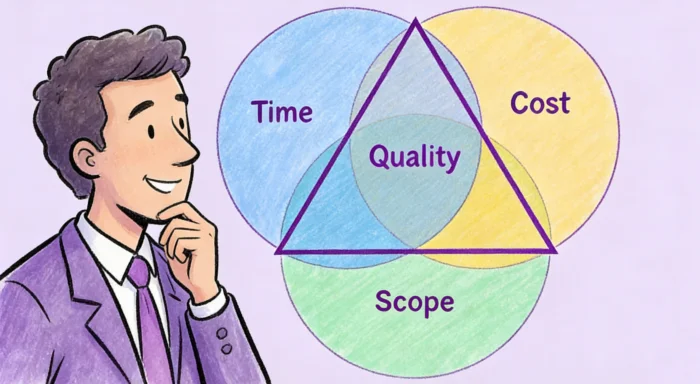
A colorful illustration of a man thoughtfully observing a diagram of the project management triangle showing the intersection of Time, Cost, and Scope with Quality at the center

There’s a quote attributed to Tom Waits, where he says Jim Jarmusch told him:

Fast, Cheap, and Good… pick two. If it’s fast and cheap, it won’t be good. If it’s cheap and good, it won’t be fast.

And, thinking about it seriously for a minute, if any of you have spent time in project management, you’ve already heard this old adage yourselves. 

It’s cynical, but it points to a fundamental truth in the professional world: you can’t change one part of a project without affecting the others.

We call this the Project Management Triangle or, for a more dramatic flourish, the Iron Triangle. It doesn’t matter whether you’re a project manager for an SME or someone with a startup. The PM Triangle will be the framework that determines your project’s success.

It is the framework that helps you understand the constant tug-of-war between:

  1. What you want to do (Scope)
  2. How much time you have to do it (Time)
  3. The resources available to get it done (Cost)

But here’s the secret: the triangle isn’t just a set of limitations. When understood correctly, it is a powerful tool for:

  1. Decision-making
  2. Client management, and 
  3. Ensuring Quality remains at the core of your service

In this comprehensive guide, we’ll break down the mechanics of it all. We’ll explore:

  • The anatomy of Scope, Time, and Cost
  • How to navigate trade-offs without crashing your project
  • The difference between Fixed and Estimated triangles in Agile vs. Waterfall
  • How to use visual tools like Kanbanchi to keep your triangle in perfect balance

Are you ready to stop picking two elements of the triangle and start mastering all three to maximize project management?

What is the Iron Triangle of Project Management?

At its simplest, the Iron Triangle is a model of constraints. Think of it as being like the physics of project management: certain laws simply cannot be broken.

The Iron in the name refers to the triangle’s rigid sides. If you pull on one corner to lengthen a side, the other sides must react. You cannot change the Scope of a project without it affecting Time or Cost.
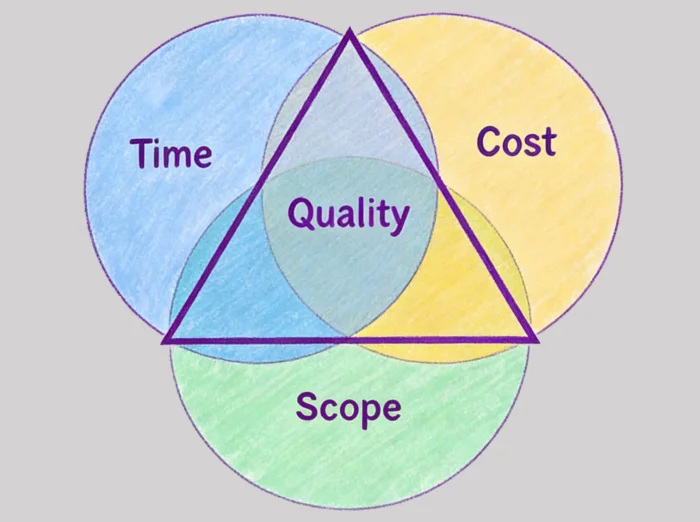
The project management triangle showing the intersection of Time, Cost, and Scope with Quality at the center
We started with this illustration, and this is exactly the iron triangle of project management

The Triple Constraint

The model is often called the Triple Constraint because it represents the three primary factors that limit every project:

1. Scope. It’s the What: The specific goals, deliverables, and tasks that define the project.

2. Time. It’s the When: The schedule, deadlines, and milestones required to complete the work.

3. Cost. It’s the How Much: The budget, resources, manpower, and tools needed.

The Logic of the Trade-off

Imagine you are halfway through a software launch. Suddenly, a stakeholder asks to add three different features to the product. This is what’s called a Scope increase.

To maintain the triangle’s integrity, one of two things must happen:

  • Time increases. The launch date gets pushed back to allow extra work.
  • Cost increase. You hire more freelancers or pay for overtime to hit the original date.

If you try to increase the Scope without adding Time or Cost? The quality of the project goes downhill. 

Why Does it Matter?

The Iron Triangle isn’t just a cool diagram; it’s a communication tool. It allows you to move away from “I can’t do that” toward “I can do that, but here is the impact on our schedule and budget.”

By visualizing constraints, you turn emotional negotiations into logical business decisions. It moves the conversation from “Work harder” to “Work smarter with the resources we have.”

Check out more Project Management Methodologies here

The Three Constraints: Scope, Time, and Cost

To master this, you have to understand each of its sides in isolation before you can balance them in unison. Let’s break down these three constraints piece by piece.

1. Scope: The What

Scope encompasses the total work required to deliver a project. It is the boundary of your project: everything inside the boundary is your responsibility; everything outside is out of scope. Here are the three key points:

Point Description
Deliverables The tangible products or results (e.g., a 3,000-word blog post, a software update, a landscape design).
Tasks The individual steps required to reach those deliverables.
Quality Standards The specific requirements that the deliverables must meet to be considered done.

2. Time: The When

Time is your most inelastic resource. Once a minute passes, you can’t get it back. In project management, time isn’t just a deadline. There are three stages to this:

Stage Description
Deadlines The final date by which the project must be completed.
Milestones Significant checkpoints that signal progress (e.g., First Draft Completed).
Dependencies Tasks that cannot start until another is finished.

3. Cost: The How Much

Many people think Cost just means money, but in the Iron Triangle, it’s broader. It refers to all the resources required to execute the Scope within the given Time. The three areas of this are:

Area Description
Financial Budget The money allocated for the project.
Human Resources The people on your team, their skill sets, and their available hours.
Tools and Equipment Software licenses (like Google Workspace), hardware, or physical materials.

If you have a fixed budget but the Scope increases, you either need more Time or more Cost (more people) to handle the load. 

A Simple Example of The Iron Triangle

Imagine you’re building a website:

  1. The Scope: 10 pages of content.
  2. The Time: 4 weeks.
  3. The Cost: 2 designers and a £5,000 budget.

If the client suddenly asks for an E-commerce store (Scope Increase), you can’t keep the 4-week deadline and the 2 designers without something breaking. You must either:

  1. Extend the Time to 8 weeks.
  2. Increase the Cost by hiring a specialized developer.

Failure to adjust one of these results in a site that is either late, over budget, or riddled with bugs.

Quality: The Center of the Triangle

If Scope, Time, and Cost are the sides of the triangle, Quality is the area sitting right in the middle. 

Quality is the silent fourth constraint. While the three sides represent the “how, when, and what”, Quality represents the “how well?”

Many project managers make the mistake of considering quality as a fixed point. In reality, Quality is the first thing to suffer when the other three sides are squeezed too hard without a proper adjustment.

The Phenomenon of the “Squeezed Center”

Imagine you are managing a project. 

  1. Your client cuts the budget (Cost)
  2. Moves the deadline up (Time), but…
  3. Refuse to reduce the number of features (Scope).

What happens? The triangle doesn’t just disappear; it collapses inward on the center.

  • To meet the deadline with less money, your team starts cutting corners
  • Code isn’t tested as thoroughly
  • Designs are rushed and lose their polish
  • Errors go unnoticed

The result is a project that is technically on time and on budget, but functionally a failure because the Quality is unacceptable.

Defining Quality Standards

Quality isn’t a vague feeling; it should be a measurable metric within your project plan. In professional project management, this is often defined by:

  • Conformity: Does the deliverable meet the initial specifications?
  • Reliability: Does the product work consistently under pressure?
  • Value: Does the final result actually solve the user’s problem?

Balancing the Triangle in Different Methodologies

Not every project treats the Iron Triangle the same way. Depending on whether your team uses a Waterfall approach or an Agile framework, the fixed and flexible parts of your triangle will shift. Understanding this distinction is the key to managing client expectations.

The Waterfall Triangle: Fixed Scope

In traditional Waterfall project management, the Scope is usually fixed at the very beginning. You spend weeks or months defining every single requirement before a single task is started.

  • Fixed: Scope (What we are building?)
  • Flexible: Time and Cost

Because the Scope is set in stone, any unforeseen complexity usually results in a delayed deadline (Time) or a request for more budget (Cost). 

This is the Plan the Work, then Work the Plan model. It’s excellent for predictable projects like construction or physical manufacturing, where the What rarely changes.

The Agile Triangle: The Inverted Model

Agile flips the triangle on its head. In an Agile environment, such as a software team using a Kanban board, the resources (Cost) and the schedule (Time) are usually fixed elements.

  • Fixed: Time (Sprints/Cycles) and Cost (Team Size)
  • Flexible: Scope

In Agile, you have a set team and a set amount of time to work. The question isn’t “When will this be done?” but rather “How much value can we deliver in this specific window?” 

If a task is too complex, it doesn’t push the deadline; instead, the team reduces the Scope of the release to ensure the most important features are finished first.

The Hybrid Reality

Most modern teams actually live somewhere in the middle. They might have a fixed deadline (a trade show or product launch) and a fixed budget, which means the only thing they can truly control is the Scope.

By recognizing which corner of your triangle is the Anchor, you can make faster, more confident decisions when things go off track.

Choosing Your Approach with Kanbanchi

Kanbanchi is a project management app that lets you consistently maintain Quality at a decent level. The beauty of Kanbanchi is that it doesn’t force you into one camp. Teams can adapt the tool to fit the methodology that suits the project.
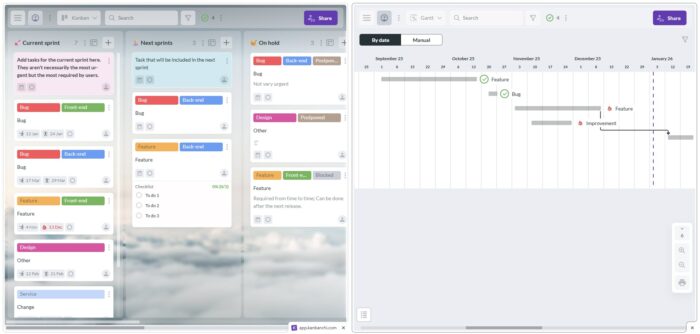
Side-by-side comparison of Kanbanchi's Kanban board view (left) and Gantt chart view (right), demonstrating easy view switching in a single project management tool
Kanbanchi’s dual-view capability: switch between Kanban board and Gantt chart
  1. For Waterfall: Use the Gantt Chart as the primary view. Set your milestones and dependencies early. If a task slips, you’ll see the immediate impact on your final delivery date, allowing you to negotiate for more Time or Cost immediately.
  2. For Agile: Focus on the Kanban View and List Grouping. Use Priority labels to rank your Scope. When a sprint or cycle nears its end, you can easily see which low-priority items need to be moved back to the backlog to protect the Fixed Time constraint.

Maintaining Quality with Kanbanchi

To prevent Quality from becoming an afterthought, you need to bake it into your workflow.

  1. Checklists

Use Kanbanchi Checklists on every card to ensure the Definition of Done criteria is met before a task is moved to the Completed list.

  1. Review Stages

Create a dedicated QA or Review list on your board. This ensures that no task jumps from Doing to Done without a second pair of eyes.

  1. Subcards

Use Subcards to break down complex Quality Assurance tasks into manageable pieces, ensuring nothing slips through the cracks.

By keeping the three sides of your triangle in balance, you protect the core. A successful project manager doesn’t just deliver a project; they deliver a quality project.

Start your free trial of Kanbanchi

Strategies for Managing the Project Management Triangle

Knowing the theory of the Iron Triangle is one thing; managing it in the heat of a project is another. When a stakeholder asks for just one more thing, you need a strategy to keep your triangle from collapsing. Here are four practical ways to maintain the balance.

1. Identify Your Primary Constraint

Before the project even starts, ask your stakeholders: “Which of these three, Scope, Time, or Cost, is the most rigid?”

  1. Fixed Time: A product launch at a specific trade show.
  2. Fixed Cost: A government grant with a hard budget cap.
  3. Fixed Scope: A regulatory compliance project where every requirement is mandatory.

Knowing which side cannot move tells you exactly which other sides must move when a change occurs.

2. Guard Against Scope Creep

Scope creep is the slow, unauthorized growth of a project’s requirements. It’s the silent killer of the Iron Triangle because it adds work without adding Time or Cost. To prevent this:

  • Document Everything: Ensure the initial scope is clearly defined in your project charter.
  • The Change Request Process: If a new feature is requested, perform an Impact Assessment. Show the stakeholder how that new feature pushes the deadline or increases the budget.

3. Use the Buffer Technique

Never plan for 100% capacity. In project management, things will go wrong. Smart managers build buffers into the flexible sides of their triangle.

  • Time Buffer: Add 10-20% extra time to your schedule for unforeseen complexity.
  • Contingency Budget: Keep a portion of the Cost side reserved for emergency resources.

In Kanbanchi, you can visualize this on the Gantt Chart by adding Buffer cards or simply extending the duration of high-risk tasks.

4. Radical Transparency with Stakeholders

The Iron Triangle is your best friend during difficult conversations. Instead of saying “No,” use the triangle to offer a choice that sounds a bit more conciliatory: 

“We can certainly add that new module to the software. However, our budget is fixed, so we will need to extend the delivery date by two weeks or remove these two lower-priority features from the current scope. Which would you prefer?”

This shifts the dynamic. You are no longer an obstacle; you are a consultant helping the stakeholder make an informed trade-off.

The Power of Visualization

It is much harder for a stakeholder to argue with a visual reality. When you can show them a Kanban board overflowing with In Progress cards or a Gantt Chart where every task is turning red due to delays, the logic of the Iron Triangle becomes undeniable.

Using Kanbanchi to Maintain the Iron Triangle

The Project Management Triangle isn’t just a diagram to hang on your wall; it’s a living reality that needs to be managed daily. To do that effectively, you need a tool that reflects the Triple Constraint in real-time. Kanbanchi is designed specifically for this balance within the Google Workspace and Microsoft 365 ecosystems.
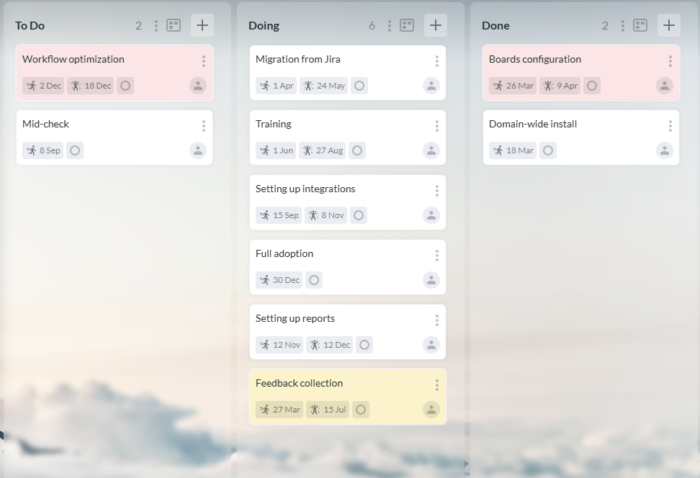
A screenshot of a Kanbanchi board titled "Kanbanchi adoption" showing various task cards with due dates and assigned owners, representing the project management triangle
Mapping the Kanbanchi adoption process onto a visual board transforms the project management triangle from a theoretical model into a practical dashboard where scope, deadlines, and team capacity are instantly visible

1. Visualizing Scope

Every task, deliverable, and request (no matter how small) becomes a Card. By using Lists to represent your workflow stages, you can see at a glance if your Scope is growing too large for your team to handle. If the To Do list is overflowing, your triangle is already out of balance.

2. Controlling Time with Gantt

The Gantt Chart is your primary weapon against schedule slippage. By connecting cards with Dependencies, you can see how a delay in one task automatically pushes the entire timeline. It turns the Time constraint from an abstract date into a visual roadmap.

3. Managing Cost and Capacity

Resources are the Cost side of your triangle. Use the Team Workload view to ensure that no single team member is over capacity. If one person has ten high-priority cards, you know you need to either extend the Time or increase the Cost by bringing in more help.

The Verdict

The Iron Triangle is unavoidable, but it doesn’t have to be a burden. When you use a visual tool like Kanbanchi, you stop guessing and start managing. You gain the clarity to make trade-offs, the data to justify your decisions, and the confidence to deliver Quality every single time.

Ready to bring your project into perfect balance? We’re glad to hear it. If you’d like to chat to us about the ways in which Kanbanchi can bring your workflow to life, we’re on hand. Get in touch with us or try Kanbanchi today.

FAQ about the Project Management Triangle

We’ll end our roundup of this topic by covering some of the most commonly asked queries about the subject. Not seen your question here? Then get in touch with our team, and we can chat with you about how Kanbanchi can help you and your team. 

What are the 3 constraints of the project management triangle?

The three constraints are:

  1. Scope (the work to be done)
  2. Time (the schedule/deadline)
  3. Cost (the budget and resources)

These three elements are interdependent; you cannot change one without affecting at least one of the others.

How does the iron triangle affect project quality?

Quality is not a separate side of the triangle; it sits in the center. If you squeeze the triangle, for example, by shortening the Time and cutting the Cost without reducing the scope, the quality of the output will almost certainly decrease as the team is forced to rush or cut corners.

What is a real-world example of the project management triangle in practice?

Imagine you are using Kanbanchi to manage a garden landscape project.

  • The Scope: Planting 50 trees.
  • The Time: Two days.
  • The Cost: Two workers.

If the client suddenly wants 100 trees (Scope increase), you must either give the workers more days (Time) or hire two more people (Cost) to maintain the quality of the planting.

How do you balance the triple constraints in Agile vs. Waterfall?

In Waterfall, the Scope is usually fixed, while Time and Cost are estimated. In Agile, the Time (sprint length) and Cost (team size) are fixed, while the Scope (the number of features delivered in that sprint) is flexible.

Try Kanbanchi today

    MultipleAuthors\Classes\Objects\Author Object
    (
        [term_id] => 973
        [term:MultipleAuthors\Classes\Objects\Author:private] => 
        [metaCache:MultipleAuthors\Classes\Objects\Author:private] => Array
            (
                [user_email] => olga.alekseeva@kanbanchi.com
                [user_id] => 20
                [first_name] => Olga Alekseeva
                [last_name] => 
                [job_title] => Growth hacking expert with over 10 years of experience with Kanbanchi
                [description] => Olga wears multiple hats across marketing, sales, product, and ops after 10+ years in the SaaS world. She is passionate about helping teams streamline their workflows with Kanbanchi and Google Workspace or Microsoft 365. "When I'm not optimizing processes or writing guides, I'm probably tweaking our product roadmap or diving into the latest productivity tools".
                [user_url] => https://linkedin.com/in/olgksv
            )
    
        [userObject:MultipleAuthors\Classes\Objects\Author:private] => WP_User Object
            (
                [data] => stdClass Object
                    (
                        [ID] => 20
                        [user_login] => olga.alekseeva
                        [user_pass] => $wp$2y$10$WuiuvYMj7CDnLrRbWchEkuBwKzmbBakK64Uk5c68bDY3qA46MFam6
                        [user_nicename] => olga-alekseeva
                        [user_email] => olga.alekseeva@kanbanchi.com
                        [user_url] => https://linkedin.com/in/olgksv
                        [user_registered] => 2025-09-03 15:47:58
                        [user_activation_key] => 
                        [user_status] => 0
                        [display_name] => Olga Alekseeva
                    )
    
                [ID] => 20
                [caps] => Array
                    (
                        [editor] => 1
                        [author] => 1
                        [contributor] => 1
                        [wpseo_editor] => 1
                        [wpseo_manager] => 1
                        [administrator] => 1
                    )
    
                [cap_key] => wp_capabilities
                [roles] => Array
                    (
                        [0] => editor
                        [1] => author
                        [2] => contributor
                        [3] => wpseo_editor
                        [4] => wpseo_manager
                        [5] => administrator
                    )
    
                [allcaps] => Array
                    (
                        [moderate_comments] => 1
                        [manage_categories] => 1
                        [manage_links] => 1
                        [upload_files] => 1
                        [unfiltered_html] => 1
                        [edit_posts] => 1
                        [edit_others_posts] => 1
                        [edit_published_posts] => 1
                        [publish_posts] => 1
                        [edit_pages] => 1
                        [read] => 1
                        [level_7] => 1
                        [level_6] => 1
                        [level_5] => 1
                        [level_4] => 1
                        [level_3] => 1
                        [level_2] => 1
                        [level_1] => 1
                        [level_0] => 1
                        [edit_others_pages] => 1
                        [edit_published_pages] => 1
                        [publish_pages] => 1
                        [delete_pages] => 1
                        [delete_others_pages] => 1
                        [delete_published_pages] => 1
                        [delete_posts] => 1
                        [delete_others_posts] => 1
                        [delete_published_posts] => 1
                        [delete_private_posts] => 1
                        [edit_private_posts] => 1
                        [read_private_posts] => 1
                        [delete_private_pages] => 1
                        [edit_private_pages] => 1
                        [read_private_pages] => 1
                        [wpseo_bulk_edit] => 1
                        [copy_posts] => 1
                        [ppma_edit_post_authors] => 1
                        [ppma_edit_own_profile] => 1
                        [wpseo_edit_advanced_metadata] => 1
                        [wpseo_manage_options] => 1
                        [view_site_health_checks] => 1
                        [switch_themes] => 1
                        [edit_themes] => 1
                        [activate_plugins] => 1
                        [edit_plugins] => 1
                        [edit_users] => 1
                        [edit_files] => 1
                        [manage_options] => 1
                        [import] => 1
                        [level_10] => 1
                        [level_9] => 1
                        [level_8] => 1
                        [delete_users] => 1
                        [create_users] => 1
                        [unfiltered_upload] => 1
                        [edit_dashboard] => 1
                        [update_plugins] => 1
                        [delete_plugins] => 1
                        [install_plugins] => 1
                        [update_themes] => 1
                        [install_themes] => 1
                        [update_core] => 1
                        [list_users] => 1
                        [remove_users] => 1
                        [promote_users] => 1
                        [edit_theme_options] => 1
                        [delete_themes] => 1
                        [export] => 1
                        [bcn_manage_options] => 1
                        [manage_security] => 1
                        [restrict_content] => 1
                        [list_roles] => 1
                        [create_roles] => 1
                        [delete_roles] => 1
                        [edit_roles] => 1
                        [cfdb7_access] => 1
                        [ppma_manage_authors] => 1
                        [ppma_manage_layouts] => 1
                        [ppma_manage_custom_fields] => 1
                        [ppma_manage_author_categories] => 1
                        [iwc_read_posts] => 1
                        [iwc_create_posts] => 1
                        [iwc_edit_posts] => 1
                        [iwc_delete_posts] => 1
                        [iwc_read_users] => 1
                        [iwc_create_users] => 1
                        [iwc_edit_users] => 1
                        [iwc_delete_users] => 1
                        [iwc_read_comments] => 1
                        [iwc_create_comments] => 1
                        [iwc_edit_comments] => 1
                        [iwc_delete_comments] => 1
                        [iwc_upload_files] => 1
                        [iwc_read_media] => 1
                        [iwc_edit_media] => 1
                        [iwc_delete_media] => 1
                        [iwc_read_terms] => 1
                        [iwc_create_terms] => 1
                        [iwc_edit_terms] => 1
                        [iwc_delete_terms] => 1
                        [editor] => 1
                        [author] => 1
                        [contributor] => 1
                        [wpseo_editor] => 1
                        [wpseo_manager] => 1
                        [administrator] => 1
                    )
    
                [filter] => 
                [site_id:WP_User:private] => 1
            )
    
        [hasCustomAvatar:MultipleAuthors\Classes\Objects\Author:private] => 1
        [customAvatarUrl:MultipleAuthors\Classes\Objects\Author:private] => Array
            (
                [url] => https://www.kanbanchi.com/wp-content/uploads/2025/09/photo_2024-04-10_17-25-16.jpg
                [url2x] => https://www.kanbanchi.com/wp-content/uploads/2025/09/photo_2024-04-10_17-25-16.jpg
            )
    
        [avatarUrl:MultipleAuthors\Classes\Objects\Author:private] => 
        [avatarBySize:MultipleAuthors\Classes\Objects\Author:private] => Array
            (
                [96] => 
                [80] => 
                [50] => 
            )
    
    )
    
  • Growth hacking expert with over 10 years of experience with Kanbanchi

    Olga wears multiple hats across marketing, sales, product, and ops after 10+ years in the SaaS world. She is passionate about helping teams streamline their workflows with Kanbanchi and Google Workspace or Microsoft 365. "When I'm not optimizing processes or writing guides, I'm probably tweaking our product roadmap or diving into the latest productivity tools".

    All articles
Share

Try Kanbanchi now

  • Collaborate seamlessly
    with your team
  • Integrate Kanbanchi
    with Google or Microsoft
  • Manage all your work in one place
Start for free

Start using Kanbanchi now

Start your free trial