
In this Article:
Try Kanbanchi now
Start your free trial


When it comes down to finishing a project, there’s a silent factor that determines whether you cross the finish line on budget or crash before the first milestone. That factor is project procurement management. Step back and think about it for a minute.
Whether you are:
…you’re rarely doing it alone. You need:
If any of these key things don’t arrive on time, at the right price, and are of poor quality, the entire project flounders. And that’s not good news for anyone.
In the past, procurement was often treated as an administrative back-office task. A series of boring purchase orders and tedious contract signatures. But these days, it’s a totally different ball game. Why? Well, consider this: global volatility, shifting trade lanes, and the rise of digital transformation have all turned procurement into a much bigger discipline.
Today, a Project Manager isn’t just a leader of people; they’ve got to be able to care for loads of ecosystems. And little wonder, according to UK Government stats, 98% of decision-makers have been planning investments in insights tools, automation, and AI since 2024.
Don’t worry if you’re feeling baffled, Kanbanchi is here to help. Our guide is designed to help you master all these ecosystems. We are moving beyond the paperwork phase and into the era of strategic sourcing and visual coordination.
If you’ve ever felt like your clients were a factor that you couldn’t control, and that your procurement data is currently scattered across a dozen different email threads, you’re in the right place.
There is a common misconception that procurement starts and ends with a signature. Let’s dispel that now.
In reality, procurement and project management are two sides of the same coin.
You can’t:
Manage a project schedule without managing your suppliers’ lead times.
You can’t:
Manage a project budget without managing client contracts.
When we talk about procurement in project management, we are referring to the strategic decision-making that occurs long before a single pound is spent.
Every project begins with a fundamental question:
‘Should we do this ourselves, or should we pay someone else to do it?’
Project management is traditionally defined by the Triple Constraint:
Procurement hits all three simultaneously.
In 2026, the most successful PMs treat their vendors as partners, not just line items on a spreadsheet.
They integrate their procurement strategy directly into their project workflow, ensuring that every external dependency is:
With all this considered, what are the factors that make up a successful procurement management process? We reckon there are six, and we’re going to cover them in our next section.
Read morearticles about Project Management
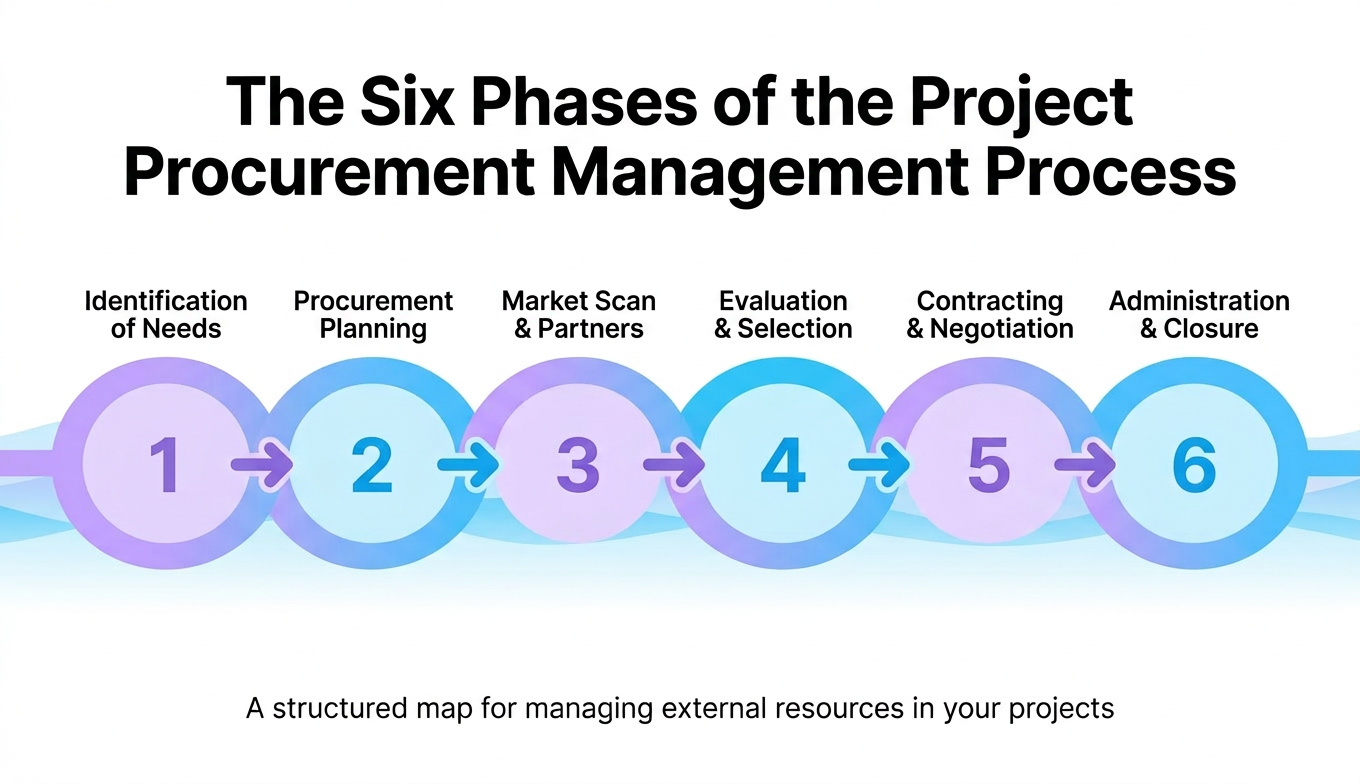
Six-step project procurement journey from needs identification to contract administration and closure.
Navigating the waters of procurement requires a structured map for task management.
While some organizations condense these steps, the six phases of the project procurement management process provide the most comprehensive framework for ensuring that every external resource aligns with your internal project goals.
We’ll look at these in more detail now.
Before you look outward, you must look inward.
This phase is about defining the What and the When.
Your Core Task: Conduct a thorough requirements analysis and ask yourselves, ‘Does this project actually require external software, or can we build it?’
The Outcome: This should be a clear list of deliverables that must be sourced externally to meet project milestones.
Strategy is born here. You aren’t just deciding what to buy; you’re also deciding how and when to buy it.
Your Core Task: Develop the Procurement Management Plan. This includes choosing contract types (Fixed-price vs. Cost-reimbursable) and setting the budget ceilings.
The Outcome: You should end up with a roadmap that outlines timelines, selection criteria, and risk mitigation strategies.
This is where you cast your net into the market to get an idea of who could help you and how they might be able to do it.
Your Core Task: Create and distribute solicitation documents like the Request for Proposal (RFP) or Request for Quotation (RFQ).
The Outcome: You need to ultimately find a pool of potential vendors who understand your requirements and are ready to compete for the work with each other.
It’s now time to filter out the white noise and get down to it. The decision making, that is! It needn’t be stressful if it’s done correctly.
Your Core Task: Use a fairly weighted scoring system to evaluate bids based on pricing, tech capability, and how they’ve fared in past projects
The Outcome: The selection of the vendor that offers the best total value and not necessarily the lowest price. Always try to choose quality over quantity with any decision like this.
Now we’re heading into the legal phase of the process. These are often tricky waters to navigate, but here are some pointers to consider.
Your Core Task: Fine-tune the Statement of Work (SOW), delivery schedules, and Service Level Agreements (SLAs).
The Outcome: When every i is dotted and every t crossed, you should ultimately have a signed, legally binding agreement that protects both parties and sets clear expectations for performance.
Although it’s the last step, it is often the most overlooked phase. Many project managers stop at the signature. Please don’t make that mistake yourselves. Ensure you’ve got the foresight to check everything thoroughly at the end.
Your Core Task: Monitor vendor performance against the contract. Once work is complete, verify all deliverables, settle final payments, and make sure you keep a note of all the lessons you’ve learned as you’ve gone through this process.
The Outcome: If you’ve followed all these steps, then you should be guaranteed a successful delivery of the project, on time and to budget. You should also have a clean close-out of all financial and legal obligations. Well done. Now it’s time for that well-earned pint.
So, with all this considered and an action plan like this in place, you might think nothing could ever go wrong? However, it’s important to understand the key challenges in procurement project management so you can anticipate and prepare for them (even if they never happen).
That’s what we’ll cover in our next section.
Even with a perfect six-phase plan, procurement project management is rarely a straight line. Because you are dealing with external entities, you are inherently dealing with variables that are often outside your immediate control.
To keep your project on track, you must anticipate and attack these four common pain points. Let’s get into them now.
Communication gaps are the leading cause of procurement failure.
When vendor updates live in one person’s inbox, and the project timeline lives in another person’s spreadsheet, delays are invisible until it’s too late to do anything about it.
Critical dependencies are missed because the PM didn’t know the vendor was behind schedule and there was no proper communication, either in the form of emails or regular meetings to discuss it all.
Centralize all vendor communications and documents in a shared visual space that works for everyone and needs little to no learning curve to get going with it.
Sometimes, vendors deliver more than what was asked for, or project requirements change mid-stream without a formal contract update. Again, this can sometimes be down to a lack of communication or information being shared.
Unplanned costs and financial constraints that balloon the budget without any warning.
Rigorous change control and a clear, shared Statement of Work (SOW) that is accessible to both the project manager and the procurement team.
Everyone can see what’s happening, when and if finances are about to be stretched too thin. Then it becomes easier to bring everyone together to discuss next steps before it escalates.
A signed contract is just a piece of paper if it isn’t monitored. Vendors may fail to meet quality standards or miss specific milestones defined in the SLA.
The project reaches the integration phase, only to discover that external components don’t work properly or that major issues in the production phase will take too long to resolve, causing significant delays.
Regular milestone tracking and check-ins, such as Daily Standups, are integrated directly into the project’s Kanban board.
All team members can see what’s on their to-do list and don’t need to be constantly reminded of meetings and emails.
Most procurement teams use heavy ERP systems, while project managers use agile tools. This technical divide creates a massive barrier to real-time collaboration. It’s much better to have everyone singing from the same hymn sheet, as it were!
Data must be manually entered into multiple systems, leading to human error and outdated information. Team members miss vital messages or updates because email chains are too long, or meeting times get lost in a sea of replies.
A unified platform like Kanbanchi that bridges the gap between high-level procurement planning and daily project execution. It makes everything run much more smoothly when there’s one place for everything to live (and only one space for people to check).
Recognizing these challenges is half the battle. The other half is equipping your team with a tool that makes transparency the default, not the exception. With that in mind, let’s take you right into the heart of Kanbanchi and show you what it can provide.
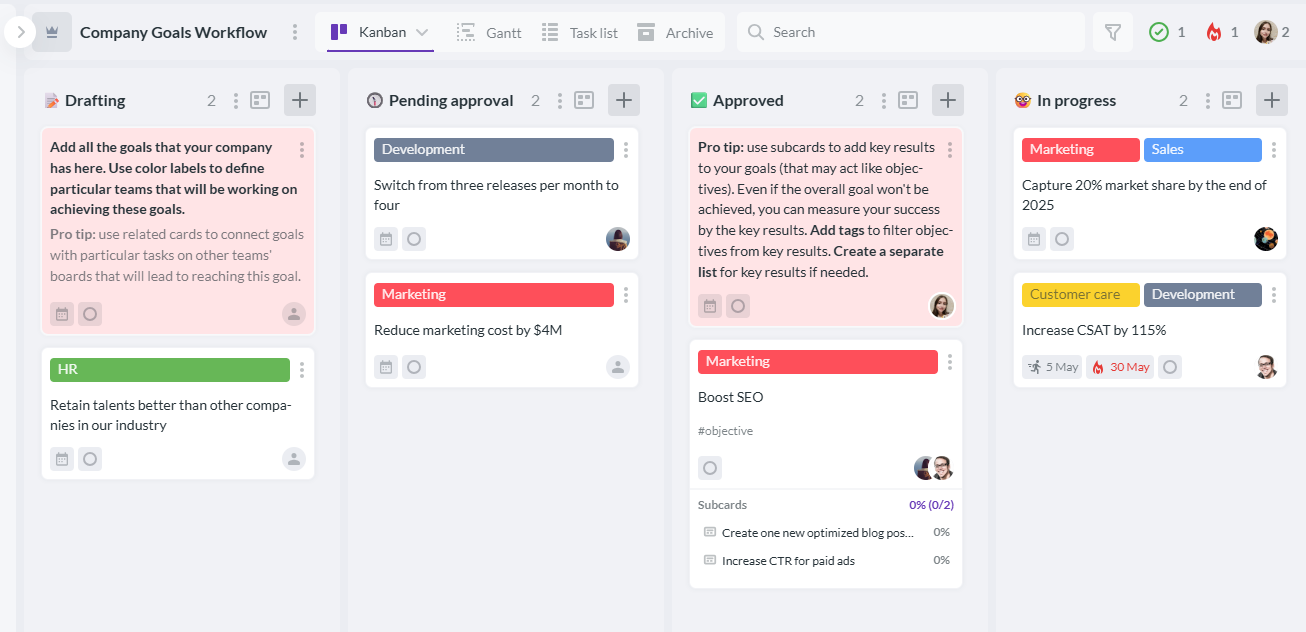
Kanbanchi board displaying tasks
If your team is already using Google Workspace, adding another complex, disconnected procurement platform is the last thing you need. You don’t need more tabs; you need more clarity – and just the one space to work in.
Kanbanchi serves as the bridge between:
It transforms the often-invisible six phases of the project procurement management process into a living, breathing visual map that everyone on your team can understand.
When your team gets that, they can perform to the best of their ability because they’re not totally overwhelmed by plans, spreadsheets, and emails! Workflows become smoother, quicker, and in the event of any hitches or changes, it’s all much easier to manage.
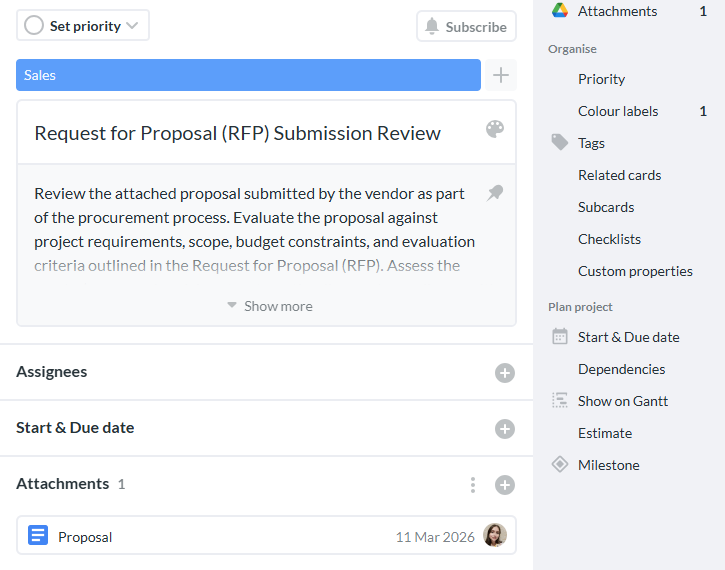
Kanbanchi task card showing a project procurement management task with an attached vendor proposal document for review.
The ‘where is that contract?’ hunt ends here. Why? Because Kanbanchi is built natively for Google, your cards don’t just link to files; they embody them and live in one space, so they never get lost.
Directly from your Shared Drives to specific task cards with one click. It really couldn’t be any easier.
Anyone with permission can access the Single Source of Truth without leaving the project board.
Inherited permissions ensure your sensitive legal documents remain secure, in line with your existing Google Drive rules.
Everything stays safe and secure, as you only have one log in to remember.
In procurement project management, timing is everything.
A two-week delay from a supplier can have a domino effect on your entire launch.
Use Kanbanchi’s Gantt Chart to plot procurement milestones alongside your internal tasks. Having a visual workspace like this can often make it easier for everyone to see what’s what at a glance (especially for clients and vendors).
By creating dependencies between Client Delivery and Internal Assembly, you can see exactly how a shift in the supply chain affects your final deadline.
You stop being reactive and start being predictive. It’s not about preparing for the worst every time, but it is about heading off potential pitfalls before they become a huge problem.
Procurement is a workflow, not just a transaction. You need to see where every vendor sits in the vetting and onboarding process.
Create a dedicated procurement board or use Swimlanes to track vendors across columns such as RFQ Sent, Technical Review, Negotiation, and Onboarded. Once this is done, it all becomes much clearer to see what’s happening.
At a glance, the Project Manager can see whether the Solicitation phase is bottlenecked, enabling quick resource reallocation before the project stalls.
Procurement involves a lot of back-and-forth. Don’t let vital vendor updates get lost in a crowded inbox, or long email chains become unwieldy to navigate. Stop it before it starts!
Use the Kanbanchi for Gmail add-on to convert vendor emails directly into cards on your procurement board.
You preserve the context of the email conversation within the task, ensuring nothing discussed in a thread is forgotten during the project’s completion.
By leveraging a visual hub that already speaks your organization’s language, you eliminate the “us vs. them” mentality between your team and your clients.
We know there’s always a lot of chatter about AI and automation, so with all the above considered, we’ll now take a look at what the future holds for procurement, as artificial intelligence becomes more prominent.
Start a free Kanbanchi trial now
To end our guide, here are some of the most frequently asked questions about project procurement management.
The PM is the bridge. While a procurement department may handle the legal and financial aspects of buying, the PM is responsible for defining requirements, ensuring the vendor’s timeline aligns with the project schedule, and managing the vendor’s output quality.
Start by identifying what needs to be outsourced.
Define the contract types you’ll use, the vendor selection criteria, and how you will monitor vendor performance.
This plan should be a living document accessible to your entire project team, ideally as a pinned document on your Kanbanchi board.
Supply chain disruptions, overspending on budgets, and scope creep are the biggest threats.
Using a real-time visual tool to track procurement for project management enables you to identify these risks early and adjust your Make vs. Buy strategy as the project evolves.
Start a free Kanbanchi trial now


In this Article:
Start using Kanbanchi now
Start your free trial