
In this Article:
Try Kanbanchi now
Start your free trial

Real estate is one of the fastest-paced industries. With the increased demand for services, more teams are turning to mastering the art of product management software to help them. Everything from due diligence on investments, through to property development task management, and the day-to-day running of the business can be effectively micromanaged this way.
What’s the pressing need? Well, there’s one thing all real estate businesses rely on for success, and that’s seamless coordination. There’s so much to consider. It’s not just a simple game of developing property or selling houses. It’s a full-on ecosystem of different stakeholders, like:
Then there’s the projects to consider. They’re all unique, so everyone will have a different deadline or require stringent compliance requirements that can be tricky to manage. Oh, and don’t forget budgets! A single missed milestone or bureaucratic holdup can affect how money is managed, and it could potentially have a knock-on effect on business down the line…
It means that traditional tools like spreadsheets and never-ending email chains, where information is often missed, have become obsolete. They’re not up to the job anymore.
Step forward real estate project management software as your solution. It’s no longer a luxury. Think of it as a cornerstone for any real estate developer business that wants to achieve:
Without any compromise on quality. Picking the right platform should be done carefully. It’s got to provide a single point of access to:
Don’t know where to start? We hear you. That’s why the team at Kanbanchi has put together this comprehensive guide to cut through the noise. We’ll look at the unique demands of the real estate sector, outline the essential features a modern project management solution must have, and let you know the best tools for the job.
It’s time to put your real estate business on the map!
A real estate project often brings together three distinct but linked subtasks, each with its own pain points. That’s why project management software is an ideal solution. Let’s start by looking at the three considerations and their issues.
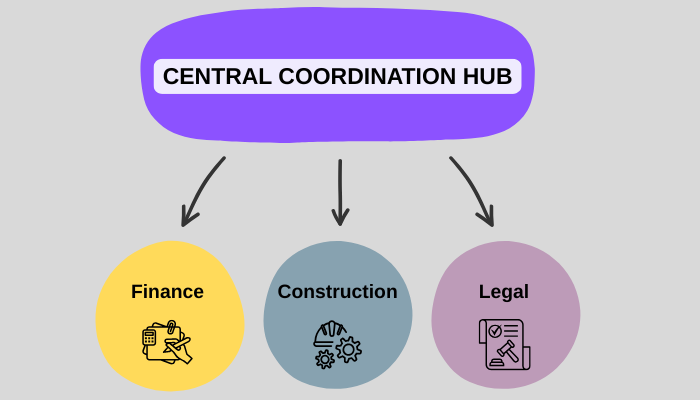
A visual summary of the interconnected tasks behind real estate project coordination.
The biggest challenge is that teams must have an overview of a vast, sequential process in which each step depends on a third party. It requires everyone to be on top of their game and proactive. Just consider the following:
All of these are time-consuming, government-driven processes. There’s no wiggle room for mistakes, and all documentation must be completed meticulously, with strict adherence to deadlines.
Can’t track them or submit the correct paperwork on time? Then you’ll likely face costly delays and client pushback.
A strong project management tool must make property development task management visible with clear checklists and core deliverables for every regulatory hurdle.
Moving from paperwork to physical build-out requires solid construction project coordination tools to ensure smooth coordination among general contractors, subcontractors, and suppliers.
If this stage isn’t tracked properly, then there’ll likely be delays in foundational work, material delivery, and site inspections.
All this has a knock-on effect on the final timeline and means projects can get bogged down and become financially unviable.
Real estate investment projects involve managing every acquisition, combining this with tracking the performance of all existing portfolios. It means team members have to work quickly and accurately.
Before an acquisition closes, there’s a comprehensive checklist to go through, including
Not one item can be missed; otherwise, there could be a financial disaster. Coupled with this is Portfolio Performance Monitoring. Once an asset is acquired, it must be continuously monitored to assess its financial performance. This requires a system that integrates data from property operations and finance to enable real-time reporting for everyone on the team.
Finally, accurate real estate investment project tracking is necessary for investor relations and strategic decision-making, such as deciding when to dispose of an asset or acquire a new one.
This is often overlooked, but it’s essential. Property management involves many recurring tasks essential to the satisfaction of tenants and landlords. It requires keeping track of:
If there’s a major issue, such as a power outage or water leak, then it needs an immediate response. The entire process from reporting to closing off the job when all parties are satisfied must be fast and completely traceable.
All communication, especially concerning maintenance, rent, and legal notices, must be centralized and documented. Disputes, service-level agreements (SLAs), and maintenance schedules have to be secure but visible. The right property management workflow software ensures every interaction is linked to the relevant property and task card.
General project management tools lack many of the features needed for this, such as secure document linking or portfolio reporting. This is why specialized solutions like the ones developed by Kanbanchi are essential for teams seeking to professionalize and scale their operations.
They’re not just note-taking tools; they’re visual tools too, as we’ll show you.
You may also be interested in other Kanbanchi blog articles for businesses; check them out!
The visual side of modern project management software is frankly invaluable, and Gantt charts are essential for real estate project management. They transform a dry list of tasks into an intuitive visual timeline, clearly showing:
By using a visual tool like the Gantt chart, project managers can see at a glance when to order materials, organize inspections, and plan for risk assessments. When it comes to selling and renting, they’re invaluable for monitoring progress between client and vendor. Everyone will be singing from the same hymn sheet (and in tune).
So, with that in mind, let’s get the foundations in place and consider what real estate project management software requires.
An ideal real estate project management software must be a comprehensive suite of tools built for
It’s got to do more than simply manage tasks; it must effectively manage the entire ecosystem of a real estate project. So, what are the must-have features?
Real estate work involves complex timelines coupled with simultaneous workflows. These are best tracked visually, moving from one defined stage to the next.
These are perfect for managing funnels and showing status columns like
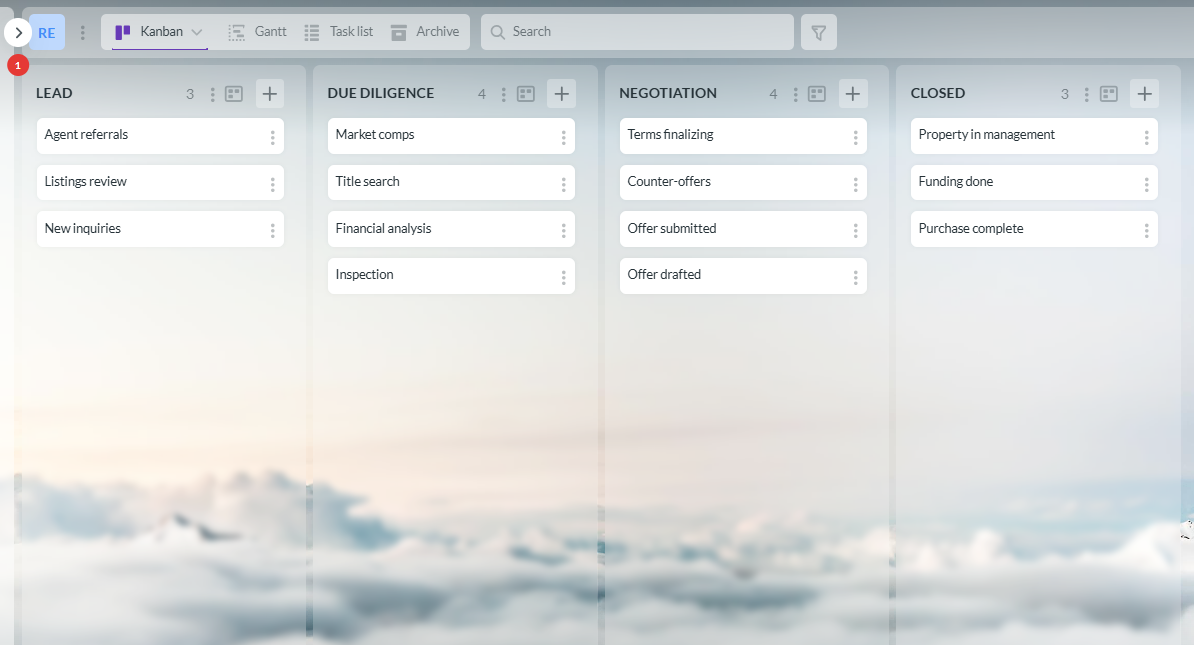
Streamlined real estate and maintenance processes organized in a Kanban layout
They are also highly effective for service-oriented tasks, such as maintenance requests (e.g., power outages or floods in tenanted accommodation).
Non-negotiable for development and construction projects. They allow project managers to map dependencies, set initial schedule baselines, and visually monitor the project’s path against real-time progress.
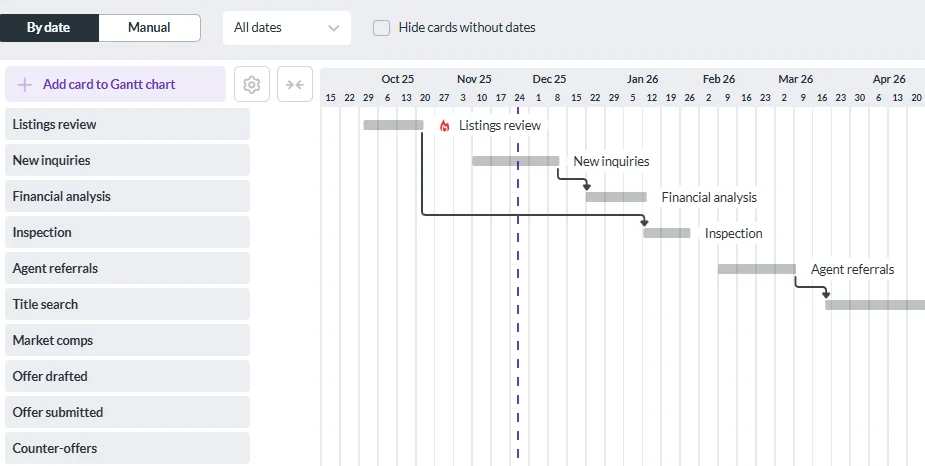
Visual representation of listings review, inspections, financial analysis, and title search with FS and SS dependencies.
Essential for scheduling important milestones like inspection dates, closing deadlines, and investor meetings.
The beauty of Kanbanchi is that it offers these three core views on a single board. It’s beautifully fluid, allowing development and project teams to choose the visualization that best suits the current workflow or reporting need.
Real estate is a team pursuit involving internal staff, external vendors, consultants, and legal partners. So, the software you use must facilitate seamless interaction between everyone.
Key features like real-time notifications give instant alerts, and in-task commenting allows team members to collaborate in harmony. It means that critical details are never buried in email chains or generally lost in the ether. Everything is in black and white, on a track-and-trace basis, creating a history of all decisions made.
The main advantage of Kanbanchi for real estate project management is its native integration with Google Workspace. This makes it instantly recognizable and usable – there’s no learning curve for most teams, and no battling multiple logins to lots of different systems.
As it’s a native Google Workspace application, Kanbanchi offers seamless, secure linking and viewing of Google Drive files directly within the main interface of the project. No matter if it’s a contract, blueprint, permit, or other legal document, it’ll all be superbly organized alongside the task it relates to.

Recurring real estate task to review listings, network with agents, and identify off-market opportunities.
Automating recurring tasks is key to saving time and ensuring that the hard graft goes into the actual project and not repetitive admin tasks. Something to think about when you consider that 82% of US based construction and real estate firms have an AI strategy in place. With template creation, team members can save time and ensure consistency.
Without these software features, a real estate firm risks:
We’ll now go one stage further and show how Kanbanchi can solve all your real estate project management issues.
Kanbanchi is not just another project management tool; it is the real estate project management software beautifully designed for maximum efficiency within the Google Workspace environment.
Ask yourself. Are you a firm that relies heavily on Google Docs, Sheets, Drive, and Gmail? When you trust in Kanbanchi, you’re investing in a system that offers a familiar, integrated, powerful solution right where your team already works.
Here is how Kanbanchi’s unique feature set directly solves the most pressing project coordination problems in real estate:
Construction projects need professional timeline management. Gantt charts are a powerful and intuitive tool for coordinating construction projects.
Spreadsheet cells don’t link up to show you the relationships and dependencies between tasks! So, if you were working on a construction project and a core component, like the delivery of bricks, was delayed, this would ultimately impact the interior designer’s timeline. You’re not going to get that crucial info from a spreadsheet and communicate it to the people who matter.
Using a Kanbanchi Gantt chart, you can define dependencies and visually drag and drop lines between tasks to establish and highlight necessary sequences instantly. Then you can track its progress. Your Gantt chart provides a real-time visual update of percent completion for every task, clearly showing which activity is currently holding up the overall schedule.
Let’s think about property management now. It invariably involves a relentless cycle of recurring tasks and urgent service requests. Your solution for this is a Kanban board, as it’s the perfect way to manage continuous workflows.
Maintenance requests can get lost in cluttered email inboxes, leading directly to tenant dissatisfaction, lease non-renewal, and potential liability issues due to delayed repairs.
Use a dedicated Kanban board for maintenance tickets. Columns can be labeled New Request, Assigned to Vendor, Awaiting Quote Approval, Work In Progress, and Closed/Follow-Up. Each card represents a single service call.
You can then create a card directly from a forwarded email using a specific Kanbanchi-enabled Gmail address. The original email becomes the description. Then a property manager can immediately assign the task to a contractor, set a deadline, and attach the vendor’s invoice—all within the card.
It doesn’t need to be a complicated process to implement real estate project management software. If you’re already a Google Workspace user, you’ll find Kanbanchi is simple to get to grips with. You’ll be able to create a highly visual, centralized system for tracking everything you need to. Need convincing? It’s OK, don’t worry! This is how to create your first organized real estate workflow:
Set up a dedicated Kanbanchi board for each property or major project you’re managing. This immediate segmentation keeps tasks focused and ensures stakeholders only see information relevant to their specific project.
Select your Kanban View and set up columns that mirror the progression of your specific real estate project. Use clear, actionable stages. Here are some ideas!
Every actionable item, regardless of size, becomes a task card. Use the card title for a clear, concise action (e.g., ‘Submit Permit App to City Council’, ‘Order Electrical Wiring’, ‘Coordinate Final Lender Walkthrough’). Always assign the card to the responsible team member and set a firm due date.
Open the card detail, click the Google Drive attachment icon. Link essential documents directly to the card. This ensures the correct document travels with the task, providing immediate context without frustrating email searches.
Switch the board view to the Gantt Chart for your development projects. Drag the task bars to set accurate durations, and use the connector tool to establish dependencies (e.g., the Interior Finishing task is dependent on the HVAC Installation task finishing). This visualization is essential for managing the project’s critical path and making the system a true real estate project management software.
Use the tagging feature to label cards by priority, contractor, or financial category. Filters allow you to instantly isolate all tasks assigned to a specific subcontractor or view all high-priority compliance deadlines across the board.
By following this process, your team gains an immediate, centralized, and highly visual framework for managing the multifaceted demands of real estate.
By leveraging Kanbanchi’s deep integration and powerful visual tools, real estate teams gain a structured, centralized, and highly efficient command center for every phase of their operation—from groundbreaking to lease management.
Interested in learning about what we can offer you for all your real estate project management requirements?
Still have a few burning questions about our real estate project management software? We’ve got you covered.
Generic PM tools often lack the robust visual features essential for real estate, like integrated Gantt charts or Kanban sheets. They also lack native, secure integrations with platforms like Google Drive. These days, that’s a non-negotiable for managing the high volume of documents involved in any kind of real estate transaction – from construction through to buying, selling or renting.
The primary role is to ensure adherence to schedule and to mitigate risks. Effective property development task management uses visual tools like Kanban and Gantt to break down a schedule into manageable, traceable tasks. It’ll provide real-time visibility into the performance of everyone on the team and give regular updates to stakeholders and investors who need accurate information at the click of a mouse.
Kanbanchi’s core strength is its native Google Workspace integration. You can directly link live Google Sheets containing essential financial models (e.g., pro-forma statements or budget vs. actuals) to a project card for, up-to-date financial reporting. While Kanbanchi doesn’t directly connect to Google Maps, task cards can hold direct Google Maps links or physical addresses, providing seamless one-click navigation to a property or construction site.
Yes, absolutely! Kanbanchi’s flexible and multi-view board structure makes it highly adaptable. You can dedicate one board to a multi-year development project using the Gantt chart for scheduling, and another board using the Kanban view to manage high-volume, recurring maintenance tickets.
Kanbanchi is built as a native extension of Google Workspace. This means user authentication is seamless, documentation stored in Google Drive is effortlessly attached and secured, and task deadlines can be instantly synched with Google Calendar. This deep integration minimizes administrative friction, reduces the learning curve, and maximizes collaboration efficiency right out of the box.



In this Article:
Start using Kanbanchi now
Start your free trial