
In this Article:
Try Kanbanchi now
Start your free trial

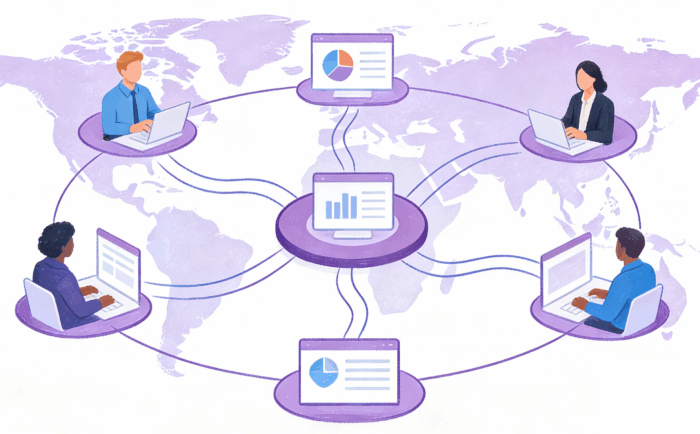
I’ll be looking at the different ways you can understand how to effectively manage remote employees. These workers need an approach that differs from traditional management. The solutions we’ll be covering here include practical strategies for communication, tracking, and engagement. This is just part of the story, though, because choosing the right tool is crucial to your success, too.
The challenge of managing teams that are spread over the planet is one of the biggest issues for many companies these days. A lack of visibility makes it difficult to keep track of everyone’s tasks and productivity levels. As more teams are adding remote workers, this is a problem that is going to become more widespread. This means that the right solutions are needed, but first, we need to look at the key issues.
Here at Kanbanchi, we started shifting towards the fully remote company model in 2017, and by the beginning of the COVID pandemic, we were already prepared. During the pandemic, when most other businesses were trying on the shoes of a remote company, we were actively supporting them with the application that is the exact tool your remote company needs. I’ll share more about Kanbanchi at the end of this article, but so far, let’s talk about management.
While we’ll be examining the tools needed for remote teams, there is a step that needs to come even before that. This is the part when you create the right culture. It is the foundation for success and for avoiding many of the common errors that companies make. We need to start by considering trust as the key element every remote team must begin with. This is the default setting among team members, ensuring that everyone feels comfortable and ready to contribute.
Asynchronous communication is where you don’t need an immediate response. It’s the easiest approach for teams that work in different time zones, or that may have varying working days for other reasons. This can be in emails, messengers, comments, and so on. Synchronous communication is carried out in real-time. It covers video calls and instant messaging. This is more difficult for many remote workers to carry out effectively, as they may need to make an effort to join at a time when this is difficult for them. If the team spans different time zones, they may need to join in the middle of the night or at another inconvenient time.
My email signature emphasizes work flexibility and asynchronous communication by clarifying that there is no expectation of after-hours responses. This small detail supports healthy remote work boundaries and flexible work hours.
Taking these factors into account, we need to look at the task of setting the rules of engagement. For example, you might want to make the split between these methods clear. Some companies state a 70/30 split, while others make it clear that synchronous communication is needed whenever complex problems need to be resolved or team bonding is scheduled.
In addition, it’s worth clarifying what response times are required when a question is asked or a task is allocated. This should be a reasonable figure that takes into account the time difference and other factors. You could also include details of how to handle sensitive feedback and social bonding sessions.
Team members want to see clarity on issues such as the company’s overall goals and challenges. This will make them feel more secure about the direction the business is taking and their role in it.
Doing this means you move towards a more outcome-based management style. You’re showing the team that you’re more interested in what they’re producing, rather than putting all the focus on when they’re sitting in front of a computer. Even with the need to track hours (for billing or other purposes), you can achieve this level of result-orientedness.
Here at Kanbanchi, we use an internal system for tracking hours that is built entirely on trust: at the end of the day, employees add the time spent on their work and describe in detail what they were doing. Managers have access to their reports and can check what they were doing. Based on the work description, they can ask questions. If they feel the description is not clear enough, they may ask the employee to provide more detail when reporting.
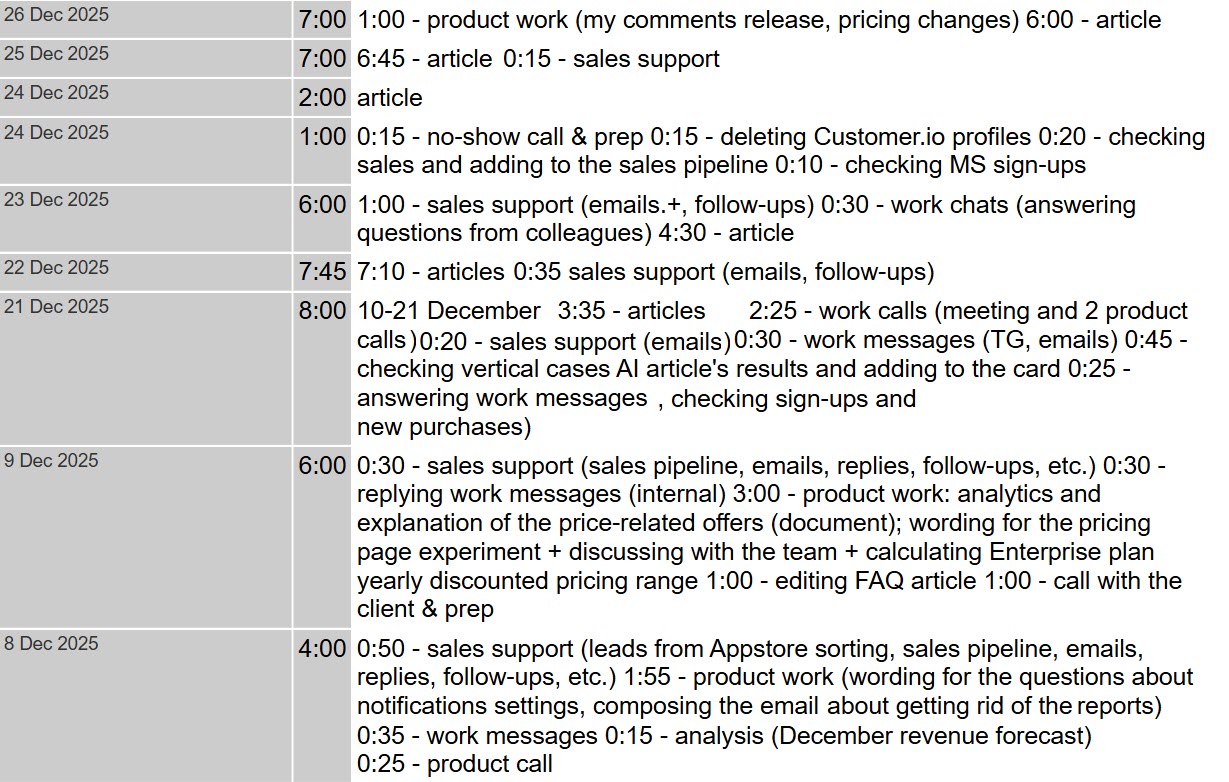
My Kanbanchi time log: daily hours + task details (sales support, product work, articles). Our trust-based, employee-led system lets managers review, rarely needing clarity.
Over the past five years, we only had two cases where there wasn’t enough clarity, and we felt employees weren’t contributing equally to logged hours.
We just saw the importance of choosing the right time for communication. To better understand how asynchronous communication should be implemented, we can review the main points to master.
The main challenge with remote leadership is tracking output rather than simply the presence of team members. It’s a significant change from the traditional way of working, which means many people struggle to adapt to it or fully understand it.
This is where the right tools are needed to help you understand what everyone is doing. You need tools that let you focus on the areas that matter, such as who is producing a high level of output and who needs help to reach that level.
Kanbanchi interface showing clear task ownership: Amanda Lewis is listed as the assignee, keeping the remote team aligned on who owns what work.
It is a change in approach that means you want to measure impact and results, rather than just monitoring activity. There is no need to check where every team member is at any time of day. You don’t need to keep track of their physical movements, which goes back to the trust element we covered earlier.
Because of this, the traditional approach to clocking in and out in physical offices is no longer practical. There is no benefit to knowing whether someone starts work at precisely 8 am every day or at 10 am on some days. This needs to be replaced by a method of visibility and performance tracking.
An employee’s performance now has to be based on their achievements. It shouldn’t be a matter of how long they spend logged onto Gmail or other tools. We still use these tools for communication, but you shouldn’t fall into the trap of using them to track when people are working.
This means you need to focus on tracking deliverables rather than time spent. In this case, the manager’s role changes. Rather than controlling the number of hours team members work, they need to support them by clearing roadblocks.

Kanbanchi’s timing section balances time tracking (total/individual hours) with task context, so you monitor effort and the work itself, aligning with results-focused remote management.
There’s a clear advantage for employees with this model of working. Rather than a rigid structure that risks burnout, they are given a high degree of autonomy within a flexible one.
For managers, it’s an apparent change of focus. They can now focus their energies on helping their team succeed, which is a more satisfying and effective way to team.
When working in the same physical space, it’s easy for managers to see who is there and what they’re working on. Yet, when the team is scattered across different cities, this is impossible. Asking who is currently logged on and what they’re working on right now can seem like micromanagement. It can also cause unnecessary interruptions.
By introducing transparent task management, you give a shared, visual approach that increases accountability. Kanban boards, like those used on Kanbanchi, are used to give a better alternative to the old-fashioned process of checking in.
On these boards, you can easily see who is responsible for each of the tasks. After that, you can check the status and progress of the tasks that you want to track. In this way, it lets you see who is performing well and meeting their performance targets.
When we look at the question of how to manage remote employees effectively, this is a great start. It brings clarity in task assignment, due dates, and status by using shared boards. All of these are the key areas that support this new way of working remotely and efficiently.
The lack of standard visibility is one of the issues that most worries managers in remote projects. This can lead to them looking for ways to monitor the time and effort being spent. However, measuring output is more effective and reinforces the autonomy of remote working.
Measuring output in place of activity is actually easier. The use of productivity and tracking tools makes this a simple approach. However, it’s important to remember that time tracking tools on software like Kanbanchi aren’t for surveillance purposes. They should be used to get a clearer picture of the capacity and distribution of the effort.
By doing this, you can monitor the workload and flow without falling into the dangers of micromanagement. If you do this, you get a clearer picture of how the team is operating and in what direction it is going.
At Kanbanchi, we’ve implemented our own tool to achieve this precise visibility into who is working on which tasks, while maintaining the trust-based foundation that defines our culture. While we do maintain a time-tracking system where employees manually log their hours and describe their tasks in detail, we’ve deliberately shifted our focus toward results and outcomes rather than time spent.
This approach has proven powerful: we use performance data not just for billing purposes, but as the basis for rewarding top performers with higher hourly rates and identifying promising employees for promotion into project management and leadership roles.
Achieving success with a remote team depends largely on the tools and workflows that you use. This is where you need to take into account the flexibility that you need and the learning curve that team members are going to encounter.
How to effectively hire and manage remote employees if your tools are overly complex and require a long training period? The best move is to choose a tool that the majority of users will be familiar with right away. This lets them get started smoothly and gain confidence quickly while starting to contribute.
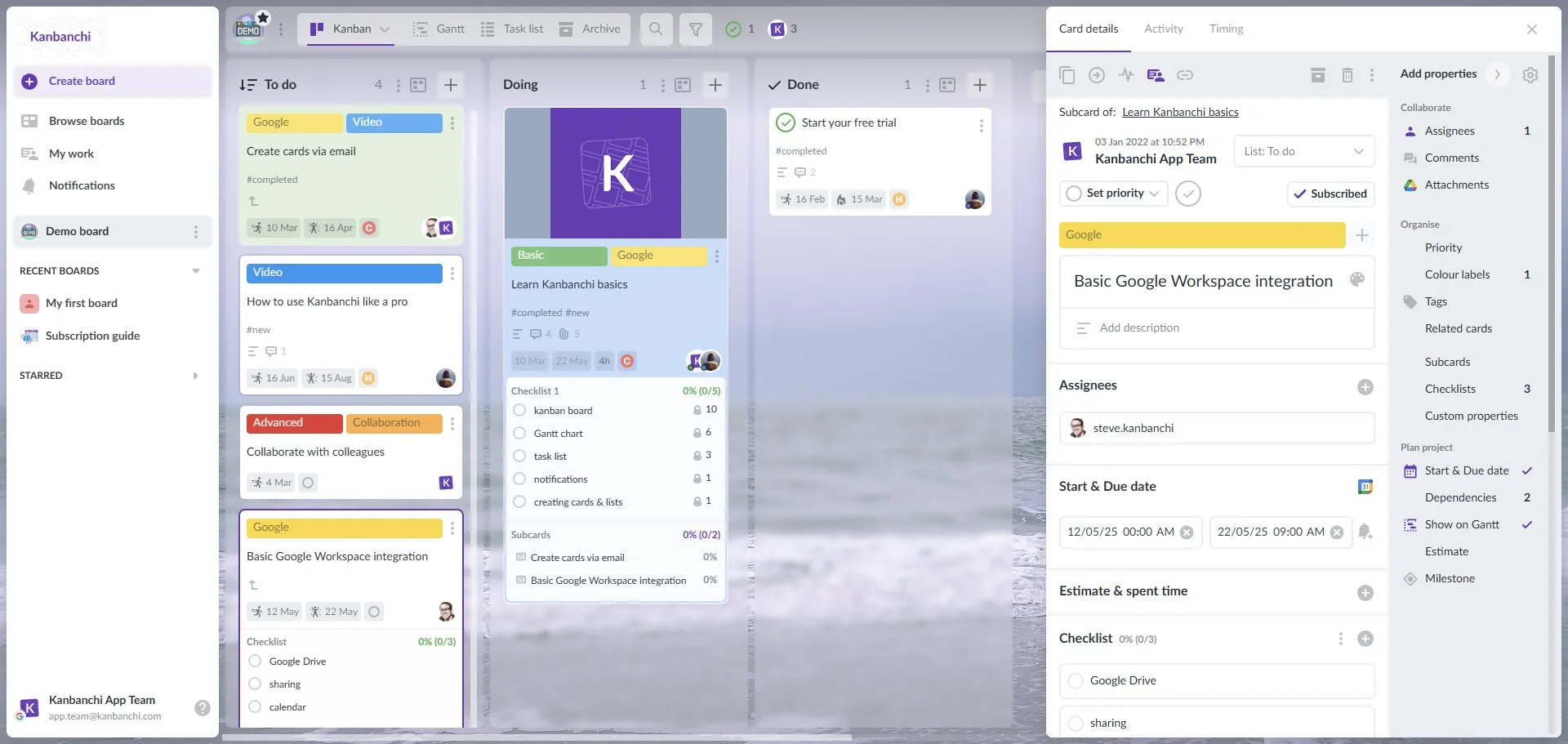
Kanban board is the ideal tool to start with: it’s visual and intuitive, and extremely easy to pick up and start working with right away.
For teams working within Google Workspace, Kanbanchi’s deep integration is exceptionally valuable. It allows team members to use Gmail, Google Docs, Calendar, and other tools without jumping from one platform to the next. The addition of kanban boards and Gantt charts makes it easy to track the workflow.
For example, the one-click Gantt chart can be used for long-term planning. This means that you can see milestones and dependencies across the projects. It gives a high degree of clarity on milestones and dependencies. Kanban boards are used to show tasks, moving across the screen as they pass from one stage to another. It is always clear who is responsible for each task and what the next stage is going to be.
Teams using Microsoft’s ecosystem benefit equally from Kanbanchi’s integration with Microsoft account and applications. Whether your team relies on Outlook, Excel, or OneDrive/SharePoint, Kanbanchi seamlessly connects with these familiar tools, eliminating the need to switch between multiple platforms.
The same powerful Kanban boards and Gantt charts provide the same visibility and project tracking capabilities, ensuring that Microsoft-based teams enjoy an equally streamlined experience for managing remote workflows.
Interestingly, Kanbanchi itself was born from a need we understood intimately. As a software development company managing our own remote teams, we created Kanbanchi as an internal tool to work alongside Google Apps, helping us make our work more transparent and our project management more successful. What we discovered was that thousands of teams around the world were struggling with the same challenges we had solved for ourselves.

Take a look at Kanbanchi from 10 years ago. We can’t even believe we started with this!
This led us to develop Kanbanchi into a standalone application that has grown into a platform serving millions of users across different organizations and industries. Even today, we continue to use Kanbanchi within our own remote team, which means we’re constantly refining the product based on real-world experience and the evolving needs of distributed teams.
SIGN UP TO TRY KANBANCHI WITH YOUR TEAM
This visual approach is one of the keys to success in remote work. It allows everyone in the team to switch on their computer and understand the situation at any time, without even speaking to anyone else.
Whether you’re using Google Workspace or Microsoft 365, the benefit remains the same: deep platform integration combined with powerful visual task and project management tools creates an environment where remote teams can thrive without unnecessary complexity. However, we understand that every team’s needs are unique, which is why we regularly evaluate and honestly review different project management solutions to help you find what works best for your specific situation.
You can explore our comprehensive comparison of leading tools in our guide:
The Best Project Management Software for Remote Teams in 2026: A Comprehensive Guide
Hiring new workers for a remote team doesn’t have to be as complex as you might think. The main task to think about is the structured, digital-first onboarding process. This is how you can get new hires up to speed quickly.
The strategy in terms of how to effectively hire and manage remote employees also has to include team-building sessions. This gives them a chance to understand the team’s culture and feel truly part of it.
Rather than forcing people to attend regular Google Meet or Zoom calls at awkward times, you can carry out interesting types of asynchronous bonding. This means that employees choose when to share photos of their pets or talk about the hobbies that they love, for example.
We maintain two distinct spaces: a “censored” chat where team members agree to keep content workplace-appropriate, and an “uncensored” chat for more personal sharing. I’m part of the censored chat myself, and I honestly have no idea what’s going on in the uncensored one. And that’s precisely the point. Employees can choose which channels to join, giving them full control over how much they want to share and with whom. In the censored chat where I participate, we regularly exchange interesting articles, useful resources, vacation photos, and insights we’ve discovered. This flexibility creates genuine connection and community without the pressure of mandatory real-time participation.
Avoiding burnout is another key concern. This is generally an issue in terms of workers feeling that they always need to be connected to prove that they’re working. By establishing core working hours and encouraging people to use the snooze function on messaging systems, you help workers understand the need to block their free time with clear boundaries.
Another idea involves no-meeting days, which are days when no one is allowed to call a meeting. This means that it’s set aside as a productive day where everyone simply concentrates on working through the tasks assigned to them. You might also point out the importance of their shutdown routines to follow. These may involve physically storing away the laptop or going for a walk.
More articles from our experts about Remote Work here
As we’ve seen, the move toward remote team working doesn’t have to be as difficult as it first appears to be. The first step you can take is to establish a clear working structure where trust creates a positive environment.
After that, you need to ensure that you have the right tools to make this approach work. This means being able to track progress in a way that fits with your overall remote working culture. These tools back up your overall approach and help team members to feel supported without being micromanaged.
The integration found in Kanbanchi helps support remote working effectively, whether you’re using Google Workspace or Microsoft 365. By using the kanban boards and Gantt charts, you can track milestones, projects, and tasks in a way that keeps your remote team connected and organized without micromanagement.
If you’re ready to put these strategies into practice, Kanbanchi offers a free trial so you can experience firsthand how transparent task management and visual workflows can transform the way your remote team collaborates.



In this Article:
Start using Kanbanchi now
Start your free trial