
In this Article:
Try Kanbanchi now
Start your free trial
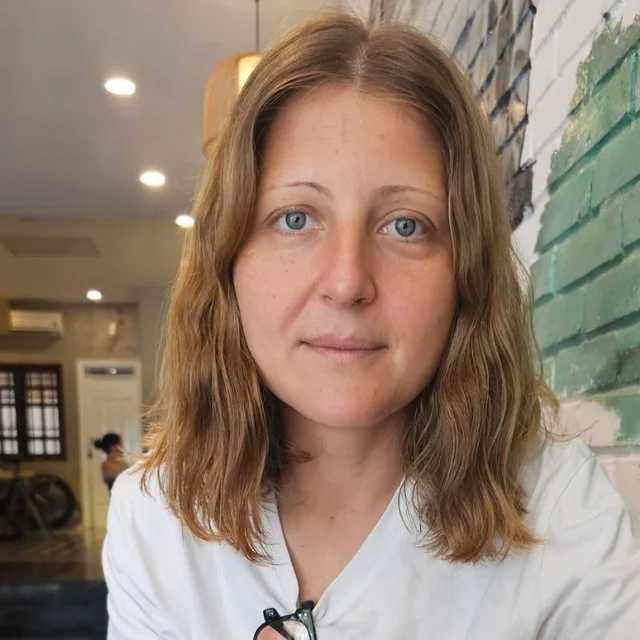

I have been leading a remote team in marketing, sales, and customer success at a SaaS company for almost seven years. In that time, I have made my share of mistakes, rebuilt my approach more than once, and landed on a set of principles and practices that actually hold up across time zones, continents, and very different personalities. This playbook is what I wish I had when I started.
It is built around a simple operating rhythm, clear OKRs, outcome-based metrics, and task tracking that keeps work moving without constant oversight, with practices aligned to how teams actually work in 2026.
Remote management in 2026 is not about watching people online. It is about building clear systems that let adults ship work without hand-holding. Remote work is now normal, not a perk, and expectations have shifted fast.
Remote workers will leave if managers still run 8-hour call cycles and track presence. The research backs this up, but honestly, seven years of leading distributed teams tells me the same thing more clearly than any study.
You cannot see desks, so visibility tricks no longer work. Micromanagement in chat feels like spying and kills trust. A sync-only culture burns people in other time zones. These are not new problems in 2026, but the tolerance for them has dropped to near zero.
Strong remote leaders design clear workflows, write tight, actionable documentation, and then get out of the way. They set constraints, remove blockers, and coach on the gap, whether that gap is clarity, capacity, or skill.

When our team became fully remote, my instinct was to keep doing what had worked before. My natural leadership style is rooted in friendship: I genuinely like the people I work with, and I lead better when I know them as people, not just as contributors.
The problem was that a friendship built over years in a shared office does not automatically travel across continents. And as new people joined who had never even met me in person, I realized I could not rely on existing relationships as a foundation. I had to rebuild how I connected from scratch.
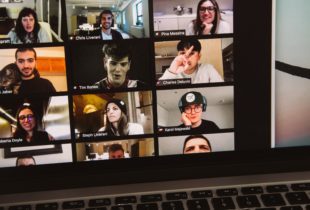
What I found was that the warmth does not have to disappear; it just has to become more intentional. Those five minutes at the start of a Google Meet call, spent asking about someone’s weekend, their kids, or what they are reading, are not wasted time. They are the work. Following colleagues on social media and occasionally exchanging a message about something entirely unrelated to work shortens the distance in a way that no structured team-building exercise can replicate. It is small, it is human, and it accumulates over time.
The other thing I had to unlearn was the instinct to work in sync. Early on, we tried to keep everyone online at the same hours. The logic being that quick questions could get quick answers, just like in the office. It felt efficient, but it was not. It burned people out, created resentment across time zones, and gave us the illusion of collaboration without the substance.
The shift to async was gradual but transformative. Now, I work completely different hours than most of my colleagues, three days a week. My team knows this. They know not to expect a reply from me until the next day on those days, and they know that if something is truly urgent (the app is down, a major client situation is escalating), they can reach me directly on personal messenger. Outside of that, we trust the system. We naturally use Kanbanchi here at our team 😉
More articles from my team members about Remote Work here
Your team needs a simple rule: everyone knows where to talk, what to share, and when. Without that, you get chaos, scattered DMs, and missed updates. Treat communication like a product: design it deliberately, test it, then standardize it.
Pick channels on purpose, not by habit.
| Channel | Use for | Response expectation |
|---|---|---|
| Chat (Slack, Google Chat) | Fast questions, informal updates | Same day |
| Project tool (Kanbanchi) | Task updates, blockers, progress | Within 24 hours |
| External or formal communication | 48 hours | |
| Video call | Complex decisions, sensitive conversations | Scheduled |
Write this into a short communication plan and share it with every new hire on day one. The goal is to make information predictable and easy to find. It cuts confusion and rework significantly.
Set a fixed weekly cadence so people stop guessing what is expected of them.
If an update is not in the tool, it did not happen. This is not a bureaucratic rule; it is what keeps a distributed team coherent without constant meetings.
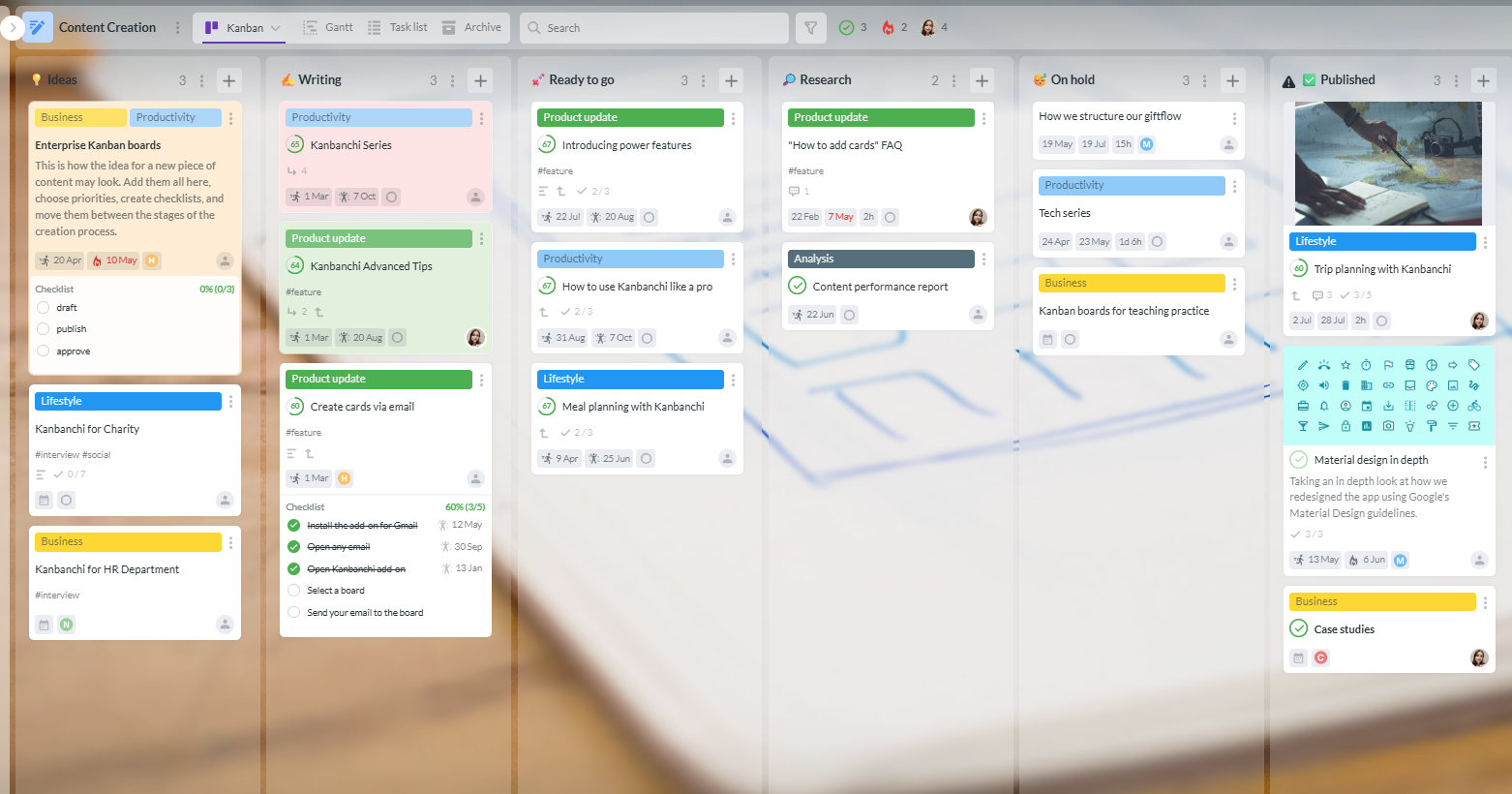
We run all of this inside Kanbanchi, which is also the product we build. Kanban boards, Gantt charts, task comments, and Google Workspace files all live in the same space. There is no need to switch between platforms to find out what is happening on a project; it is all there.
EXAMPLE OF KANBANCHI BOARD THAT WE HAVE???
Stop running meetings as status theatre. Use them only when real-time discussion genuinely moves faster than async. For every meeting: write a one-line purpose statement, list the decisions needed, share links to relevant boards or docs in advance, and end with clear owners and due dates.
| Meeting type | Use it for | Do not use it for |
|---|---|---|
| Weekly sync | Risks, trade-offs, decisions | Reading updates aloud |
| Planning | Scope, priorities, capacity | Detailed task grooming |
| Retrospective | Process fixes | Blame or venting |
Run short, sharp, and recorded when needed. The project board is the source of truth; meetings are decision points, not the only place where work is visible.
One thing that has made a consistent difference in how I manage across very different personalities is using Myers-Briggs as a loose framework for communication. I am not prescriptive about it! It is not a label that you can put on people permanently, but understanding where someone falls on the introvert/extrovert axis, or how they prefer to receive information, genuinely shapes how I can approach them, especially when their type is completely different from mine.
The principle is simple: you are not adjusting your standards or your expectations. You are adjusting the way you communicate them.
An introvert in customer success might find a Monday group call draining, but does their best thinking in writing. A high-energy person in sales might need a short verbal check-in to feel connected before they can focus on async updates. Our team is small (in some cases, literally one person per function), so adapting to the individual is not just a nice-to-have; it is the whole game.
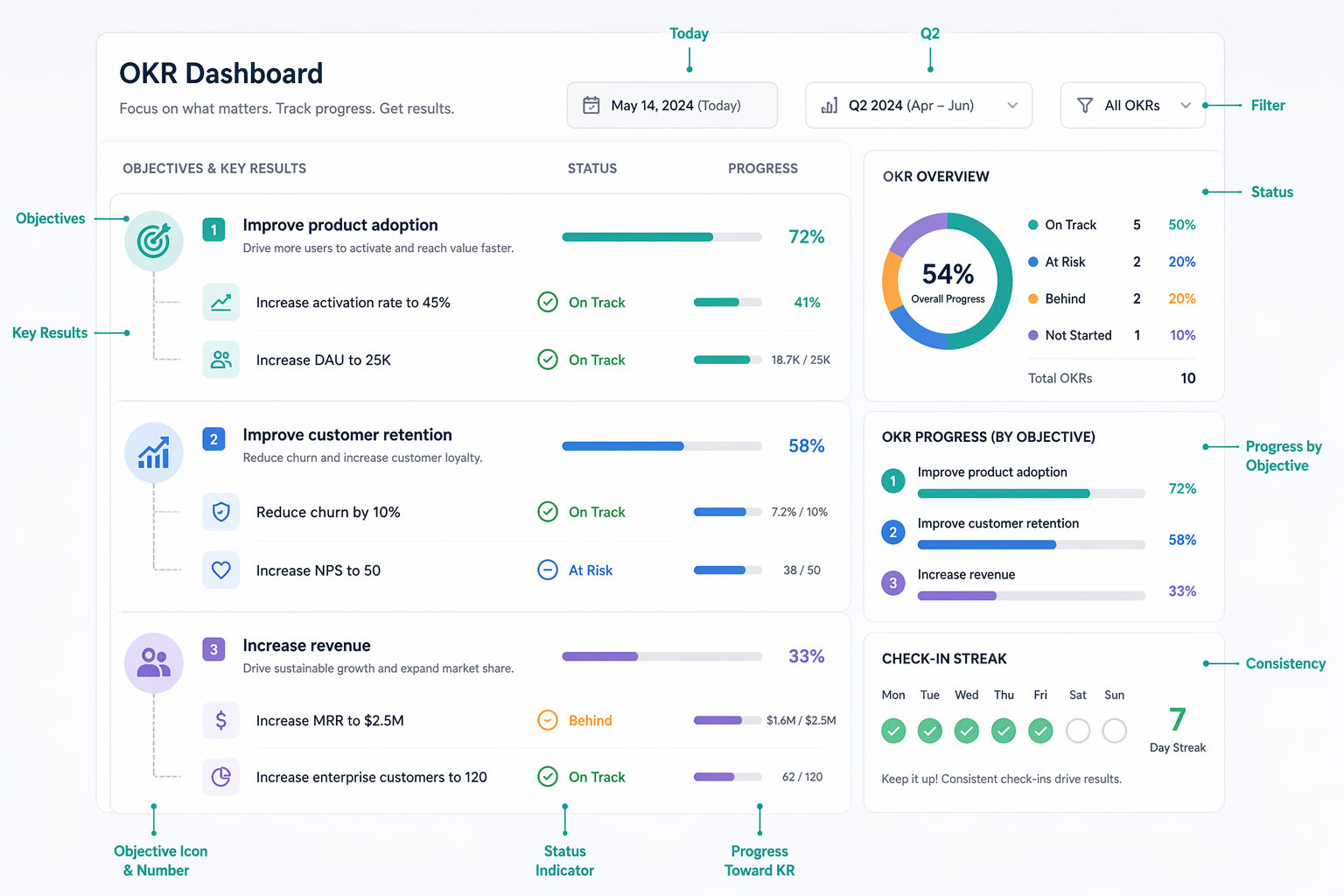
Set team OKRs, not vague goals. Each objective should answer: why does this matter now? Then add three to five key results that are specific and numeric, time-bound, and owned by one person.
Example: “Ship new onboarding flow as measured by a 15% lift in week-four activation.”
OKRs work best when they are visible to everyone and tied to daily work. A Kanban-style board that shows both OKRs and linked tasks lets you see at a glance whether the work being done actually supports the goals.
Stop chasing updates in chats, emails, and scattered documents. Use a shared project tracking tool as your single source of truth. Leaders should be able to see tasks, owners, due dates, and blockers in one place without having to ask. Use visual views strategically:
Rule of thumb: if work is not on the board, it does not exist.
You want ownership, not paranoia. The system exists to coach, not to spy. Practical moves:
When you see a problem, ask three questions before reacting: Is this a clarity issue? A capacity issue? Or a skill issue? Then, coach the gap. Shift praise and feedback toward outcomes: shipped value, reduced risk, saved time. People learn quickly what the culture actually rewards.
We are often asked how we keep a remote sales team motivated without the office energy: the buzz of a shared floor, the visible leaderboard, and the team celebrating a closed deal together.
My honest answer is that we are building a model where the business itself does the motivating.
Our team knows that the better they perform, the more revenue the company generates, and the higher their salaries go. We review and raise salaries regularly, and sometimes we raise them simply because revenue has grown, without anyone having to ask. At the same time, everyone understands that if the team fails collectively, everyone bears the consequences. Because we are small, the connection between individual effort and company outcome is visible and real. There is no hiding behind a large org chart.
This is not for every company or every culture. But if you can create genuine transparency between performance and reward, you remove a significant source of anxiety and replace it with something much more powerful – a shared stake in the outcome.
One area where remote leaders often hold back is difficult conversations: performance issues, hard feedback, and letting someone go. There is a common assumption that these moments require a physical room, a table, and some kind of gravitas that a video call cannot provide.
I do not find that to be true. After years of online calls, they feel just as real to me as face-to-face conversations. If anything, there is a small mercy in the distance. It creates just enough separation to stay clear-headed and professional in a moment that could otherwise feel charged.
What matters in a difficult conversation is not where you are. It is whether you have done the work beforehand: whether your expectations were clear, whether you gave feedback early enough to course-correct, and whether the person genuinely had what they needed to succeed. If you can answer yes to those questions, the conversation itself is just the next honest step, and it doesn’t matter where it happens
Keep a tight feedback loop across the whole team:
Aim for at least one meaningful recognition per person each week. It takes minutes and pays off for months.
High trust, clear culture, and strong follow-through keep remote teams from drifting. You protect all three by being boringly consistent, and consistency starts with small, honest moments. Telling your team what you are doing, following through, and letting them do the same. No performance, no pretending. Just a leader who says what they mean and means what they say.
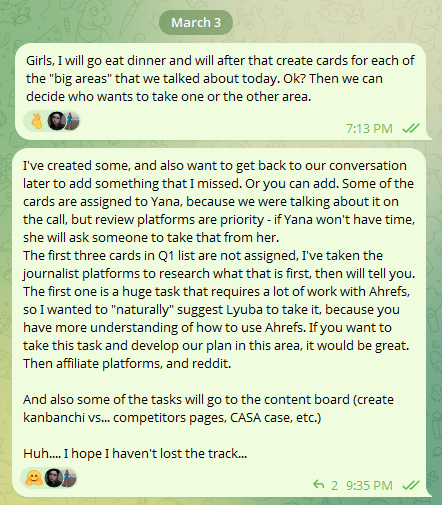
Trust grows when people know what to expect from you. Lock in simple rhythms: the same weekly check-in time, the same update format, the same rules for response times. Stick to them. No surprise rule changes, no moving goalposts.
If you cannot keep a promise, communicate early. Silence kills trust faster than mistakes.
The thing we are most deliberate about in our culture is trust and responsibility. People here are not afraid to take the lead and be accountable for their decisions. That does not happen by accident; it happens because leadership consistently rewards people who own their work, even when things go wrong, and never punishes honest mistakes made in good faith.
Psychological safety in a remote team is not a soft concept. People who are afraid to make decisions wait for permission. People who feel trusted move.
Your team should never have to guess when you are reachable. Share your working hours openly. If you work non-standard hours on certain days, say so. Tell people explicitly what the protocol is for genuinely urgent situations versus things that can wait.
Normalizing this also gives your team permission to have boundaries of their own. A leader who is always available at all hours (consciously or not) creates pressure on everyone else to do the same.
The principles in this playbook hold across contexts. The tactics need to flex.
Use one source of truth for work in progress, a shared Kanban board or Gantt tool, so trust and accountability do not depend on memory, proximity, or who happened to be in a meeting.
Our team uses Kanbanchi – the app we develop and use. Tasks, deadlines, file attachments, and progress visibility all in one place. For small remote teams in particular, simplicity is not a nice-to-have. It is what actually gets adopted and used consistently, which is the only thing that makes any system work.
Aim for one focused weekly team call and short 1:1s every one or two weeks. Keep everything else async in your project hub so people get long, deep work blocks instead of constant interruptions.
Async-first means people post updates, decisions, and questions in shared tools before asking for a meeting. Use chat, Kanban boards, and clear written briefs. Meetings become the exception for complex topics, not the default for every small decision.
Switch to outcome-based goals. Set clear OKRs, break them into tasks, and track progress in a shared board. Judge people on results and delivery, not online status or response speed.
Start with one change at a time. Move all work into a single Kanban board for one pilot project. Show faster decisions and fewer misunderstandings. Once people feel the difference, extend it.
Intentionally. Build small rituals: consistent check-in formats, public recognition, and a few minutes at the start of calls to be human. Follow people on social media. Ask about their lives. Connection over distance is possible; it just has to be designed, not assumed.
Remote leadership in 2026 lives or dies on clarity, not control. The teams that perform are not the ones with the most meetings or the most oversight. They are the ones where expectations are visible, accountability is real, and trust runs in both directions.
Seven years in, the thing I believe most is this: the distance between people on a remote team is not the hard part. The hard part is building a system clear enough that distance no longer matters. Get the system right, then get out of the way.
This playbook is built around how we work at Kanbanchi, including how we use our own product to run our remote team every day. If you want to turn these principles into a live operating system for your team, try Kanbanchi today.

In this Article:
Start using Kanbanchi now
Start your free trial