
In this Article:
Try Kanbanchi now
Start your free trial

When it comes to project management, what do you favour: the stricter structure of Waterfall or the faster-paced Agile? Or, are you in a position where you’re struggling to make a decision between the two? You’re most definitely not alone. Want to know why? For lots of workplaces and teams, a one-size-fits-all approach to project management just doesn’t work anymore. That’s because large projects require a predictable timeline, but they need the ability to change and flow freely when clients alter their demands. And we all know that happens a fair bit!
Have you heard of hybrid project management before?
This isn’t just another buzzword to add to your LinkedIn profile. It is a pragmatic strategy that gives you and your team the best of both worlds: you can plan like pros and carry out your tasks with all the energy of a vibrant startup. Once you start to blend the practical elements of a few different methodologies, it becomes easier to create a unique workflow, one that fits your specific project needs (and can also be tailored to each new one), rather than forcing your work into boxes that don’t fit its scope.
You might not know where to start with it all, so that’s why we’ve put this guide to hybrid project management together. In it, we’re going to dive deep into:
At its core, the hybrid project management methodology is the intentional combination of two or more project management styles: Waterfall and Agile. Think of it like you would a spectrum…
What do you do with it? You define the requirements, design a solution, build it, test it, and then…deliver. It’s perfect for the construction or manufacturing industries, where changing the foundation of the project halfway through just won’t cut it, for anyone involved.
What do you do with it? You work in short sprints, constantly gather feedback, and evolve the product as you go. It’s a favoured option for the software or design world.
You can see the problem, though, can’t you? Most modern projects don’t live at these extremes. There’s like a messy midpoint where they co-exist. So, a hybrid approach is the way to go with project management. It recognizes this reality by applying Waterfall and Agile elements to the appropriate areas of business:
| Waterfall elements | Agile elements |
|---|---|
| high-level planning | execution |
| budgeting | team collaboration |
| milestone setting | task management |
When you adopt a hybrid methodology in project management, you gain a big picture view of the finish line. However, you also maintain the ability to change lanes during the race.
Why are so many project managers ditching pure methodologies in favor of a hybrid approach to project management? The answer is simple: reality rarely follows a perfectly straight line or a perfectly circular sprint. The one-size-fits-all attack no longer works. There’ll always be bumps in the road or stumbling blocks that unwittingly trip you up.
The hybrid approach in project management solves these pain points by creating a safety net of structure around a core of flexibility.
The hybrid approach in software project management has become particularly popular. Think of it this way: Software teams often face fixed constraints, such as getting ready for a product launch date for a trade show; however, they’ve got to remain Agile during the coding phase to address unexpected tech issues that’ll need to be resolved pronto.
Pro Tip: Use a hybrid model when your project has a fixed deadline but the path to get there involves high levels of uncertainty or technical complexity. You might also want to think about Workback scheduling.
By implementing a hybrid methodology in project management, you aren’t just compromising; you’re optimizing. You are giving your team the tools to be disciplined where it matters and creative where it counts.
When we discuss a hybrid project management methodology, it’s important to recognize that it’s a customizable framework. It’ll be able to support a wide range of sectors and industries, and that means every team’s blend will look totally different.
Here are three of what we reckon are the most common mixes for hybrid project management models. Even these can all be adapted to fit your team.
This is perhaps the most frequent hybrid approach in software project management.

While some tasks are milestones with fixed dates, teams are free to allow Agile flexibility within the phases in between, and use Scrum methodology, for example
In this model, the overarching project is managed using a Waterfall timeline, with specific components handled using hybrid agile project management.
Example: A marketing agency might plan a 6-month product launch (Waterfall) but manage the creative asset production (design, video, copy) in 2-week Agile sprints.
Many teams use hybrid project management methodologies, maintaining a permanent Kanban board for continuous workflow while grouping tasks into milestones that follow a sequential timeline. This ensures that, as the team progresses through tasks, they still meet specific calendar dates.
Choosing the right hybrid approach to project management depends on your project’s DNA.
The beauty of a hybrid approach in project management is that you can adjust the mix of methodologies as the project evolves. You might start with waterfall during discovery and shift to being 90% Agile during production.
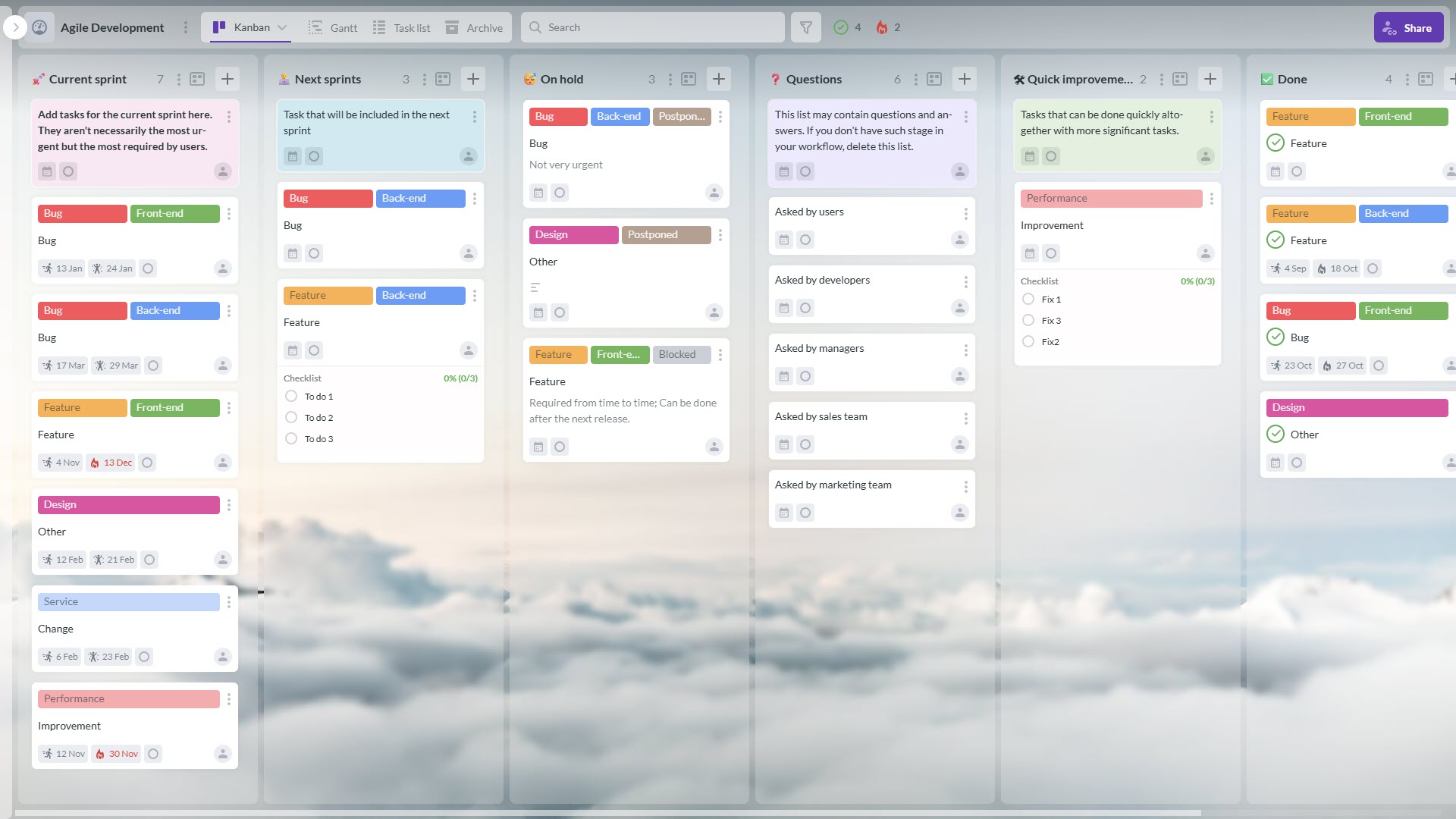
Kanbanchi provides a tool to support Agile in project management. Kanban boards can be used by development, marketing, operational, and other teams, along with the integrated Gantt chart with fixed milestones.
While it offers the best of both worlds, the hybrid approach to project management style isn’t a universal easy button.
It requires a certain level of maturity from the team and a clear understanding of the project’s goals. With that in mind, how do you know if your project is a candidate for a hybrid methodology in project management?
If your clients demand fixed budgets and firm delivery dates, but your team needs flexibility to address daily technical challenges, a hybrid approach is your bridge. It provides the high-level reporting leadership craves while protecting the team’s iterative workflow.
For large-scale projects such as launching a new product line, the sheer scale requires a Waterfall approach to manage dependencies. However, individual departments (such as UX design or content creation) will move much faster with hybrid agile project management.
In sectors such as healthcare, finance, and government, certain phases must be sequential for regulatory reasons (the Waterfall phase). Once compliance is met, the implementation can benefit from the speed of a hybrid project management approach.
How do you know if you meet the criteria to use a hybrid approach to project management? We’ll consider this below.
OK, so before we continue, it’s important to ask yourself these questions:
Checked more than two of these? Then a hybrid project management methodology is likely your most efficient path forward.
The Golden Rule to follow is to use Waterfall for the “What” and the “When,” and use Agile for the “How.”
By recognizing these signals early, you can establish a structure that supports your team rather than constrains them. It’s about being smart with your resources and realistic about your constraints.
You may also be interested in our guide on managing multiple projects with many tasks:
Multi-Project Management in Kanbanchi: Organize Multiple Boards with Clear Oversight
To successfully execute a hybrid approach project management strategy, you’ve got to choose a tool that doesn’t box you in. Most apps are either too rigid, like traditional Gantt software, or too unstructured, like simple task lists in Google. Kanbanchi is designed specifically to bridge this gap. It lets you maintain a single source of truth while switching between views based on the task at hand.
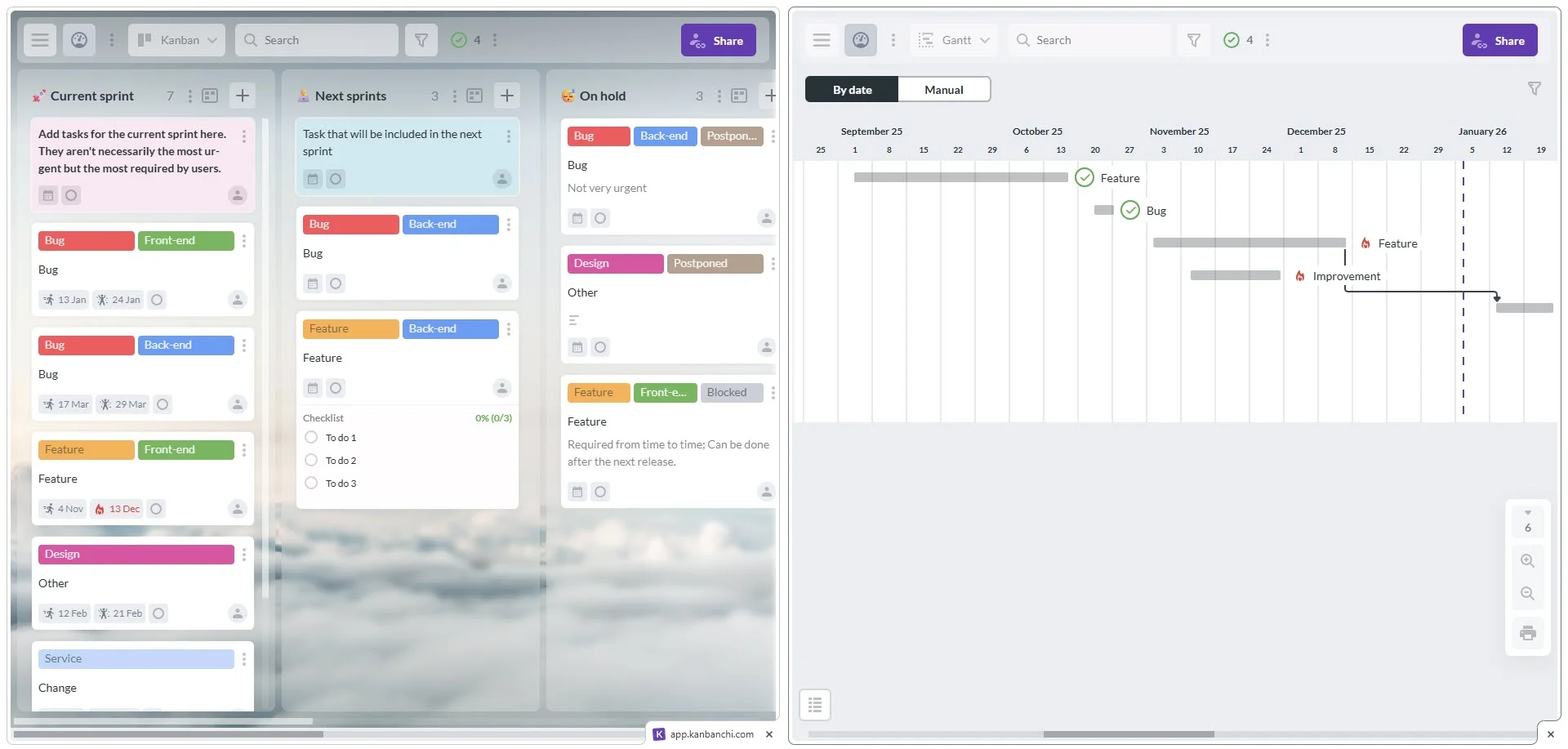
Kanbanchi’s dual-view capability: switch between Kanban board and Gantt chart within the same project, maintaining a single source of truth for your team
You can have both synced in real-time. This is the secret sauce for a hybrid project management methodology.
Since Kanbanchi integrates with Google Drive, Calendar, and Gmail, your hybrid workflow stays connected:
By using Kanbanchi, you aren’t just managing tasks; you are managing a methodology. Whether you’re taking a hybrid approach with software project management or carrying out a complex marketing campaign, the flexibility of this approach means your work quality won’t suffer
Ready to move from theory to practice? Setting up a hybrid approach to project management in Kanbanchi is straightforward. It’s all about creating a hierarchy that honors both the deadline and the daily flow. Here’s a simple way to use our software to get the most from a project.
By setting these high-level milestones first, you establish the “Waterfall” skeleton of your project.
Take those large milestones from your Gantt chart and break them down into smaller, manageable cards.
This is where your hybrid agile project management comes to life.
Kanbanchi will automatically adjust your schedule if the Agile execution takes longer than planned.
This is how you can manage adjusting resources accordingly.
Since it’s all within Google Workspace, you can tag team members and link directly to Google Sheets for budget tracking or Slides for stakeholder presentations.
Choosing a hybrid approach in project management isn’t about indecision; it’s about being smart. By following this setup, you create a system in which the hybrid project management methodology isn’t just a concept; it’s a living, breathing workflow that keeps your team productive and your stakeholders informed.
By leveraging the predictability of Waterfall and the speed of Agile, you give your team the best possible environment to succeed.
Ready to see how a hybrid workflow can transform your team’s productivity? Start your journey with Kanbanchi today and experience the power of a truly flexible project management tool integrated directly into your Google Workspace, OneDrive, or SharePoint.
To wrap up, let’s address the most common questions regarding the hybrid project management methodology. Whether you are transitioning from a traditional background or a startup environment, these answers will help clarify your path forward.
It is the practice of combining the structured planning of the Waterfall with the flexible execution of Agile. You plan the big picture in advance but remain adaptable during the day-to-day work.
It entirely depends on your project. While Scrum is excellent for small, highly flexible teams, a hybrid approach to project management is often superior for larger organizations that require long-term budget forecasting and fixed delivery dates alongside Agile development.
Absolutely. In fact, it is the industry standard for many enterprise-level software firms. It enables a structured discovery phase and a fixed release schedule, while giving developers the flexibility of Sprints and Kanban boards during coding.
The easiest way is to pick a tool like Kanbanchi that supports both views. Start by mapping your key deadlines in a Gantt chart, then create a Kanban board for your team to manage the tasks required to meet them.
The main risk is process overloading. If you aren’t careful, you can end up with too many meetings or conflicting priorities. To avoid this, clearly define which parts of your project are Waterfall (the “what” and “when”) and which are Agile (the “how”).
In this Article:
Start using Kanbanchi now
Start your free trial