
In this Article:
Try Kanbanchi now
Start your free trial


If you’ve been exploring different project management solutions, you’ve probably heard of Scrum.
But what does Scrum actually mean when we’re talking about project management?
Well, simply put, Scrum is a project management framework. It allows teams to handle complex projects, particularly in environments where change is frequent. Scrum was created in response to more conventional project management styles, which are known to be rigid and slow to adapt to change.
The Scrum project management methodology aligns with the Agile philosophy, which is based on principles such as:
Scrum relies on small, cross-functional teams that work together to plan and complete projects. The framework itself revolves around short, focused work periods called sprints (usually lasting a week to a month). During these sprints, teams work together to create usable increments of the product.
Rather than operating in a top-down structure, Scrum teams work collaboratively. Every member helps to identify goals, point out challenges, and work towards achieving the overall project objectives.
Agile Scrum project management is very common in software development these days, as software development teams routinely deal with complex projects and constantly changing requirements.
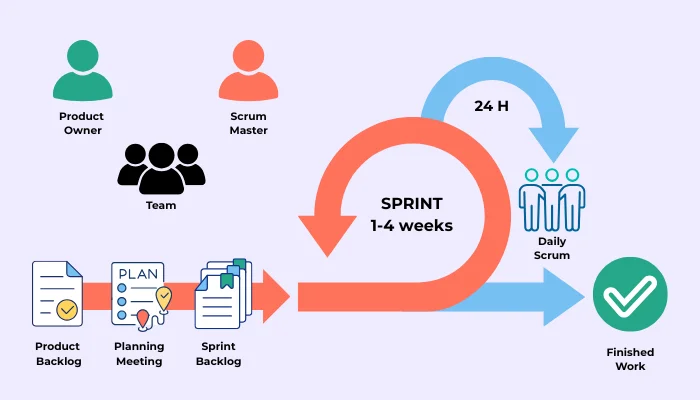
A visual representation of the Scrum framework illustrating its iterative workflow, team collaboration, and the principles of transparency, inspection, and adaptation that form the foundation of Agile project management
If you want to understand what Scrum means in project management, you need to understand where the concept came from.
The idea behind Scrum was born in the 1980s from an article written in the Harvard Business Review.
The article, called The New New Product Development Game, looked at the benefits of self-organizing teams in product development. It compared traditional project management (where projects are completed in sequential order) with a new approach, where iterative work is completed by self-organizing, cross-functional teams.
Inspired by the ideas presented in this article, Jeff Sutherland and Ken Schwaber would later develop the Scrum framework in the 1990s. They applied the idea of self-organizing, cross-functional teams to software development, where Scrum is commonly used today.
The term “Scrum” actually comes from rugby. It describes the moment when players regroup to restart play and regain possession of the ball. This framework adopted the name because it relies on periodic pauses, or “Scrums”, where teams can take stock of their work, discuss necessary adjustments, and plan for the work ahead. The main principles of the Scrum project management methodology are:
Scrum’s core principles also align nicely with the Agile mindset. Daily team chats, group planning, and continuous improvement are all part of Scrum. Scrum also uses backlogs to record new product requirements, which goes hand-in-hand with Agile’s focus on openness to change.
A Scrum team typically consists of five to seven members. Scrum teams must work together to deliver product increments, and therefore, strong communication and collaboration are key.
When using Scrum in project management, teams include three specific Scrum project management roles: the product owner, the Scrum master, and the development team.
The product owner is the person in charge of everything about the product. They must have a deep understanding of the business, its customers, and the market as a whole. The product owner speaks for the customers and makes sure the final product aligns with what customers truly want.
One of the main responsibilities of the product owner is managing the product backlog. This means creating the backlog, keeping it up-to-date, and deciding what’s most important based on what others say. If customers want something new, the product owner puts it in the backlog and decides how important and urgent it is.
Product owners establish project goals based on the items in the product backlog. They also make sure everyone knows what to work on first, so they can focus on the most important stuff for the next sprint.
The Scrum master acts as both a facilitator and a coach. Generally speaking, they make sure everyone on the team gets, and more importantly, follows the Scrum framework properly. They need to have a solid understanding of the framework and help the team put Scrum principles into practice.
If you’re a Scrum master, you’ll need to organize daily stand-up meetings where team members talk about how projects are going and any obstacles in their way. Moreover, the role involves actively helping the team overcome these hurdles. The Scrum master is also involved in sprint planning, deciding which tasks teams should tackle next, and facilitating sprint reviews.
The Scrum master must have a solid understanding of the team’s activities and make improvements to ensure all work aligns with Scrum. As an example, they may find ways to make information more accessible to all team members. Furthermore, the Scrum master should promote self-organization and foster a team environment where all team members confidently address everyday challenges on their own.
The development team spearheads the design, construction, testing, and eventual release of the product increment for every sprint. Based on past projects and the feedback, the development team maps out the work for each sprint and estimates the volume of work they can complete per iteration.
The development teams must deliver a useful and valuable product increment at the end of each sprint, ready to be potentially released to the public. Working together, all development team members share the accountability for seeing each sprint through to its completion.
Working within the Scrum framework, development teams must have strong communication and close collaboration. Team members should also have different skill sets, but should be able to train each other to make the team more versatile.
Scrum artifacts and deliverables are pieces of information that allow Scrum team members to understand the work that needs to be done. Artifacts allow teams to define the product, the work needed to finish the product, and the tasks that have been performed. In this way, artifacts give teams the transparency that is essential when using Scrum.
The three main Scrum artifacts include:
Generally speaking, Scrum artifacts are key to transparency. The product backlog, for example, acts as a clear, accessible to-do list of all tasks. This gives product owners a comprehensive overview of what must be done to deliver a finished product.
On the other hand, the sprint backlog gives development teams a clear look into what they’re working on and how they can achieve their sprint goal.
Think of an increment as a sort of trial run for the final product, giving you a glimpse into the progress made by developers. Once the sprint wraps up, team members get to test the increment, checking to see if it meets the established definition of done.
Scrum events (also known as ceremonies) are structured meetings where Scrum teams gather to discuss work in progress, plan future work, address issues, and more. There are four main events in Scrum, each with its own purpose. These events are sprint planning, daily Scrum, sprint review, and sprint retrospective.
Sprint planning is where teams can figure out what can be realistically accomplished during the sprint and create a plan to get there. During sprint planning, team members identify what work can be delivered during the sprint and how they plan to achieve it.
The main goal behind sprint planning is ensuring everyone on the team has a clear grasp of the deliverables, along with the steps needed to produce the increment.
While the Scrum master usually handles organizing the sprint planning event, everyone on the team plays a part. The product owner needs to lay out their product backlog so tasks can be ranked by importance. The development team then looks at what can be realistically completed from the product backlog. The team then collectively settles on the specific sprint objectives.
As a general rule, Scrum teams should set aside approximately 8 hours for sprint planning (for a 4-week sprint).
Every day, the Scrum team needs to hold a brief meeting (often called a stand-up). The daily Scrum ideally lasts no more than 15 minutes. The main idea behind this daily meeting is to ensure everyone is on the same page and working toward the same goals.
In these stand-ups, team members share their progress, flag any obstacles they’re facing, and bring up any other important points. Teams will often have each member answer questions such as:
These daily meetings help team members stay focused and accountable, which is particularly important in Agile teams.
To keep things efficient, daily Scrums should be short and effective. Teams should use a timer to keep the meeting under 15 minutes.
A sprint review is where all team members review the work that was completed during a sprint. The development team shows other team members product backlog items marked as “done”. Team members and other stakeholders can inspect the increment and give their feedback.
During a sprint review, the product owner determines whether the sprint’s increment is ready for release or needs more changes. These reviews can be either formal presentations or informal demos. The purpose is to show completed work and get valuable feedback from all stakeholders.
During the review, the product owner can also revise the product backlog based on the work performed. Scrum teams should usually allocate 4 hours for a sprint review (for a 4-week sprint).
The sprint retrospective is an important event in Scrum. It’s when the product owner, Scrum master, and development team get together to reflect on the past sprint.
If you’re working in a Scrum team, the sprint retrospective gives you the chance to look at everything from team dynamics, tools, and work processes. The goal is to celebrate the wins and pinpoint what needs improvement for the next sprint. Essentially, sprint retrospectives help Scrum teams consistently refine and improve their work.
For a four-week sprint, teams should allocate up to three hours for a retrospective.
Learn more about Project Management Methodologies
The Scrum framework sets out core principles that Scrum team members should follow to guide their work, actions, and behavior. The following values are considered essential to the success of Scrum teams:
Commitment: Scrum teams must be small and Agile, and all team members work together to achieve sprint goals. In Scrum, commitment goes beyond mere accountability; it’s about understanding your capacity. Team members should only commit to what they know they can deliver. Everyone must be committed to the team’s overall success. Commitment requires actively participating in daily Scrums, sharing updates, and tackling any obstacles that come up.
Courage: Maintaining communication in high-stress situations or during conflict can be difficult. That’s where courage comes in. Team members need to be willing to speak up, confront problems directly, and not shy away from challenges. Courage is also required to learn new skills, adapt when clients suddenly change their minds, and dig deep to solve complex problems.
Focus: Every sprint is a mini-marathon with a clear finish line and very specific targets. Focus is needed to keep things on track and make sure work gets done on time. In Agile Scrum project management, all team members must work collaboratively. And having one team member who cannot focus can hurt the whole team.
Openness: Collaboration requires openness. At every daily Scrum, team members must openly discuss work in progress, accomplishments, and challenges. This transparency gives everyone a view of the bigger picture and how sprint goals are actually being achieved. Openness is crucial because sharing skills, knowledge, and experiences is what helps a team overcome roadblocks.
Respect: A team is only ever as good as the respect the members have for each other. Whether you’re the product owner, Scrum Master, or a developer, it’s so crucial to appreciate that everyone contributes to achieving sprint goals. Effective teams celebrate each other’s wins (big and small) and offer support when things get tough.
Scrum and Agile often get lumped together.
And while there’s definitely some overlap, it’s important to understand that Scrum and Agile are two separate things.
Agile is an overarching philosophy that outlines high-level principles on how to manage software development. Agile’s main principles include continuous improvement, collaboration, and welcoming change. It’s founded on the values and principles you’ll find in the Manifesto for Agile Software.
Unlike conventional project management approaches, Agile focuses on being flexible, collaborating with customers, and adapting to changing product requirements.
So what is Scrum in Agile project management, really?
Well, simply put, Scrum is a distinct project management framework that closely aligns with Agile principles. For example, like the Agile methodology, Scrum emphasizes customer feedback and breaks large projects into smaller sprints.
The key difference is that while Scrum is considered an Agile framework, it’s not the only way to implement Agile principles in software product development. For example, another approach to Agile project management is Kanban.
Kanban is a project management system that teams can use to visualize and manage workflows more efficiently. Tools like Kanbanchi use visual boards, called Kanban boards, to show all work stages in a project (e.g., To Do, In Progress, Done).
Kanban encourages a pull-based workflow, allowing team members to simply pull tasks as they have capacity. This drives self-organization (which also aligns with Agile). Like the Scrum framework, Kanban also allows teams to work transparently. Tools like Kanbanchi let team members view the progress of all tasks related to a project.
However, while Scrum and Kanban both align with Agile principles, there are also some differences between the two approaches:
| Aspect | Scrum | Kanban |
|---|---|---|
| Structure | Structured with defined roles (Scrum master, product owner, development team) | Flexible with no fixed roles |
| Workflow | Time-boxed sprints (usually 4 weeks) | Continuous workflow with no required iterations |
| Planning | Planned sprint backlog with work selected in Sprint Planning | Just-in-time planning. Work pulled as capacity allows |
| Changes during work | Fewer changes mid-sprint. Changes to backlog made between sprints | Changes allowed anytime |
| Meetings | Mandatory Scrum events: sprint planning, daily standup, sprint review, retrospective | Optional meetings. Collaboration done through Kanban software (e.g. Kanbanchi) |
| Work delivery | Increment delivered at the end of each sprint | Continuous delivery as work is finished |
Scrum is a popular framework for software development teams. Some of the main benefits of Scrum in project management include:
While Scrum is a highly effective project management framework, it’s not without drawbacks. Some disadvantages of Scrum include:
If you’re considering using Scrum for your team, here are some of the best Scrum project management tools to consider:
Jira offers templates that allow teams to turn complex projects into more manageable tasks. Users can assign tasks to team members, organize work into sprints, and track workflows. With Jira, users can also get real-time updates on projects, which allows team members to quickly respond to changes or obstacles in product development.
Trello is a project management software that’s easy to use. It’s great for small teams who need help with iteration planning, automating routine tasks, and monitoring sprint progress. With Trello, users can add checklists, due dates, and team assignments on cards, which is useful during sprint planning and task tracking.
This work management platform comes with many useful features for Scrum teams. Teams can use Wrike to manage product backlogs, visualize project timelines, and assign tasks. It also comes with built-in proofing tools, which can make reviewing increments and giving feedback easier.
Asana uses boards and timelines to make it easy for teams to visualize projects. With Asana, Scrum teams can plan sprints, share updates and changes to projects, and give feedback during sprint retrospectives. Asana also integrates with other communication tools like Slack, which can facilitate the high level of collaboration that Scrum teams need.
Kanbanchi is a versatile project management tool that Scrum teams can use for project planning, task assignment, and collaboration.
This intuitive tool uses Scrum boards to visually map out all tasks involved in a project. For example, Scrum boards can show stages like product backlog, design, and testing. When a sprint is finished, all tasks associated with the sprint can be stored in an archive.
One of the main benefits of this tool is its seamless integration with Google Workspace. Team members simply log in to Kanbanchi with their Google account, and the project management platform is synced with Google apps like Gmail, Drive, and Sheets.
Many software development teams prefer to use the Scrum project management methodology. This is because software development typically requires strong collaboration, adaptation to changing requirements, and frequent problem-solving. In addition, startups often use Scrum in project management because the framework provides a high level of flexibility.
Agile project management with Scrum is best suited for small teams (5 to 7 members) that can benefit from its iterative, collaborative, and flexible framework. While it’s best suited for product teams, startups, and software development teams, Scrum is gaining traction in other industries, such as education, marketing, and finance.
However, using the Scrum methodology in project management is not always the best solution. Since it requires strong communication, the framework may be ineffective for larger teams where communication between all team members is hard to maintain.
Other Agile frameworks may be a better fit for some teams. For example, Kanban can work well for teams that require a continuous workflow (instead of fixed-length sprints). Without sprints, it can be easier for teams to respond to frequent changes in project scope.
Kanban also doesn’t use prescribed roles, which can be better for small, flexible teams. In addition, there are no fixed meetings with Kanban, which can work well for teams that want a simpler project management system.
Scrum is one of the most popular project management frameworks for software development teams due to its focus on collaboration, adaptability, and continuous improvement. Working in short, focused sprints also allows teams to stay aligned to project goals and deliver product increments quickly. The framework is also valuable for teams that frequently incorporate customer feedback into their work.
To make it easier to implement Scrum, there’s a range of Scrum project management tools available today.
Teams can use tools like Jira and Kanbanchi to create Scrum boards that visually map out all tasks involved in a sprint. For example, Scrum boards in Kanbanchi can show project stages like design, testing, and review. When a sprint is finished, all tasks associated with the sprint can be stored in an archive. These tools also make it possible to assign roles, such as product owner, Scrum master, and developer, helping to clarify team responsibilities.
Now that you understand what Scrum in project management is and how it can benefit your business, it’s time to start implementing this Agile framework. With values like commitment, courage, and openness, it’s possible to adopt Scrum and experience all the benefits it has to offer.
Get started with Kanbanchi today for a seamless transition to Scrum project management.



In this Article:
Start using Kanbanchi now
Start your free trial