
In this Article:
Try Kanbanchi now
Start your free trial

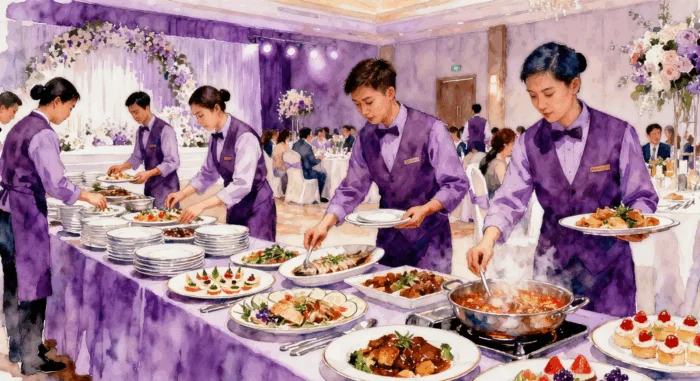
Catering businesses face unique operational challenges that traditional project management tools fail to address. This case study examines how a mid-sized catering company transformed its event coordination and kitchen workflows by implementing Kanbanchi as the catering project management software. They achieved measurable improvements in on-time delivery rates, food waste reduction, and client satisfaction through systematic operational optimization.
Before implementing dedicated catering project management software, food service businesses struggle with fragmented workflows that scatter critical event information across disconnected systems. Menu planning complexities arise when caterers manage multiple simultaneous events with varying dietary requirements, portion specifications, and presentation standards, often without centralized coordination tools. This challenge intensifies during peak seasons when wedding receptions, corporate functions, and social gatherings overlap, demanding precise ingredient forecasting and kitchen capacity planning.
Task assignment inefficiencies lead to confusion among kitchen staff, service personnel, and logistics coordinators when they lack visibility into their responsibilities and deadlines. Research indicates that 91% of hospitality professionals have experienced challenges managing event logistics, leading to last-minute scrambles and service quality degradation. Timeline management difficulties compound these problems as caterers coordinate food preparation schedules, equipment transport, venue setup, and service delivery across multiple concurrent events.
Inventory tracking gaps result in ingredient shortages, over-purchasing waste, and budget overruns when catering teams lack systematic approaches to managing perishable goods and supplies. The food industry faces a unique challenge in managing perishables, which creates constant time pressure to ensure products are processed, packaged, and delivered before expiration. Client accommodation changes become problematic when last-minute menu modifications, guest count adjustments, or dietary requirement additions occur without structured communication channels and workflow adaptation mechanisms.
Equipment coordination challenges arise when caterers must manage limited resources, such as chafing dishes, serving utensils, linens, and specialty cooking equipment, across multiple events. Without systematic tracking, teams face equipment shortages, double-bookings, and logistical nightmares that undermine service quality. The cumulative effect of these challenges results in stress, inefficiency, and customer dissatisfaction that threatens business sustainability.
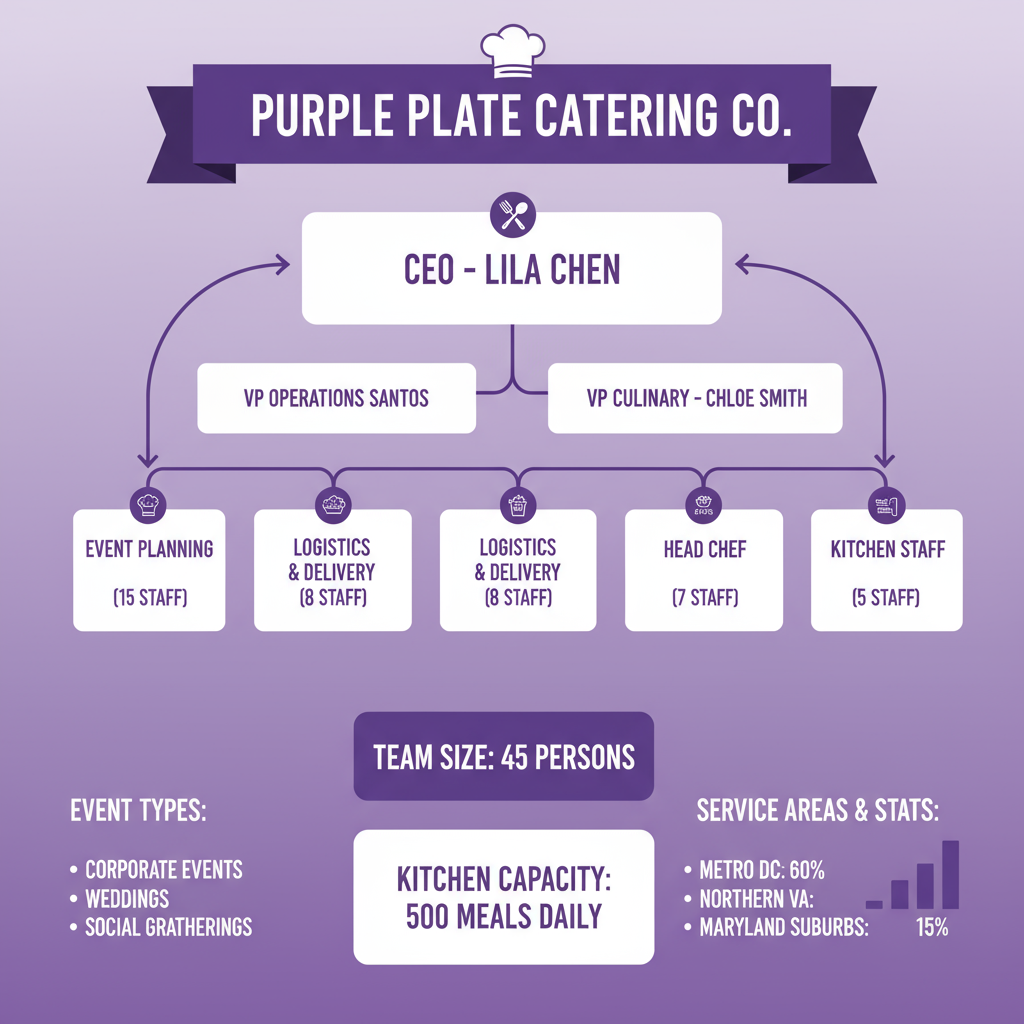
The catering company profiled in this case study operates as a full-service event caterer serving corporate clients, wedding parties, and private social functions across metropolitan and suburban markets. The business employs 45 team members, including executive chefs, line cooks, prep staff, service coordinators, logistics managers, and event servers, who collectively manage 85-110 events monthly during peak seasons.
Event types range from intimate dinner parties serving 20 guests to large corporate galas accommodating 500+ attendees, requiring flexible menu planning and scalable operational processes. The company’s kitchen facility processes up to 500 meals daily during high-volume periods, demanding precise scheduling and workflow coordination to maintain quality standards while meeting aggressive timelines.
Service offerings include customized menu development, full-service event planning, equipment rental, staff coordination, venue setup, food service, and post-event cleanup. The company prides itself on accommodating diverse dietary requirements, including vegetarian, vegan, gluten-free, kosher, and allergy-specific preparations that demand meticulous ingredient tracking and kitchen protocol compliance.
The catering team operates under constant time pressure, managing perishable ingredients, coordinating delivery logistics, and executing flawless service at client locations with varying kitchen facilities and equipment availability. Meeting these demands while maintaining profitability requires streamlined internal workflows that minimize waste, optimize staff utilization, and ensure consistent quality across all events.
Purple Plate evaluated multiple food service project planning tools over a two-month selection process that included software demonstrations, trial deployments, and team feedback sessions. Key evaluation criteria included ease of use for non-technical kitchen staff, visual workflow management, timeline planning capabilities, mobile accessibility for field teams, and integration with existing Google Workspace systems.
Kanbanchi’s visual board interface emerged as a decisive factor because kitchen staff and service coordinators immediately understood the intuitive column-based workflow without extensive training. The ability to visualize event progression from initial planning through menu development, shopping, preparation, setup, service, and cleanup resonated with teams accustomed to physical kitchen whiteboards and paper checklists.
Management particularly valued Kanbanchi’s timeline and Gantt chart capabilities that enable comprehensive event scheduling and resource planning across multiple concurrent catering engagements. The platform’s one-click view switching between Kanban boards for daily task management and Gantt timelines for multi-event coordination addressed both operational and strategic planning needs. This hybrid approach proved superior to competitors offering only single-view perspectives that forced teams to choose between workflow visualization and schedule management.
The company’s leadership emphasized Google Workspace integration as critical because the business already relied on Gmail for client communication, Google Drive for menu planning documents, and Google Calendar for event scheduling. Kanbanchi’s native integration eliminated duplicate data entry and authentication friction that competitive tools introduced through separate login systems and file management approaches.
And we also think that they liked that Kanbanchi is a “purple” company too
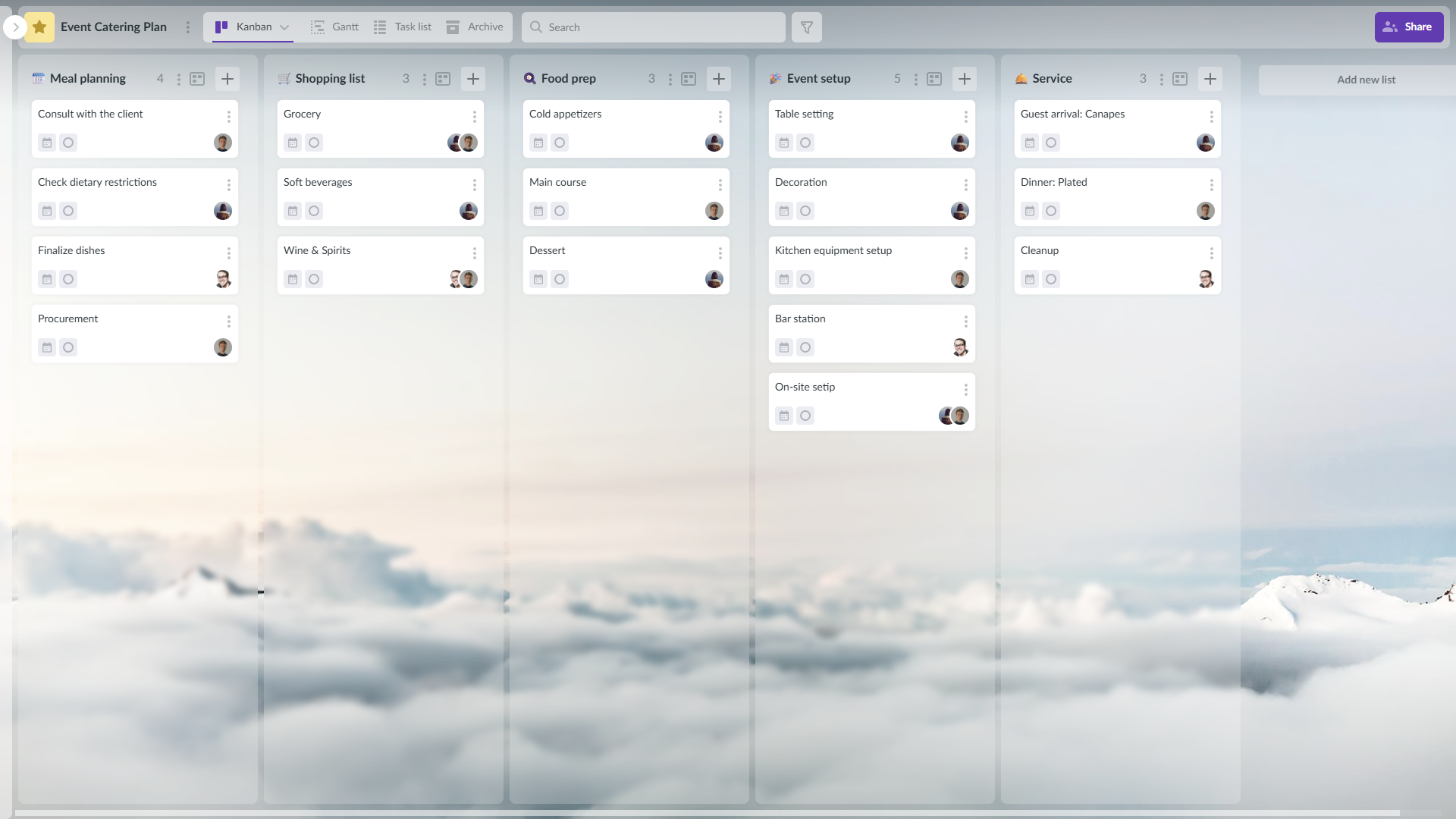
Kanbanchi streamlines event planning for busy catering businesses
The catering company executed a structured eight-week Kanbanchi deployment beginning with management training and progressively expanding to kitchen staff, service coordinators, and field personnel through systematic onboarding programs.
This involved collaboration between the leadership team and Kanbanchi support to create standardized board templates for various event types, including corporate functions, wedding receptions, and private parties. This initial phase produced master templates with consistent column structures representing workflow stages: Client Consultation, Menu Planning, Shopping List, Food Preparation, Equipment Packing, Venue Setup, Service Execution, and Post-Event Cleanup.
Management team members learned advanced features, including custom field creation for dietary restrictions, label systems for food categories, timeline view configuration for multi-event scheduling, and reporting capabilities for business analytics. Training emphasized practical application using upcoming real events rather than abstract scenarios, enabling immediate productivity gains.
They brought executive chefs, line cooks, and prep staff onto the platform through hands-on training sessions conducted during non-peak kitchen hours. Training focused on core functionality, including card creation for recipe tasks, checklist usage for ingredient lists, file attachment for presentation photos, and mobile app navigation for recipe access during food preparation.
Kitchen staff appreciated visual task organization that replaced scattered paper systems and verbal communication that previously caused confusion and mistakes. The ability to attach recipe photos directly to preparation cards proved particularly valuable for maintaining presentation consistency across different events and staff members.
They completed operational deployment by training event coordinators and logistics personnel on timeline management, resource allocation, and field coordination capabilities. This phase included establishing equipment tracking systems, transportation scheduling workflows, and client communication protocols within the Kanbanchi environment.
They made workflow adjustments, addressing implementation challenges and integration configuration with Google Calendar for automated deadline synchronization. Leadership conducted weekly review sessions to identify adoption barriers and success stories that informed ongoing platform optimization.
Implementation metrics tracked throughout the rollout included board creation rates, task completion percentages, mobile usage statistics, and staff proficiency assessments. The structured approach achieved 92% active user adoption within the eight-week implementation period while maintaining operational performance targets.
Several specific Kanbanchi capabilities delivered immediate operational value for the catering company’s event coordination and kitchen management workflows, fundamentally changing how teams plan, execute, and deliver exceptional food service.
They provided intuitive workflow management that kitchen staff and service coordinators could understand immediately, requiring no extensive technical training. The column-based layout mirroring physical kitchen workflow stages enabled seamless transition from paper-based systems to digital coordination. Teams could visualize all event tasks simultaneously, identify bottlenecks in food preparation, and proactively address potential delays before they impacted service quality.
Their combination revolutionized multi-event scheduling by providing a visual calendar representation of all concurrent catering engagements with overlapping resource requirements. Management could identify scheduling conflicts, optimize kitchen capacity utilization, and make informed decisions about new event bookings based on comprehensive workload visibility. The ability to drag-and-drop events on the timeline for schedule adjustments streamlined planning workflows that previously required manual spreadsheet updates.
They enabled the catering team to capture event-specific metadata, including dietary restrictions, guest counts, service styles, equipment needs, and venue characteristics that inform operational planning. Color-coded labels for food categories (appetizers, entrees, desserts), dietary types (vegetarian, vegan, gluten-free), and preparation status (shopping, prepping, ready) provided instant visual clarity across complex event boards with dozens of concurrent tasks.
It enabled seamless access to menu documents, presentation photos, client contracts, and recipe specifications directly from relevant cards. Kitchen staff could reference plating diagrams during food preparation, service coordinators could review client agreements during setup, and management could access all event documentation without searching through disconnected file systems.
Features like card comments, @mentions, and activity tracking streamlined team communication and eliminated email volume by approximately 40%. Chefs could provide cooking instructions within preparation cards, coordinators could clarify setup requirements with field staff, and management could review progress without scheduling separate meetings or sending multiple emails.
This catering company tracked comprehensive operational metrics before and after Kanbanchi implementation to quantify the platform’s business impact on event delivery performance and operational efficiency.
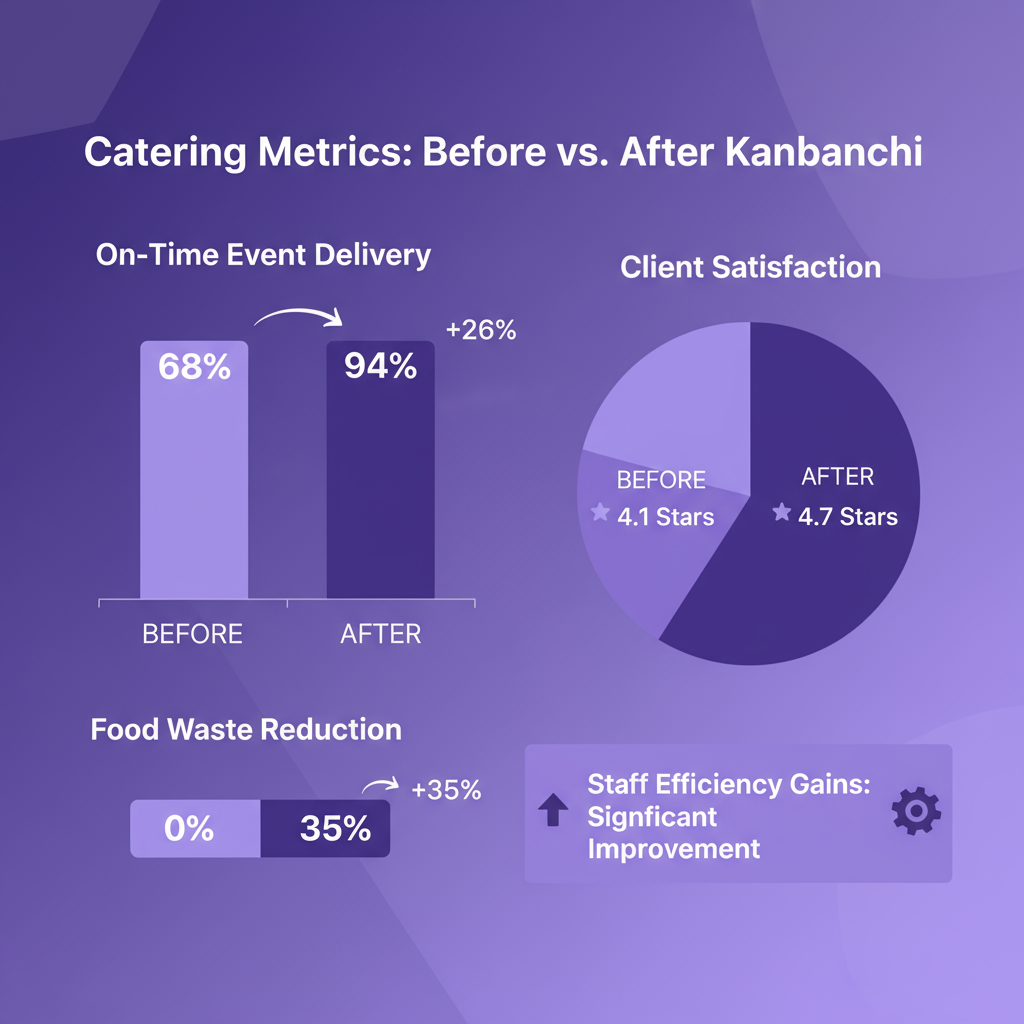
On-time event delivery rates improved from 68% to 94%, representing a 38% improvement in client commitment fulfillment. This dramatic enhancement stemmed from better visibility into preparation progress, proactive identification of potential delays, and systematic escalation of blocking issues before they impacted service timing. The company attributes this improvement to Kanbanchi’s visual workflow management and timeline coordination capabilities that prevented the communication breakdowns plaguing previous operations.
Food waste reduction decreased by 35% through improved ingredient forecasting and systematic inventory management enabled by centralized event planning. Template-based shopping lists for standard menu items combined with historical data analysis reduced over-purchasing while maintaining adequate safety stocks for last-minute client changes. This waste reduction directly improved profit margins while supporting sustainability objectives important to corporate clients.
Client satisfaction scores increased from 4.1 to 4.7 stars based on post-event surveys and online reviews. Feedback specifically cited consistent food quality, reliable service timing, and responsive communication as key satisfaction drivers. The transparency enabled by shared Kanbanchi boards for client-visible preparation milestones built trust and strengthened relationships that generated repeat business and referrals.
Staff coordination efficiency improved as measured by a 12-hour per week reduction in management oversight time previously consumed by status checking and problem resolution. Systematic workflows and real-time task visibility enabled teams to self-coordinate effectively while escalating only genuine blockers requiring management intervention. This time savings allowed leadership to focus on business development and strategic planning rather than operational firefighting.
“Kanbanchi transformed our kitchen operations from reactive chaos to proactive coordination. I can see all event menus for the entire week, plan ingredient purchasing efficiently, and coordinate prep schedules to optimize kitchen workflow. The visual boards make it immediately obvious when we’re overloaded, enabling me to request additional prep staff before we fall behind. Food quality consistency has improved because every prep cook can reference the exact recipe specifications and plating photos directly from their mobile devices.”
“Before Kanbanchi, we lost countless hours searching for menu documents, clarifying verbal instructions, and recovering from miscommunication about dietary restrictions. Now, everything is organized in a single system, allowing every team member to access exactly what they need. The reduction in food waste alone justified the investment—we’re no longer over-purchasing ingredients because we have systematic visibility into all upcoming events and can consolidate shopping lists intelligently.”
“Field coordination became exponentially easier with Kanbanchi’s mobile app. I can update setup progress in real-time, photograph completed arrangements for chef approval, and communicate with kitchen staff about delivery timing without endless phone calls. Clients appreciate seeing their event timeline and understanding exactly when different service elements will occur. This transparency reduces client anxiety and positions us as professional operators rather than caterers flying by the seat of our pants.”
“Equipment tracking was a nightmare before Kanbanchi. We frequently encountered situations where two events required the same chafing dishes or specialized serving pieces, as nobody had comprehensive visibility into equipment allocation. The systematic approach enabled by Kanbanchi’s resource tracking capabilities eliminated these conflicts. I can now see all equipment commitments across multiple events and proactively identify conflicts weeks in advance rather than discovering problems the day before service.”
Purple Plate company identified several implementation strategies that proved critical for achieving maximum operational value from Kanbanchi adoption.
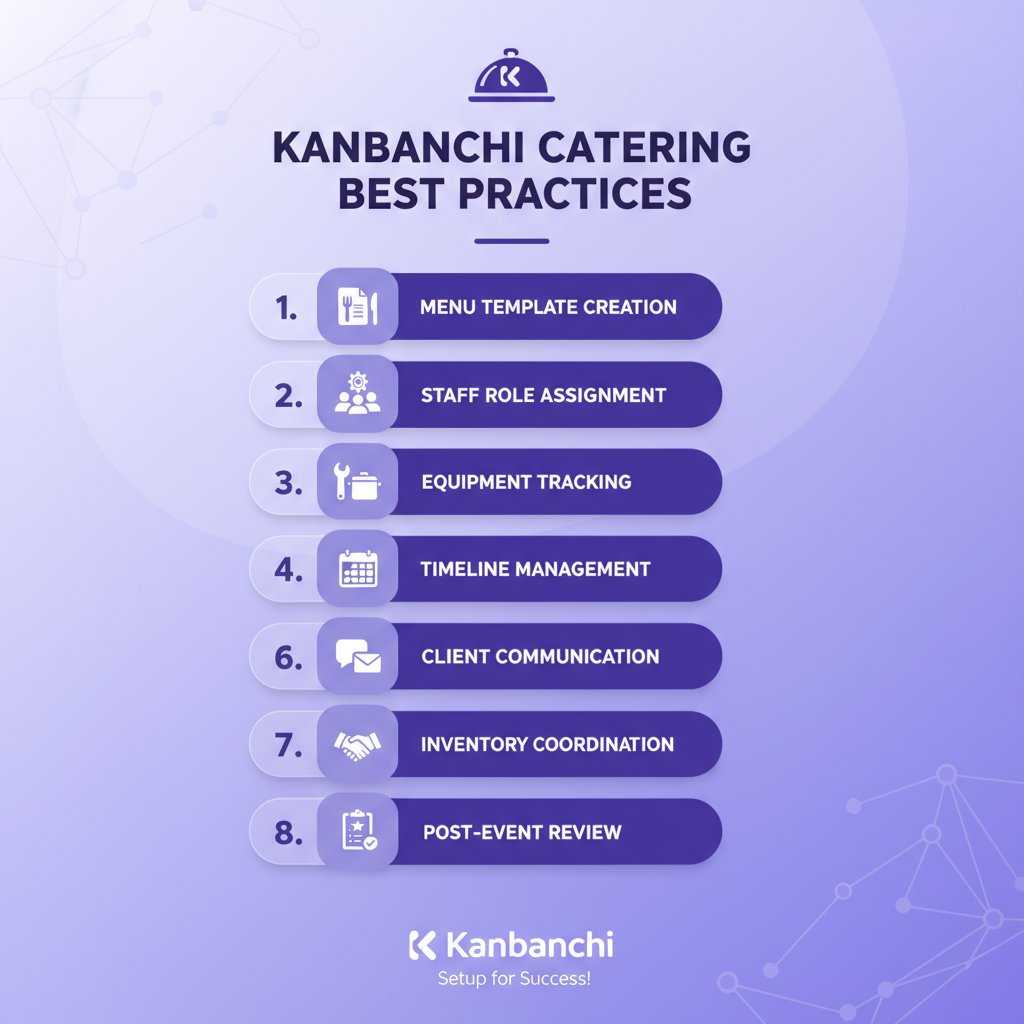
Create comprehensive event templates for different catering categories, including corporate functions, wedding receptions, private parties, and specialty events that capture standard workflow stages, everyday tasks, and typical timeline requirements. Investment in template quality during initial setup pays dividends through accelerated event planning and consistent execution standards across all team members.
Implement systematic labeling conventions for food categories, dietary restrictions, preparation status, and equipment types that enable rapid visual scanning across complex multi-event boards. Color-coded systems should align with the kitchen team’s mental models to minimize cognitive load and maximize immediate comprehension during high-pressure service periods.
Establish daily board review rituals where kitchen managers and event coordinators conduct 15-minute standup meetings reviewing all active event boards to identify potential conflicts, resource shortages, or timeline concerns requiring proactive attention. These systematic reviews prevent minor issues from escalating into service-impacting crises.
Leverage mobile capabilities extensively by training all field staff on mobile app usage and establishing expectations for real-time status updates during event execution. Mobile adoption transforms field coordination from periodic check-in calls to continuous visibility that enables proactive problem-solving and quality assurance.
Integrate deeply with Google Workspace by configuring automatic calendar synchronization for event deadlines, Drive folder structures for menu documents, and Gmail integration for client communication capture. These integrations eliminate duplicate data entry and reduce friction between communication, documentation, and coordination activities.
Document recipe specifications thoroughly within preparation cards, including ingredient lists, cooking instructions, plating diagrams, and timing requirements that enable consistent execution regardless of which kitchen staff member handles preparation. Comprehensive documentation reduces dependency on verbal communication and institutional knowledge that walks out the door when employees leave.
Conduct regular template evolution sessions quarterly to incorporate learnings from completed events into standardized frameworks while maintaining workflow consistency. Systematic improvement processes ensure templates remain relevant as menu offerings expand and operational capabilities develop.
Monitor adoption metrics systematically through monthly reviews of board creation rates, task completion percentages, mobile usage statistics, and user engagement indicators that identify struggling team members requiring additional support. Early intervention prevents adoption failures that can undermine organization-wide implementation success.
Most kitchen staff achieve basic proficiency within 5-7 days of active use, with advanced feature mastery developing over 4-6 weeks. Teams familiar with visual workflow tools or previous project management systems adapt more quickly, while those new to digital coordination may require additional hands-on support. Proficiency timelines depend heavily on template quality and training effectiveness rather than inherent platform complexity.
Yes, Kanbanchi works on iOS and Android, enabling field coordinators and service staff to access event boards, update task status, attach photos, and communicate with kitchen teams from client venues. Mobile functionality ensures seamless coordination between kitchen preparation and event execution without laptop requirements.
Yes, Kanbanchi cards support comprehensive recipe documentation through description fields, checklists for ingredient lists, file attachments for plating photos, and custom fields for cooking times and temperatures. Many catering teams attach PDF recipe documents from Google Drive directly to preparation cards for easy mobile access during cooking.
Kanbanchi scales effectively from small 5-person catering operations to large 100+ person food service organizations. The case study company’s 45-person team represents a mid-size deployment, but the board-based architecture supports both intimate catering businesses and large-scale event operations without performance limitations.
While Kanbanchi doesn’t provide specialized food safety features, catering teams successfully use custom fields and checklists to document temperature checks, sanitation procedures, and compliance activities required by HACCP and local health regulations. Many businesses create dedicated boards for food safety monitoring alongside event coordination boards.
Kanbanchi pricing starts at $3.97 per user per month for the essential plan and $13.97 per user per month with unlimited boards and advanced features. Plans are flexible; you can find your own plan. Most catering businesses achieve positive ROI within the first quarter through food waste reduction and operational efficiency improvements that exceed software costs by substantial margins.
Catering businesses seeking to replicate these operational improvements can follow a systematic approach to Kanbanchi evaluation and implementation.
It’s better to use real upcoming events rather than artificial test scenarios to evaluate Kanbanchi’s capabilities for actual catering workflows. Create boards for 2-3 confirmed bookings, configure essential workflow columns and labels, and involve kitchen staff who will use the system daily. This hands-on evaluation reveals how Kanbanchi addresses specific catering pain points better than feature comparison charts.
These individuals should possess credibility with team members and a willingness to invest time in template development and peer training. Successful implementations typically start with 3-4 week pilot phases involving 6-8 team members managing diverse event types.
These should include on-time delivery rates, food waste percentages, client satisfaction scores, and staff coordination efficiency. Baseline measurements before deployment provide comparison points for quantifying improvements and justifying continued investment.
Template quality during pilot phases determines adoption success and productivity gains for all subsequent users. Templates should capture standard workflow stages, everyday preparation tasks, typical timeline sequences, and equipment requirement patterns for each event type.
Use real event scenarios that resonate with catering workflows. Training effectiveness increases dramatically when kitchen staff see immediate relevance to daily challenges rather than generic project management concepts. Hands-on exercises building actual event boards during training sessions cement learning more effectively than passive presentations.
During rollout, it will help to identify struggling users requiring additional support or workflow optimization. Weekly check-ins during the first month provide opportunities to address questions and share success stories that build implementation momentum. Early intervention prevents adoption failures that undermine organization-wide deployment success.
Catering businesses implementing specialized catering project management software like Kanbanchi achieve measurable improvements in event delivery, operational efficiency, and client satisfaction that directly impact bottom-line profitability. The case study company’s experience demonstrates that systematic workflow optimization through purpose-built tools delivers quantifiable ROI within months while fundamentally improving staff experience and customer relationships.
The challenges facing catering operations—menu planning complexity, timeline coordination, inventory management, client changes, and equipment tracking require integrated solutions that address the unique characteristics of event-based food service. Generic project management platforms fail to accommodate catering-specific needs, including recipe management, mobile field coordination, perishable inventory tracking, and multi-event resource optimization that define food service delivery excellence.
Kanbanchi’s Google Workspace integration provides frictionless adoption for the many catering businesses already using Gmail, Drive, and Calendar for daily operations, eliminating authentication barriers and file management complications that hamper alternative solutions. The platform’s hybrid Kanban-Gantt approach addresses diverse stakeholder needs within catering teams, enabling kitchen staff to work in preferred Kanban views while management maintains Gantt timelines for multi-event coordination.
Ready to streamline your catering operations and achieve similar results?
Start your free Kanbanchi trial today
to experience how systematic event management transforms menu planning, kitchen coordination, and service delivery.
You may also be interested in other Kanbanchi blog articles for business owners; check them out!

In this Article:
Start using Kanbanchi now
Start your free trial