Growth hacking expert with over 10 years of experience with Kanbanchi
When cleaning service managers implement effective cleaning company project management, their success depends on three critical capabilities:
coordinating crews across multiple client locations
maintaining consistent quality standards
responding quickly to scheduling changes
For most cleaning companies, these challenges grow exponentially as they expand from 5 to 50+ team members.
The cleaning services industry processes $500+ billion annually, yet many companies still rely on spreadsheets, email chains, and handwritten notes to manage crew assignments, client locations, and quality inspections. Without proper project management for cleaning companies, this fragmented approach leads to missed appointments, inconsistent service quality, and frustrated customers. These problems directly impact retention and revenue.
This comprehensive case study examines how three successful cleaning service companies transformed their operations using Kanbanchi’s visual cleaning company project management system. We’ll explore their specific challenges, implementation strategies, and measurable results that demonstrate how structured workflows improve scheduling accuracy, quality control, and crew utilization.
The Cleaning Services Industry Challenge
Modern cleaning companies operate in a highly competitive market where operational efficiency directly determines profitability. With labor typically accounting for 70% of service costs, optimizing crew schedules and eliminating wasted time are essential to maintaining margins.
Common Operational Challenges
Cleaning service companies commonly experience significant operational losses through several interconnected challenges:
Scheduling inefficiencies: Missed or double-booked appointments represent one of the most costly operational failures, generating immediate service recovery costs and reputation damage
Quality control gaps: Inconsistent service delivery across the customer base leads to complaints and customer churn, particularly among new clients
Crew coordination problems: Setup and travel time inefficiencies between job sites consume substantial hours weekly, directly reducing billable time and crew productivity
Customer communication failures: Vague scheduling information and delayed responses to client requests generate frustration and erode trust
Equipment and inventory tracking: Poor visibility into equipment location and supply consumption results in unnecessary expenses, duplicate purchases, and mid-job equipment failures
These operational challenges compound rapidly as cleaning companies grow. What works for a 5-person operation managing 20 clients becomes chaotic at 30+ employees managing 150+ active clients across multiple locations. Without systematic processes, growth typically requires proportional increases in management overhead. Such a cost structure limits profitability and scalability.
*Company name and details of this case have been modified to protect confidentiality while preserving the authentic operational challenges and solutions described.
Shine Bright Cleaning Services* operates across three metropolitan areas, managing commercial cleaning contracts for office buildings, retail spaces, and corporate facilities. The company operates with 28 full-time crew members divided into 7 specialized teams:
Daytime cleaning teams: 3 teams handling office cleaning during business hours
Evening maintenance teams: 2 teams performing deep cleaning after business closes
Specialty teams: 1 carpet and upholstery specialist team, 1 post-construction cleaning team
Leadership: Operations manager, 2 supervisors, 1 quality control inspector
The company manages 110+ active client contracts, ranging from weekly office cleaning to specialized quarterly projects. Monthly revenue averages $95,000 with a gross margin of 38% after labor and supplies.
Initial Challenges: Scheduling and Quality Chaos
Before implementing Kanbanchi, Shine Bright’s* operations suffered from fundamental coordination problems that directly impacted profitability and customer satisfaction.
Scheduling and Route Inefficiencies
Operations manager Krista* described their pre-system situation: “We were using a combination of Outlook calendars, Google Sheets, and frankly, a lot of phone calls. Our team leads would email me schedules, I’d compile them manually, then distribute assignments. If a client called with a change request at 2 PM, that change would take 2-3 hours to coordinate across phone calls and email updates.”
This approach created systematic inefficiencies:
Missed or double-booked appointments: Monthly incident rate of 4-6 missed client appointments, generating immediate service recovery costs and reputation damage
Inefficient routing: Crews weren’t organized by proximity, resulting in excessive travel time between jobs (average 22 minutes between appointments)
Communication delays: Schedule changes required 4-8 hours to fully coordinate across all stakeholders
Wasted crew capacity: High variation in daily crew workload, with some teams working 9+ hours while others completed work by 2 PM
Quality Control and Consistency Issues
Quality assurance was largely reactive rather than preventative. The company relied on customer complaints to identify quality problems rather than systematic inspection processes. Krista* explained: “We had one QC inspector checking maybe 20% of completed jobs post-delivery. If a client complained about carpet cleaning quality, we’d find out 3 days later and have already moved to the next job.”
Specific quality challenges included:
Inconsistent service delivery: Customer complaints about unmet expectations averaged 7-8 per month (6.4% of completed jobs)
No accountability tracking: Difficult to identify which crew member failed to complete specific tasks
Post-completion discovery: Problems identified after jobs are completed, requiring expensive rework
No quality feedback loop: Information about what quality issues occurred wasn’t systematically shared with crew members
Equipment and Supply Management Gaps
Managing specialized equipment and cleaning supplies across 7 teams created unexpected expenses and operational delays:
Lost or misallocated equipment: High-value specialized equipment (carpet cleaners, window cleaning rigs) is frequently not located when needed
Supply stockouts: Crews arriving at jobs to discover missing specialized cleaning products, requiring emergency runs and service delays
Over-purchasing: No visibility into actual inventory consumption, resulting in excessive supplies and storage costs
Equipment maintenance gaps: Specialized equipment wasn’t regularly serviced, leading to mid-job failures
Client Communication and Expectation Management
Without centralized scheduling and quality information, client communication was reactive and often inaccurate. Issues included:
Inaccurate arrival time estimates: Clients received vague time windows (e.g., “sometime between 8 AM and 12 PM”) instead of specific arrival times
Change request delays: Client requests for rescheduling or service modifications took 4+ hours to process
No confirmation of service completion: Clients had no visibility into whether their cleaning had been completed and approved by quality control
Dispute resolution delays: Service discrepancies discovered by clients (missing services, quality issues) required several days to investigate
Kanbanchi Implementation (Scheduling and Quality Control)
Implementation Timeline: 6 Weeks
Shine Bright’s* implementation focused on three core outcomes: eliminating scheduling chaos, establishing systematic quality control, and improving client communication.
Week 1-2: Board Configuration and Team Training
Shine Bright* configured Kanbanchi with a unified cleaning operations board containing the following workflow:
List 1: Requests: new cleaning contracts, one-time projects, and client change requests
List 2: Scheduled: approved jobs with specific dates, times, and assigned crews
List 3: In Progress: active jobs with real-time crew status updates via mobile app
List 4: Done: completed jobs with no outstanding issues
Color label “Equipped”: verification that specialized equipment is prepared and assigned
Color label “QC Inspection”: jobs awaiting quality control verification
Tag “Client Confirmation”: delivery of completion confirmation to clients
Requests
Scheduled
In Progress
Done
New requests Change requests
The job is approved Crew assigned
The crew is working Real-time updates from the mobile app
Completed jobs No outstanding issues
Each card tracked:
Client name and location
Job type and specific requirements
Assigned crew member(s) and team lead
Scheduled date and estimated duration
Specialized equipment needed
Quality checklist items specific to the job type
Client’s special instructions or notes
Week 3-4: Pilot Implementation with One Team
Rather than deploying company-wide, Shine Bright* tested the system with their highest-volume daytime cleaning team (Team A: 4 crew members managing 25 regular clients). This pilot approach:
Identified workflow problems before full deployment
Generated internal advocates when the pilot team experienced scheduling improvements
Provided training examples using real client data
Refined processes based on actual operations
The pilot team adopted the system within 5 business days, quickly appreciating the reduced phone calls and clearer job instructions.
Week 5-6: Full Deployment Across All Teams
Building on pilot success, Shine Bright* deployed Kanbanchi to all 28 team members. Mobile app adoption was critical; crew members could access job assignments, track progress, and report completion from job sites without returning to the office.
Crucial information included:
Crew efficiency tracking: Estimated vs. actual job duration for performance measurement
Equipment assignment: Specific equipment needs and verification of availability
Client contact: Direct communication and confirmation of service completion
Results: Immediate and Measurable Improvements
After 8 weeks of operation, Shine Bright’s* metrics showed dramatic improvements across all key performance indicators.
Scheduling and Route Optimization
Missed appointments: Reduced from 4-6 monthly to 0 in the first month (100% improvement)
Schedule change processing time: Decreased from 4-8 hours to 15 minutes (96% faster)
Route optimization: Travel time between jobs decreased from 22 minutes to 8 minutes on average (64% improvement) through improved crew routing
Crew utilization: Workload variation decreased from 4-9 hours daily to consistent 7-8-hour days
The dramatic improvement in route efficiency resulted from visible scheduling that allowed Krista* to group nearby jobs and assign them to the same crew, eliminating excessive travel time.
Quality Control and Customer Satisfaction
Customer complaints: Decreased from 7-8 monthly (6.4% of completed jobs) to 1-2 monthly (0.9% of completed jobs)
Post-completion rework: Eliminated through pre-delivery quality control, saving approximately $800 monthly in rework labor
Quality consistency: Systematic checklists resulted in uniform service delivery across all teams
Customer satisfaction scores: Increased from 7.2 to 8.8 out of 10
Supervisor Michael* noted, “The quality checklist on every job ensures our crews complete all required tasks. We catch quality issues before they reach clients, and we know exactly who completed each task if questions arise.”
Equipment and Inventory Management
Equipment availability: From sporadic tracking to 100% visibility of specialized equipment location and status
Supply stockouts: Eliminated through improved inventory tracking and automated reordering thresholds
Equipment maintenance: Systematic scheduling improved equipment lifespan by an estimated 23%
Unexpected equipment-related delays: Decreased from 3-4 monthly incidents to 0
Operational Efficiency and Cost Reduction
Administrative overhead: Operations manager time spent on scheduling and status updates decreased by 70%, from 12 hours weekly to 3.6 hours
Schedule change incidents: Decreased from 8-10 weekly to 1-2 weekly through improved proactive communication
Client communication time: Reduced from 4 hours daily to 1 hour daily through automated notifications
Overall labor efficiency: Improved by 18% through better route optimization and reduced administrative overhead
Krista* provided a specific perspective: “The time I save on scheduling allows me to focus on business development and customer relationships. I’m now meeting with prospective clients instead of chasing down schedule changes.”
Reduced rework labor: $800/month savings from eliminated post-completion quality fixes
Improved crew utilization: 18% efficiency gain equivalent to adding approximately 1.4 FTE at full productivity without hiring costs ($2,400/month value)
Administrative labor savings: 8+ hours weekly saved in operations management time (valued at $960/month)
Reduced scheduling errors: Avoided schedule mistakes, preventing loss of approximately $1,200-1,500 monthly in service recovery costs
Total measurable monthly improvement: $5,360 in operational efficiencies. Kanbanchi’s $307,72/month cost for 28 users (at $10.99/user) generated immediate positive ROI within the first month.
Fresh Start Residential Cleaning: Service Scaling
Fresh Start Residential operates exclusively in the residential cleaning market, providing weekly house cleaning, deep cleaning, and move-in/move-out services. The company manages operations through:
Crew: 12 cleaning specialists organized into 6 two-person teams
Fresh Start manages 180 active residential clients, with 65% weekly recurring cleaning subscriptions and 35% one-time specialized services. Monthly revenue averages $72,000 with a 42% gross margin.
Initial Challenge: Scaling Growth Without Chaos
Sarah Mitchell started Fresh Start three years ago as a solo operation and has grown to 12 team members. What worked with 3 employees was failing at 12. Her primary challenges:
Crew Scheduling and Communication
Sarah explained the situation: “I was sending text messages to crews at 6 AM with their daily schedule. If someone called in sick, I spent 30 minutes figuring out coverage. We had clients calling at 9 AM about arrival times, and I had no way to reliably tell them when their cleaner would arrive. It was completely unprofessional.”
Specific challenges included:
Manual scheduling: Sarah spent 4-5 hours weekly creating schedules in a Google Sheet, then texting assignments
No real-time updates: Crews didn’t know about changes until contacted by phone/text
Sick day chaos: Unplanned absences required immediate manual rescheduling and client notification
No-show accountability: Difficult to identify who failed to complete specific appointments without investigating
Client communication: Clients had no confirmation of upcoming appointments
Quality Control and Service Consistency
Without supervision, the quality of most jobs varied significantly. Sarah had no systematic way to ensure consistent service:
No quality verification: Sarah visited 5-10 client homes monthly (8-10 hours) to inspect quality
Quality complaints: 12-15 complaints monthly about incomplete or inadequate cleaning
No feedback loop: Crew members didn’t know what quality issues they were creating
Client retention impact: Poor service consistency contributed to 18% monthly churn rate among new clients
Crew Motivation and Accountability
Without systematic tracking, managing crew performance was difficult:
Time tracking uncertainty: Manual timesheets made it unclear if crews completed jobs within the estimated duration
Performance visibility: No data on which crew members consistently delivered quality, vs. creating problems
Compensation fairness: Hard to defend pay decisions without objective performance data
Career development: No way to track individual team member improvements over time
Fresh Start’s Kanbanchi Implementation
Implementation Timeline: 3 Weeks
Sarah recognized that professional growth required professional operations management. She implemented Kanbanchi with explicit focus on scaling cleanly to 20+ employees without requiring hiring a full-time manager.
Simplified Board Structure for Residential Operations
Unlike Shine Bright’s* complex commercial board, Fresh Start used a streamlined structure:
List 1: Backlog: New client onboarding and special project requests
List 2: Scheduled: Weekly and one-time jobs assigned to specific crew members
List 3: In Progress: Active jobs with crew check-in
List 4: Quality Check: Awaiting either crew self-assessment or spot-check inspection
List 5: Complete: Finished jobs with no outstanding issues
List 6: Issues/Rework: Quality problems requiring correction
Backlog
Scheduled
Working
Quality Check
Complete
Issues/Rework
New client onboarding and special project requests
Weekly and one-time jobs assigned to specific crew members
Active jobs with crew check-in
Awaiting either crew self-assessment or spot-check inspection
Finished jobs with no outstanding issues
Quality problems requiring correction
Each card included:
Client name and address
Service type (weekly recurring, deep clean, move-in/move-out)
Assigned team members
Specific client notes and access instructions
Estimated duration and arrival time
Quality checklist items
Week 1: Training and Board Setup
Sarah configured Kanbanchi boards aligned to her residential workflow. She created a master “Weekly Schedule” board showing all recurring jobs scheduled for the upcoming week, plus a separate “Special Projects” board for one-time deep cleaning and move-in/move-out services.
Week 2-3: Initial Deployment to Current Team
All 12 current team members received training (approximately 15 minutes each) on using the mobile app and completing quality checklists. The learning curve was minimal because crew members primarily needed to understand:
Checking their phone for scheduled jobs
Updating job status from “In Progress” to “Complete” by dragging cards
Photographing quality issues requiring attention
Results: Preparation for Scaling
Fresh Start’s results centered on operational professionalization that enabled sustainable growth:
Scheduling Reliability and Crew Communication
Schedule distribution time: From 30-45 minutes daily texting to automatic mobile app visibility (100% improvement)
Sick day handling: From 30-minute scrambling to 5-minute rescheduling through visible crew availability
Client arrival confirmation: From vague time windows to specific arrival time notifications within 15 minutes
Schedule change processing: From manual rescheduling to automated updates across all affected parties
Sarah noted, “My crew now sees their schedule the night before and knows exactly where to go. I’m no longer the personal scheduler. If someone calls in sick, I can see available crew capacity and reschedule in seconds. It’s professional.”
Quality Control and Client Satisfaction
Quality complaint rate: Decreased from 12-15 monthly to 2-3 monthly (80% reduction)
Required rework: Eliminated through systematic quality checklists
Client satisfaction: Increased from 6.9 to 8.3 out of 10
New client retention: Improved from 82% (after 3 months) to 94% through consistent quality
Sarah implemented a monthly quality spot-check process. She uses the Kanbanchi board to identify 8-10 jobs weekly for personal inspection, focusing on new clients to ensure consistent quality. This systematic approach replaced her previous ad hoc 8-10-hour weekly inspection schedule.
Crew Performance and Accountability
Time tracking accuracy: From manual estimates to documented actual performance per job
Performance visibility: Crew members with consistent quality vs. those requiring coaching became evident
Accountability: Crew members knew specific jobs were reviewed, and they’d receive feedback on quality
Marcus, the cleaning supervisor, appreciated the accountability: “Now we can say, ‘Here are your last 10 jobs: 8 had excellent quality, and 2 had issues here and here. Let’s talk about improving those areas.’ It’s fair and objective.”
Administrative Burden Reduction
Weekly scheduling time: From 4-5 hours to 1 hour (80% reduction)
Crew communication overhead: From daily texting and calls to in-app notifications
Quality inspection logistics: From 8-10 hours weekly in-home inspections to 2-3 hours monthly targeted inspections
Scaling Preparation
Most importantly, Fresh Start’s operational improvements positioned the company for sustainable growth. Sarah could now:
Train new crew members with documented processes instead of informal onboarding
Monitor quality consistently, even asthe team size grew
Scale client base to 250-300 accounts (up from 180) without increasing her administrative workload
Maintain service consistency during the scaling phase
Sarah observed, “Before Kanbanchi, growth meant hiring more management. Now I can add 10 more crew members without adding management overhead. The system handles most of the coordination that would have required a full-time scheduler.”
Financial Impact
Monthly improvements:
Administrative time savings: 3-4 hours weekly (valued at $480/month)
Quality inspection time savings: 6+ hours weekly (valued at $720/month)
Reduced rework labor: Estimated $300/month from eliminated quality-related callbacks
Improved crew utilization: Better scheduling generated an approximate 8% efficiency improvement valued at $1,440/month
Total monthly improvement: $2,940 in operational efficiencies. Kanbanchi’s cost ($71.88/month for 12 users at $5.99/user + $116.97/month for 3 administrative users on the higher plan at $38.99/user) was recouped within the first 3 weeks, with cumulative annual savings of $35,280.
CH Clean Facilities: Specialized Cleaning with Equipment Tracking
Leadership: Owner Tom Schaffen and operations manager
Teams: 15 crew members organized into 5 specialized teams (4 crew members per team for high-skill work)
Client base: 45 active contract clients, primarily annual or multi-month agreements
Monthly revenue averages $110,000 with significant equipment investment and maintenance costs.
Initial Challenge: Equipment and Compliance Nightmare
CH Clean’s operations were complicated by intensive equipment requirements and rigorous compliance requirements. Tom described the situation: “We have $85,000 in specialized equipment: pressure washers, industrial vacuums, chemical application systems. If equipment wasn’t maintained properly, it failed at job sites. We also have OSHA compliance requirements for healthcare cleaning and chemical handling certifications. If someone wasn’t certified for a job, we’d discover it after dispatch and have to scramble.”
Specific problems included:
Equipment Management Chaos
Equipment location tracking: Tom had no visibility into where expensive equipment was at any given time
Maintenance scheduling: Equipment was serviced reactively (after failure) rather than preventatively
Equipment assignment: Crews weren’t verifying they had assigned equipment before traveling to job sites (average 2-3 incidents monthly of equipment-less arrivals)
Duplicate equipment purchase: Without knowing what equipment was used and where, Tom over-purchased to ensure availability
Unexpected mid-job failures: Equipment failures required emergency calls to other crews and service delays
Compliance and Certification Tracking
Healthcare facility and industrial cleaning require specific certifications:
OSHA bloodborne pathogen training (healthcare)
Chemical handling certifications (industrial)
EPA regulations compliance (environmental)
Problems included:
No verification process: Crews arrived at jobs without confirming certifications before dispatch
Certification expiration: Tom tracked certifications on a spreadsheet that wasn’t visible to crew leads
Audit complications: Documentation of who completed which jobs with what certifications was scattered
Crew Scheduling and Skill Matching
CH Clean’s specialized work required specific skill sets:
Pressure washing expertise: Requires experience to avoid equipment damage
Chemical application proficiency: Specific chemical knowledge and safety protocols
Industrial knowledge: Understanding facility-specific requirements and equipment
Without systematic tracking, scheduling often mismatched crew skill levels to job requirements.
Quality and Safety Documentation
Post-job verification was critical but poorly documented:
Job completion verification: No systematic documentation of what work was actually completed
Safety compliance: No records of whether safety protocols were followed during chemical handling jobs
Client sign-off: No documented proof that clients accepted completed work
Incident documentation: Accidents or safety issues weren’t systematically documented
CH Clean’s Kanbanchi Implementation
Implementation Timeline: 9 Weeks
Tom implemented Kanbanchi specifically to address equipment management, compliance tracking, and quality documentation. All with higher complexity requirements than residential or simple commercial cleaning.
Advanced Board Configuration
CH Clean’s Kanbanchi board structure was more sophisticated than typical cleaning operations:
Primary Workflow Board: “Service Delivery”
List 1: Incoming Requests: New project requests or client change requests
List 2: Dispatch: Crew has confirmed assignment, equipment, certifications, and arrival time
List 3: In Progress: Active job with real-time crew status updates
List 4: Client check: Client sign-off on completed work
List 5: Completed: Job documentation filed and compliance verified
Color label “Crew”: After verification that the assigned crew has the required certifications
Color label “Equipment”: Physical verification that all assigned equipment is prepared and ready (removed when the equipment is returned and checked for damage/maintenance needs)
Related cards: Adding equipment cards from the secondary board, and removing them after returning the equipment.
Incoming Requests
Dispatch
In Progress
Client Check
Completed
New requests Change requests
Crew has confirmed assignment Equipment ready Certifications checked Arrival time confirmed
Crew arrived on site Real-time crew status updates
Client sign-off on completed work
Job documentation filed Compliance verified
Secondary Board: “Equipment and Maintenance Management”
List 1: Available: Equipment ready for assignment
List 2: Assigned: Currently assigned to the crew for an active job
List 3: Return Inspection: Equipment returned and waiting for inspection
List 4: Maintenance Scheduled: Equipment awaiting routine maintenance
List 5: Repair: Repair before redeployment; then go back to List 1
Certification Tracking Component
Custom fields tracked:
Current certifications: OSHA, chemical handling, and EPA compliance status
Certification expiration dates: To make sure to renew them
Crew skill specializations: Pressure washing proficiency level, chemical expertise, and industrial knowledge
Prior project experience: Tracking of similar work completed for future matching
Initially, they added a separate list for this component on the main board, but later it turned out that a separate board works better for this purpose. CH Clean’s implementation was more complex due to equipment and compliance tracking requirements. The 9-week timeline reflected the greater complexity:
Week 1-2: Equipment Audit and Certification Mapping
Tom conducted a complete equipment audit, documenting all $85,000 in assets:
Simultaneously, he verified the current certifications of all 15 crew members, documenting which individuals held required credentials.
Week 3: Boards Configuration
Tom configured equipment tracking with location assignment fields and maintenance schedules. Kanbanchi’s automation features:
Certification expiration alerts: Automated notifications 30 days before certification expiration
Equipment maintenance scheduling: Automated alerts for routine maintenance intervals (determined by manufacturer specifications and usage frequency)
Equipment assignment verification: Card workflow prevented crew dispatch until equipment availability was confirmed
Week 4-6: Pilot Implementation with High-Risk Services
Rather than deploying company-wide, CH Clean began with its healthcare cleaning contracts (which have the highest compliance requirements and the highest risk). This pilot:
Tested equipment workflows: Identified equipment assignment and return process problems
Generated internal advocacy: Healthcare teams experienced improved organization and reduced rework
Week 7-9: Full Deployment and Process Refinement
Expanding to all services, CH Clean trained all 15 crew members on:
Confirming assigned equipment before leaving the facility
Reporting equipment issues immediately
Completing quality and safety documentation before considering jobs complete
Process refinements emerged:
Equipment staging area: Physical space where equipment was gathered and verified before crew departure
Pre-dispatch checklist: Mandatory verification that the crew had certifications, equipment, and client-specific documentation
Post-job inspection: Physical equipment inspection for damage or maintenance needs
Separating certification tracking: Separate board for that
Results: Compliance, Safety, and Efficiency
CH Clean’s improvements focused on eliminating equipment failures, ensuring compliance, and documenting quality/safety.
Equipment Management and Utilization
Equipment location visibility: From unknown to 100% real-time tracking
Preventative maintenance compliance: From reactive to 100% adherence to maintenance schedules (resulting in an estimated 40% reduction in equipment failure rates)
Equipment-less job site arrivals: From 2-3 monthly incidents to 0
Mid-job equipment failures: Decreased from 1-2 monthly to 0
Equipment utilization efficiency: Improved 28% through better assignment and reduced downtime from failures
Tom observed: “We know every piece of equipment’s location and status at all times. Maintenance never gets missed. Equipment failures that used to happen 2-3 times monthly don’t happen anymore. That alone is worth it.”
Compliance and Certification Tracking
Compliance violations: Eliminated through automated certification verification before dispatch
Certification expiration incidents: From 2-3 monthly staff arriving uncertified to 0 (automated 30-day alerts prevented lapses)
Crew qualification matching: From occasional mismatches to 100% alignment of crew skills to job requirements
Audit documentation: From scattered records to complete, organized documentation of crew qualifications and job assignments
Tom noted, “Our healthcare clients conduct audits. Previously, I’d scramble to prove which certified staff did which work. Now I can print a report showing every healthcare job, who completed it, and confirmation of their current certifications. It’s professional and auditable.”
Quality and Safety Documentation
Post-job quality verification: From informal to systematic documentation on every job
Eliminated emergency service calls: $1,500/month in charges prevented
Reduced equipment failures and duplicate equipment purchases: ~$800/month in avoided costs
Labor efficiency gains: 8+ hours monthly in documentation and crew coordination (valued at $960/month)
Preventative maintenance efficiency: 35% reduction in total maintenance costs (~$1,200/month savings)
Improved crew utilization: Better equipment and crew matching increased effective capacity by 12% ($1,800/month value)
Total monthly improvement: $6,260 in operational efficiencies. Kanbanchi’s cost ($172.35/month for 15 users at $11.49/user + $77.98/month for 2 administrative users on the higher plan at $38.99/user ) generated immediate positive ROI with cumulative annual savings of $74,640.
These three case studies reveal consistent success patterns applicable to cleaning service companies of any size or specialization:
1. Visible Scheduling Improves Client Experience
All three companies experienced dramatic improvements in client communication through simple visibility of job scheduling. When crew assignment, location, and estimated arrival time are visible in a system, companies eliminate the vague “sometime this afternoon” communication that frustrates residential and commercial clients. Transparent scheduling also enables clients to make proactive changes; rescheduling becomes efficient rather than emergency-driven.
When crews know that specific jobs are tracked and may be reviewed, quality improves dramatically. This accountability isn’t punitive; rather, it creates professional standards. Teams appreciate clear feedback on what they’re doing well versus where improvements are needed. The most successful implementations included visible quality checklists that crews completed themselves, creating documentation of their own work quality. Self-documentation is more effective than manager inspection alone.
3. Systematic Quality Control Eliminates Rework
Spot-checks or post-completion quality inspections are expensive and ineffective. Pre-delivery quality verification prevents customer issues entirely. Companies that built quality verification into their workflows (checklists before job completion) eliminated expensive rework and customer satisfaction issues. Quality checklists should be job-type-specific, capturing the specific requirements for different cleaning services (e.g., residential deep clean has different requirements than healthcare facility cleaning).
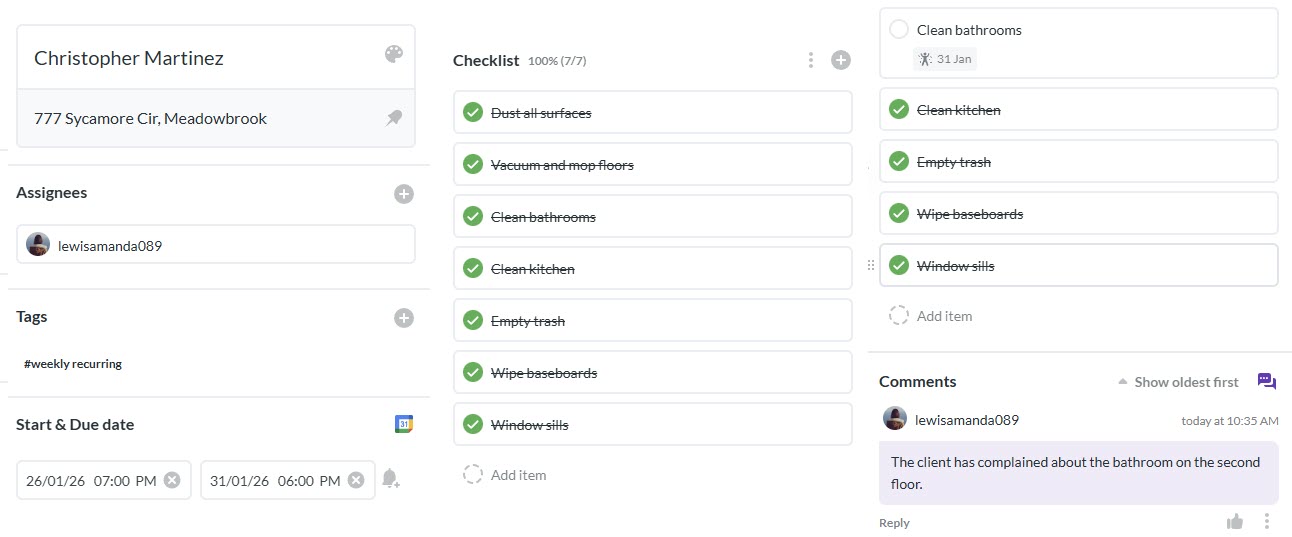
Drive crew accountability and eliminate rework by implementing the detailed digital quality checklists found in effective cleaning company work management tools
Equipment tracking prevents both operational disasters (equipment-less job arrivals) and efficiency problems (unnecessary duplicate equipment purchases). Companies working with specialized equipment particularly benefit from systematic tracking that prevents mid-job failures. Equipment maintenance scheduling deserves automation: preventative maintenance is more cost-effective and reliable than reactive repair.
5. Certification and Compliance Tracking Reduces Risk
Companies operating in regulated environments (healthcare, industrial) must track crew certifications. Automated alerts prevent unqualified crew dispatch while providing documentation for regulatory audits. The safety and liability benefits justify the tracking overhead.
6. Mobile App Adoption Drives Crew Adoption
All three case studies emphasized the importance of the Kanbanchi mobile app for crew adoption. Crew members rarely use web-based cleaning company project management tools. They need phone-based visibility of assignments. The mobile app proved critical to adoption. Crews adopted the system faster when they saw immediate personal benefits (clearer assignments, reduced text messages, better documentation) rather than abstract management improvements.
7. Administrative Burden Reduction Enables Growth
The most significant long-term benefit across all three companies was reduced administrative overhead. As companies scaled from 5 to 50+ employees, the old manual scheduling approach would have required hiring a full-time manager. Systematic process management enabled growth without proportional management expansion. Companies investing in operational systems can scale to 2-3x their current size with the same administrative resources.
Best Practices for Cleaning Companies Implementing Kanbanchi: Board Configuration Strategy
Start with simplicity: Don’t recreate complex corporate workflows. Cleaning services succeed with straightforward processes:
Job-type specific cards: Create card templates for different service types (recurring residential, one-time deep clean, commercial, specialized services). Standardized card formats ensure consistent information capture.
Quality checklist customization: Service-specific quality checklists are more effective than generic task lists. Residential deep clean and healthcare facility cleaning have completely different quality requirements.
Implementation Timeline Recommendations
Small companies (2-8 crew members): 2-4 week implementation focused on core scheduling and mobile app adoption
Medium companies (9-20 crew members): 4-8 week implementation, including quality control workflows and basic automation
Large companies (20+ crew members) with equipment tracking: 8-12 week implementation including equipment management, compliance tracking, and advanced reporting
Change Management and Adoption
Start with high-pain problems: Implement solutions to the most frustrating problems first. Pain-driven adoption is more effective than process-driven adoption.
Crew involvement in design: Let crews provide input on how workflows should be structured. They understand job realities better than management.
Early wins matter: Achieve quick scheduling improvements before introducing quality control or equipment tracking. Build momentum through visible early successes.
Mobile app first: Prioritize crew access through the mobile app before worrying about backend reporting and compliance documentation. Front-line adoption enables everything else.
Success Metrics to Track
Scheduling accuracy: Percent of jobs scheduled and completed on the intended date/time
Administrative burden: Hours spent weekly on scheduling, quality verification, and crew communication
Crew utilization: Actual hours worked per crew member, variation in daily assignments
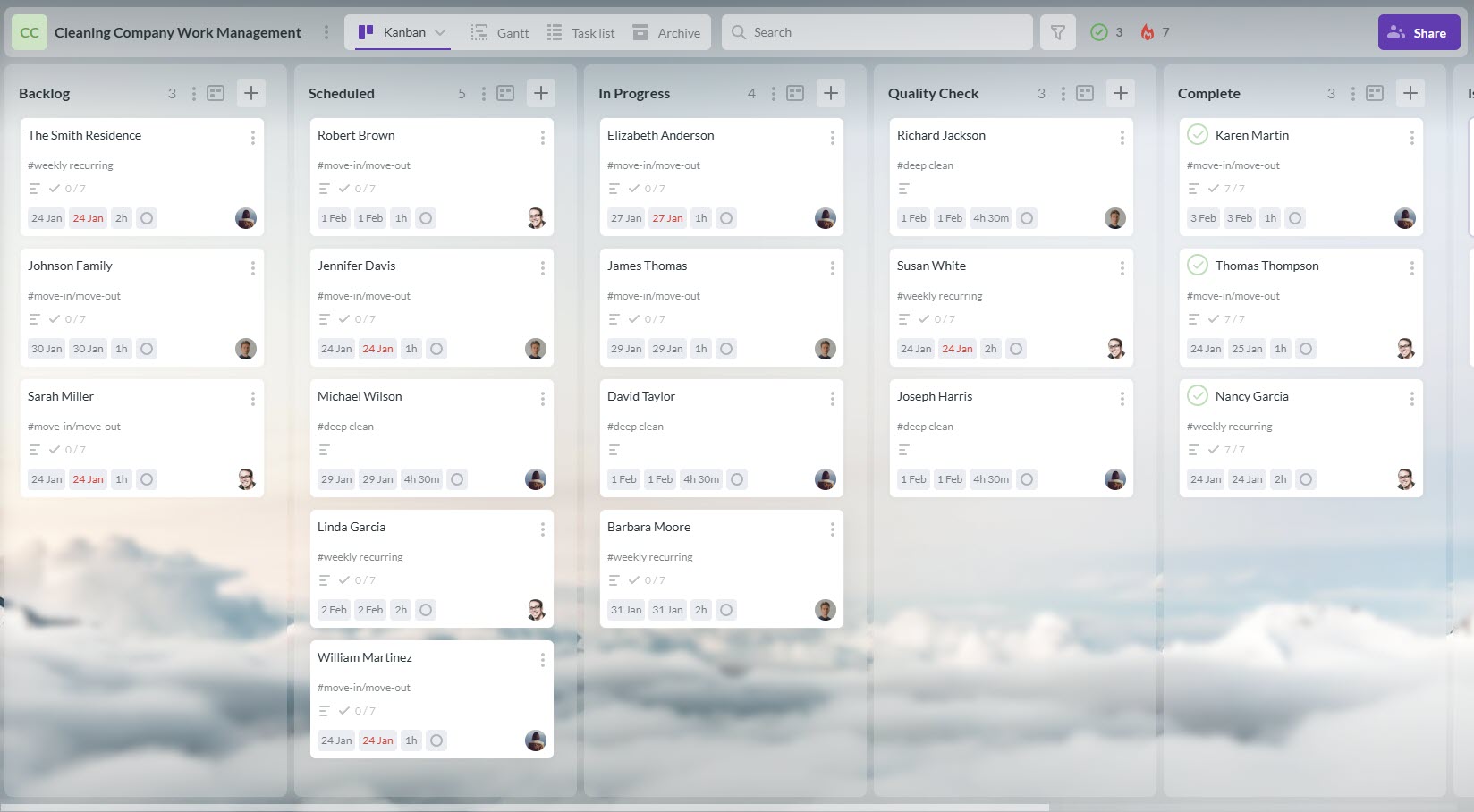
Ensure nothing falls through the cracks by using a visual cleaning company work management board to track daily appointments and crew assignments from start to finish
“The biggest fear when growing from 10 to 30 employees is maintaining quality and customer relationships. Many companies respond by hiring management, but that requires finding experienced managers and integrating them into operations. With Kanbanchi, we scale quality control systematically rather than depending on any single person’s attention to detail.”
“Our quality checklist ensures every job is verified before customer contact. New team members see documented quality standards immediately, not from training but from actually completing quality checklists on every job.”
On Client Communication Transformation:
“Previously, clients had legitimate complaints about vague arrival times. ‘Sometime between 8 and noon’ isn’t professional. Now, clients receive a confirmation with the specific crew name and estimated arrival within 15 minutes. That professionalism impacts retention and referrals more than most people realize.”
Sarah Mitchell, Owner, Fresh Start Residential
On Growth Without Adding Management:
“I started Fresh Start because I wanted to avoid corporate bureaucracy, but I was creating chaos instead. I kept thinking growth meant hiring a manager. Kanbanchi showed me that smart systems replace management overhead. I went from 12 people (my personal limit) to planning for 25 people with myself and Marcus handling operations.”
“The crew sees their schedule on their phone. If someone calls in sick, I can see who can cover. Quality is systematic instead of dependent on my spot-checking. That’s scalable. My current model can handle 25 people without me working 60-hour weeks.”
On Crew Perspective:
“Honestly, the crews like it. They know what jobs they’re doing, what time to show up, and what’s expected. No more ‘Why am I scheduled here?’ confusion. They get feedback on quality. Good performers see that and take pride in their work. Less professional crews know they’re being monitored.”
“One crew member asked why I wasn’t spot-checking anymore. She was proud of maintaining consistent quality. That’s the psychology you want. Professional standards replacing management micromanagement.”
Tom Schaffen, Owner, CH Clean Facilities
On Compliance and Safety Risk Management:
“For specialized services, compliance isn’t optional; it’s critical. Healthcare facilities audit our crew certifications. Before Kanbanchi, I’d scramble to prove who did what with what certifications. Now I can open the board to see every job, the assigned crew, their certifications on that date, and the client’s sign-off. It’s auditable and professional.”
“Equipment failures used to happen because maintenance was sporadic. With scheduled reminders and documented maintenance history, equipment lasts longer and fails less frequently. That’s pure risk reduction.”
On Equipment Investment Protection:
“We have $85,000 in equipment. If equipment isn’t properly tracked and maintained, that’s expensive waste. Systematic equipment management protects that investment. Crew members now confirm they have assigned equipment before leaving the facility. “Wait, where’s the pressure washer?” happens now at the office, not at the client site.”
Case Study Comparison Summary
Metric
Shine Bright* (Commercial)
Fresh Start (Residential)
CH Clean (Specialized)
Company Size
28 crew members
12 crew members
15 crew members
Active Clients
110+
180
45
Implementation Timeline
8 weeks
6 weeks
12 weeks
Primary Focus
Scheduling and quality
Crew communication and growth
Equipment and compliance
Missed Appointments
4-6 monthly → 0
N/A (less frequent)
N/A
Customer Satisfaction
7.2 → 8.8/10
6.9 → 8.3/10
6.8 → 8.6/10
Administrative Time Savings
70% reduction
80% reduction
40% reduction
Quality Complaint Rate
6.4% → 0.9%
6.7% → 1.1%
6.7% → 0.8%
Equipment Failures
N/A
N/A
1-2 monthly → 0
Crew Utilization Improvement
18%
8%
12%
Monthly Cost Savings
$5,360
$2,940
$6,260
Kanbanchi Monthly Cost
$159
$72
$90
Payback Period
<1 week
3 weeks
<1 week
Implementation Checklist for Cleaning Services
Pre-Implementation (Weeks 1-2)
Baseline metric establishment – Track current scheduling accuracy, quality complaint rate, administrative time, crew utilization
Current process documentation – Document exactly how schedules currently work, quality is managed, and equipment is tracked
Team readiness assessment – Identify which teams are most frustrated with current processes (start there first)
Hardware requirements – Ensure crew members have smartphones capable of using the mobile app
Google Workspace setup – Ensure all team members have Google accounts for authentication
Board Configuration (Weeks 3-4)
Core workflow columns – Define columns representing your actual job process (don’t overthink this initially)
Card template design – What information must every job card include? (Client, location, crew, time, contact info, special notes)
Monthly metric review – Compare current metrics to baseline. Are improvements measurable?
Quarterly optimization – Review workflows quarterly and refine based on experience
Continuous improvement – Encourage crew feedback on workflow improvements
Team expansion planning – Use documented processes and quality standards for new crew training
Benefits of Cleaning Company Project Management for Your Business
The cleaning services industry continues to grow as businesses and homeowners prioritize professional cleaning. Yet most companies still operate with outdated scheduling and quality management approaches that don’t scale beyond 15-20 employees.
Companies implementing modern operational systems gain sustainable competitive advantages:
Better customer experience through transparent scheduling and consistent quality
Improved employee satisfaction through clear expectations and professional standards
Operational efficiency that grows with your business without proportional management expansion
Data-driven decisions about crew performance, equipment needs, and business growth
The three cleaning companies featured in this case study transformed their operations with professional systems that they continue refining and expanding. Their success isn’t dependent on extraordinary circumstances. It’s based on systematic processes, clear visibility, and continuous improvement approaches that are available to any cleaning service company.
Getting Started with Kanbanchi for Your Cleaning Service: Next Steps
Week 1: Sign up for a free trial and create your core scheduling board with 10-15 of your most typical clients
Week 2: Invite your top crew members to test the mobile app and provide feedback onthe workflow
Week 3: Implement quality checklists for your primary service type
Week 4: Plan expansion to additional workflows (equipment tracking, compliance documentation, advanced reporting)
Cleaning service companies at every stage of growth, from 5-person startups to 50+ employee organizations, face the same fundamental operational challenges: coordinating crew schedules, maintaining quality standards, and managing client expectations. These challenges become exponentially more difficult without systematic processes and visible cleaning company project management.
Shine Bright’s* scheduling transformation, Fresh Start’s preparation for scaling, and CH Clean’s compliance and equipment management improvements demonstrate that professional operational systems aren’t reserved for large corporations. Cleaning service companies achieve remarkable results through relatively simple but systematic approaches to:
Visible scheduling that coordinates crew assignments, client locations, and equipment
Systematic quality control that prevents customer problems rather than reacting to complaints
Documented processes that scale with your business without requiring proportional management expansion
Crew accountability that drives professional standards and continuous improvement
The operational improvements achieved by these three cleaning companies:
from 18% to 80% administrative time reduction
0.8% to 6.4% customer complaint rates
andmonthly cost savings between $2,940 and $6,260
represent the transformation available to any cleaning service company willing to systematize its operations. Your business growth isn’t limited by the number of crews you can personally manage. It’s only limited by your operational systems’ ability to coordinate, track, and optimize their activities.
Frequently Asked Questions
How long does it take to see improvements after implementing Kanbanchi?
Cleaning companies typically observe initial improvements in scheduling accuracy and crew communication within 1-2 weeks. Measurable quality improvements and customer satisfaction gains appear within 4-6 weeks of consistent use. Long-term operational optimization continues for 3-6 months as teams refine workflows and integrate additional tracking.
Can Kanbanchi work for both residential and commercial cleaning?
Yes. Different board configurations support varying service types. Companies with both residential and commercial clients typically create separate boards for each service type, with one master scheduling board showing all services. Kanbanchi’s flexibility accommodates service-specific quality requirements while maintaining unified coordination.
How do we train crews on Kanbanchi if they’re not tech-savvy?
The mobile app’s simplicity (check phone for assignments, update job status, take photos of quality issues) minimizes training requirements. Most crews become productive after 15-20 minutes of hands-on practice. The learning curve is similar to using text messaging or simple phone apps that most people already use daily.
How does Kanbanchi improve customer satisfaction?
Improvements come from three primary areas: (1) Transparent scheduling with specific arrival times instead of vague time windows, (2) Faster response to client requests through systematic change management, and (3) Consistent service quality through systematic quality verification. Customer satisfaction improvements average 15-25% according to cleaning service implementations.
Can we integrate Kanbanchi with our booking or accounting systems?
Kanbanchi integrates directly with Google Workspace tools (Gmail, Google Drive, Google Calendar, Google Sheets). For other systems, you can export data from Kanbanchi to integrate with accounting software. Direct third-party integrations are limited compared to enterprise platforms, but Google Workspace integration covers most cleaning service needs.
How do we track profitability if we’re using Kanbanchi?
Kanbanchi tracks operational metrics (job completion, crew hours, quality) but does not directly track financial data. Export job and crew data to Google Sheets and connect to your accounting system for profit analysis. Many cleaning companies use Kanbanchi for operations and maintain separate accounting software for financial tracking.
What’s the best way to migrate existing schedule data to Kanbanchi?
Most cleaning companies benefit from starting fresh with Kanbanchi rather than migrating historical data. Historical schedules aren’t needed for future operations. Maintain your existing system in parallel for 2-3 weeks while testing Kanbanchi with new schedules, then transition completely once you’re confident in the new system. However, you can use the importing feature if you want to add historical data too.
How does Kanbanchi compare to other project management tools like Asana or Monday.com?
Kanbanchi’s primary advantage for cleaning services is its deep integration with Google Workspace, low cost for teams, and simplicity optimized for field-based teams. Generic project management tools are feature-rich but more complex and expensive. For cleaning companies, Kanbanchi’s simplicity and Google focus typically outweigh more complex alternatives’ additional features.
What security and privacy protections does Kanbanchi provide?
Data stored in Kanbanchi lives in your Google Drive, following the same security and privacy protocols as your other Google Workspace documents. This provides enterprise-grade security while maintaining familiar access controls and sharing permissions.
Can we customize Kanbanchi beyond the basic templates?
Yes. Kanbanchi is highly customizable for lists, card properties, and workflows. However, cleaning service implementations succeed by starting simple (don’t customize too much initially) and adding complexity gradually as teams become comfortable with the basics.
Growth hacking expert with over 10 years of experience with Kanbanchi
Olga wears multiple hats across marketing, sales, product, and ops after 10+ years in the SaaS world. She is passionate about helping teams streamline their workflows with Kanbanchi and Google Workspace or Microsoft 365. "When I'm not optimizing processes or writing guides, I'm probably tweaking our product roadmap or diving into the latest productivity tools".
There isn’t a specific corporate project management tool used across Etam. Every department is free to pick the solution that best suits their needs. Here’s the story of Serge Fraguas who has chosen Kanbanchi.
Hello Studios video production company always had a challenge to stay in creative mode and do administrative work simultaneously. Find out how Kanbanchi allows them to keep their brains free for creating.