
In this Article:
Try Kanbanchi now
Start your free trial

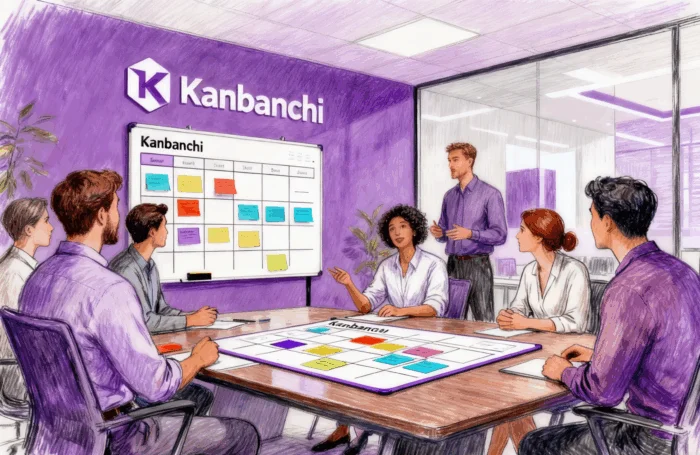
Strategic consulting firms face unique project management challenges that can undermine client satisfaction and profitability. The need for specialized consulting project management software has never been more critical. 82% of professional service firms name poor visibility into project progress as a significant pain point.
This case study examines how a huge consulting firm* transformed its engagement management by implementing Kanbanchi, achieving measurable improvements in deliverable completion rates, proposal turnaround times, and client satisfaction scores through systematic workflow optimization.
*This firm is one of the Big Four;
we can’t name them according to the signed NDA agreement.
The consulting firm profiled in this case study operates as a strategic business consultancy serving other companies across technology, healthcare, professional services, and many other sectors. The average individual team may comprise 25 to 300 consultants, including partners, senior consultants, analysts, and research specialists, who manage 15-100 concurrent client engagements at any given time.
Typical projects include market entry strategy development, operational efficiency assessments, digital transformation roadmaps, and organizational restructuring initiatives. Engagement durations range from 8-week rapid assessments to 12-month transformation programs requiring sustained cross-functional collaboration. The firm prides itself on data-driven recommendations backed by rigorous research and stakeholder engagement.
Project teams typically include 3-5 consultants per engagement, with partners overseeing multiple simultaneous projects while maintaining client relationships and business development activities. This multi-project management reality creates complexity that demands efficient coordination systems enabling consultants to context-switch between engagements without losing critical information.
The consulting firm’s client base expects sophisticated deliverables, including comprehensive reports, executive presentations, implementation roadmaps, and ongoing advisory support. Meeting these expectations while maintaining profitability requires streamlined internal workflows that minimize administrative burden and maximize billable time focused on client value creation.
Before implementing dedicated consulting project management software, firms struggle with scattered workflows that fragment client information across multiple disconnected tools. Scope creep emerges as the most common pitfall, occurring when clients add deliverables mid-project without adjusting timelines or budgets due to loosely defined goals. This challenge stems from inadequate documentation during kickoff phases and a lack of formal change processes for managing evolving client expectations.
Poor visibility into project progress creates situations where managers make decisions based on outdated information, leading to missed deadlines and unhappy clients. Without centralized dashboards, consulting teams juggling multiple engagements cannot spot issues before they escalate. Research indicates that 47% of project workers cannot track project KPIs in real-time, while 50% waste at least one day monthly manually compiling reports.
Ineffective stakeholder engagement undermines project success when key clients are not adequately involved from the outset. Maintaining open communication channels proves critical for preventing misunderstandings and keeping expectations aligned throughout engagement lifecycles.
Inadequate resource allocation across multiple concurrent client projects leads to consultant overload and burnout.
Disconnected tool ecosystems force teams to navigate patchwork systems of spreadsheets, task tools, and email that create silos and confusion. The resulting technology gaps prevent efficient collaboration and increase administrative overhead that should be focused on client value delivery. Consulting firms report that addressing these challenges through integrated platforms improves productivity by up to 50%.
The consulting firm evaluated multiple business consulting task management solutions over a six-month selection process that included demos, pilot testing, and stakeholder feedback sessions. Key evaluation criteria included ease of use, Google Workspace and Microsoft integration, collaboration features, reporting capabilities, and total cost of ownership. Kanbanchi’s Google Workspace integration, along with support for Microsoft 365 environments, proved to be a decisive factor, because the firm’s branches rely on different tools in their operations.
Partners particularly valued Kanbanchi’s hybrid Kanban-Gantt approach that allows teams to work in their preferred view while maintaining unified project data. Consultants managing day-to-day deliverables appreciated the visual Kanban boards for workflow management, while partners needed Gantt timelines for client reporting and resource planning. The one-click view switching capability addressed both needs without data duplication.
Template functionality provided immediate value by enabling the firm to create standardized engagement frameworks for different project types, including strategy assessments, operational reviews, and transformation initiatives. This standardization reduced project setup time from several hours to minutes while ensuring consistency across all client engagements. Evaluation team members noted that competitor tools either lacked template capabilities or required complex configuration.
The firm’s procurement team emphasized pricing transparency and scalability as critical selection factors. Kanbanchi’s straightforward per-user pricing without hidden fees for essential features aligned with the consultancy’s cost structure. The platform scaled effectively from small teams to enterprise deployments without requiring architectural changes or migrations to different product tiers.
The following table showcases potential features that were evaluated across various platforms before choosing Kanbanchi.
| Feature | Kanbanchi | Asana | Monday.com | Wrike |
|---|---|---|---|---|
| Client Portals | Via Shared Boards | Via Guest Access | ✓ | ✓ |
| Time Tracking | ✓ | Third-party | ✓ | ✓ |
| Budget & Billing | ✓ | Third-party | Third-party | Add-on |
| Google Workspace Integration | ✓ Native | Integration | Integration | Integration |
| Microsoft Integration | ✓ | Integration | Integration | Integration |
| Gantt Charts | ✓ | ✓ | ✓ | ✓ |
| Resource Management | ✓ | ✓ | ✓ | ✓ |
| Customizable Templates | ✓ | ✓ | ✓ | ✓ |
| Real-time Collaboration | ✓ | ✓ | ✓ | ✓ |
| Consulting-specific Templates | ✓ | ✓ | ✓ | ✓ |
The firm executed a structured four-phase Kanbanchi rollout over a year, beginning with a pilot team and progressively expanding to the entire organization through systematic training and support programs.
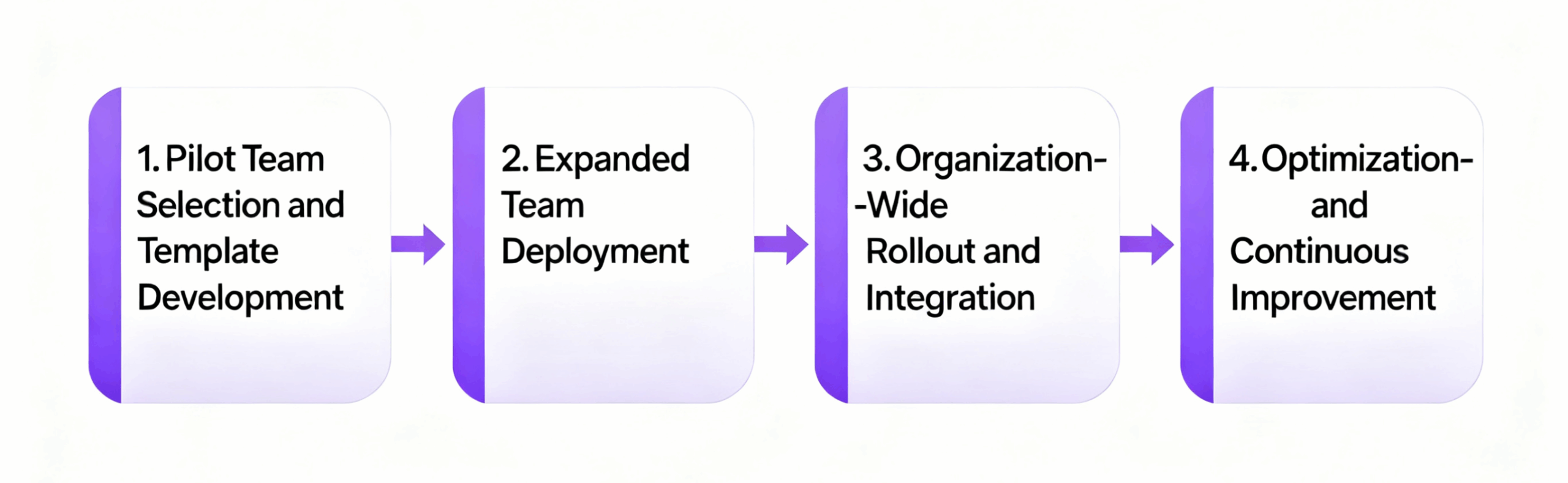
The pilot team worked with Kanbanchi support to create master templates for the firm’s most common engagement types, including strategy consulting, operational assessments, and change management projects. At this phase, each team within the company chose who would be pioneering Kanbanchi adoption. This phase was the longest, because we needed to produce standardized board structures with consistent list names, label systems, and card templates that would serve the entire organization. It took five months to develop it for each team. Depending on your company’s internal processes structure, it may take less (or more) time.
During this phase, additional consultants were invited onto the platform with structured training sessions covering board creation, card management, collaboration features, and reporting capabilities. Training emphasized practical application through real project scenarios rather than abstract feature demonstrations. Consultants appreciated hands-on exercises that demonstrated how Kanbanchi addressed their specific pain points around deliverable tracking and client communication. This phase took three months.
During the subsequent three months, we completed the transition by migrating all remaining consultants and administrative staff to Kanbanchi while establishing integration protocols with existing business systems. The firm configured Google Calendar synchronization for deadline management, Drive integration for proposal storage, and Gmail connectivity for task creation from client emails. This three-month phase included change management support, addressing adoption challenges, and workflow optimization.
Over the course of a month or so, minor changes were made to templates based on user feedback, establishing reporting standards, and implementing advanced features, including automation and time tracking. The consulting leadership team conducted review sessions to identify adoption barriers and success stories that could inform ongoing platform optimization. The structured approach achieved 95% user adoption within the 12-week implementation period while maintaining billable utilization rates above organizational targets.
Several specific Kanbanchi capabilities delivered immediate value for the consulting firm’s engagement management workflows, fundamentally changing how teams coordinate research, track deliverables, and communicate with clients.
Board-per-engagement organization provided dedicated workspaces for each client project, eliminating the confusion that arose from mixed-project task lists. Consultants could focus entirely on one client’s needs when working within that engagement’s board, reducing context-switching overhead by an estimated 35% compared to previous multi-project tracking systems. The firm established naming conventions, including client name, engagement type, and start date, to facilitate rapid board identification across the portfolio.
Timeline and Gantt chart views revolutionized client reporting and resource planning by providing visual project schedules that partners could share directly with stakeholders. The ability to switch from Kanban workflow views for daily task management to Gantt timelines for executive presentations eliminated manual reformatting work that previously consumed 3-4 hours per week per partner. Dependency tracking within Gantt charts enabled systematic management of sequential deliverables across multi-phase engagements.
Collaboration features, including card comments, @mentions, and file attachments, streamlined team coordination and reduced email volume by approximately 40%. Consultants can discuss research findings, review draft sections, and provide feedback directly within relevant cards, eliminating the need for separate email threads. Client-facing collaborators received controlled access to specific boards, enabling transparent progress tracking without exposing internal firm communications.
Time tracking integration enabled accurate capture of billable hours for proposal development, research activities, analysis work, and client meetings. The simple start/stop timer interface encouraged consistent tracking compliance, while detailed reports enabled financial analysis of engagement profitability and resource allocation patterns. Firms report that accurate time tracking prevents under-reporting costs and improves budget management.
Custom fields and labels enabled the firm to capture engagement-specific metadata, including client industry, service line, engagement stage, and priority level. This structured data enabled advanced reporting capabilities, providing leadership with portfolio-level visibility into resource distribution, revenue pipeline, and capacity planning needs across all concurrent engagements.
SIGN UP FOR A FREE TRIAL OF KANBANCHI
The consulting firm tracked comprehensive performance metrics before and after Kanbanchi implementation to quantify the platform’s business impact on engagement delivery and operational efficiency.
Deliverable completion rates improved from 78% on-time delivery pre-Kanbanchi to 94% post-implementation, representing a 20% improvement in client commitment fulfillment. This improvement stemmed from better visibility into task status, proactive identification of potential delays, and systematic escalation of blocking issues before they impacted client deliverables. The firm attributes this improvement to Kanbanchi’s visual workflow management and automated deadline reminders.
Proposal turnaround time decreased by 35% from an average of 6.2 days to 4.0 days for standard engagement proposals. Template-based proposal boards standardized the creation process while collaboration features streamlined partner review and approval workflows. Faster proposal delivery improved the firm’s competitive positioning in time-sensitive client procurement processes while reducing opportunity cost from delayed engagement starts.
Client satisfaction scores increased from 4.1 to 4.6 on a 5-point scale based on quarterly client surveys. Feedback specifically cited improved communication, better progress visibility, and more reliable delivery commitments as key satisfaction drivers. The transparency enabled by shared Kanbanchi boards built client trust and strengthened long-term relationships that generated repeat business and referrals.
Administrative overhead decreased by approximately 3 hours per consultant per month through the elimination of status report compilation, manual schedule coordination, and information searching across disconnected systems. This time savings directly translates to increased billable capacity without the need for additional hiring, thereby improving engagement, profitability, and consultant work-life balance.
Resource utilization optimization enabled the firm to increase average billable utilization from 68% to 76% through better visibility into consultant availability and workload distribution. Leadership could identify underutilized resources and proactively assign them to new engagements, while preventing overallocation that leads to burnout and quality degradation.
Direct feedback from consulting team members provides qualitative context for the quantitative improvements achieved through Kanbanchi implementation.
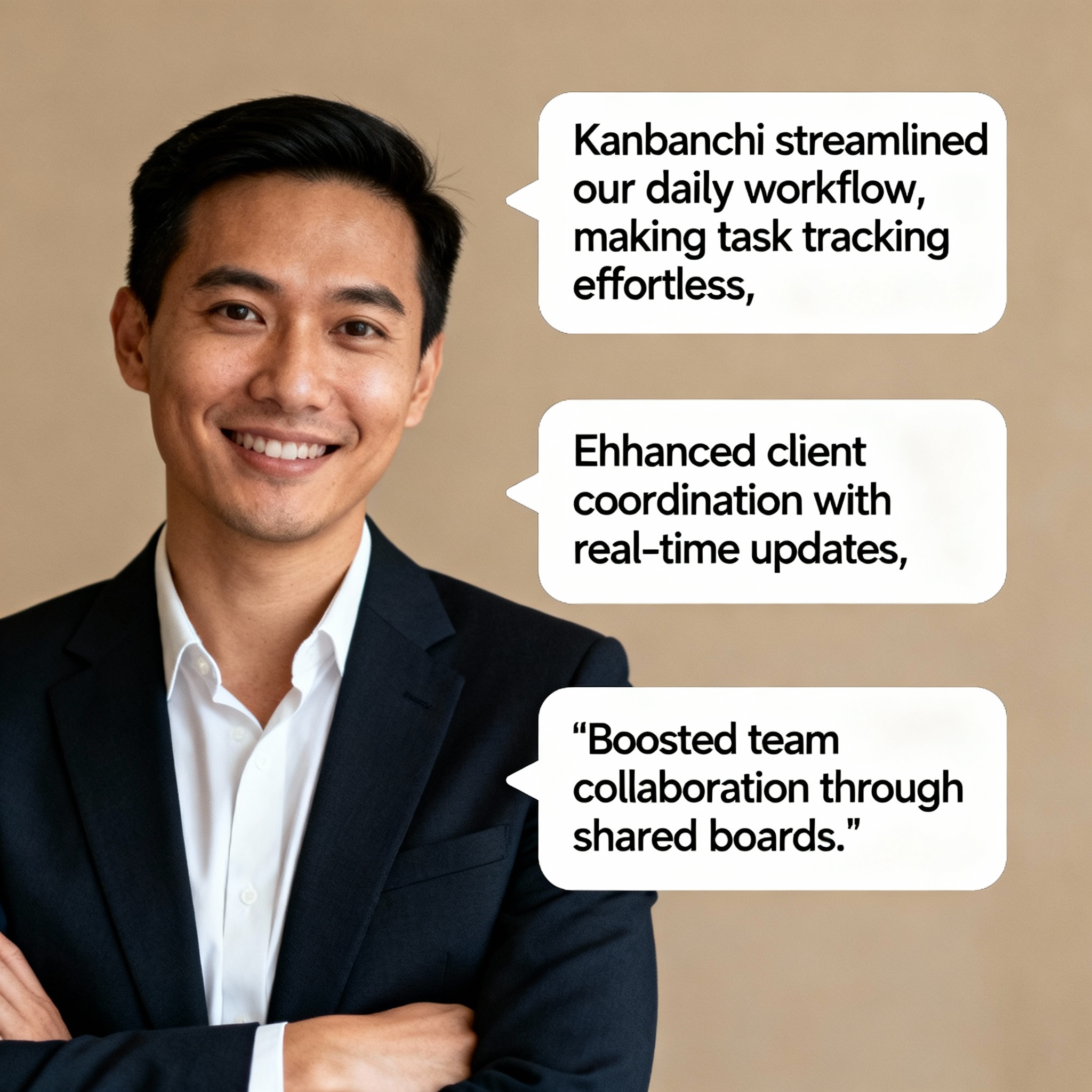
Senior Partner, Strategy Practice: “Kanbanchi transformed how we manage client relationships from chaotic juggling to systematic coordination. The ability to share boards directly with clients creates unprecedented transparency, strengthening trust and reducing the constant status update requests that used to consume my time. I can now oversee six concurrent engagements effectively, where I previously struggled with four.”
Principal Consultant, Operations: “The template system was a game-changer for our practice. We codified our proven engagement methodology into reusable boards, ensuring consistency across all projects and eliminating hours of administrative setup. New team members can start contributing immediately using our standardized frameworks rather than reinventing workflows for each engagement.”
Senior Analyst, Research: “Before Kanbanchi, I constantly lost track of research tasks across multiple client projects. The visual Kanban boards provide instant clarity about what needs attention, what’s blocked, and what’s complete. I’m more productive because I spend time doing actual research instead of trying to remember what I’m supposed to be working on.”
Engagement Manager, Change Management: “Client collaboration features completely changed our stakeholder management approach. Instead of emailing status updates and collecting feedback through disconnected channels, clients can see real-time progress and provide input directly within the project board. This transparency reduces anxiety and creates a partnership rather than a vendor-client dynamic.”
Partner, Healthcare Practice: “The financial impact is undeniable. Better project visibility and systematic workflows increased our team’s billable utilization by eight percentage points while simultaneously improving work quality and reducing consultant stress. Kanbanchi paid for itself within the first quarter through improved productivity alone.”
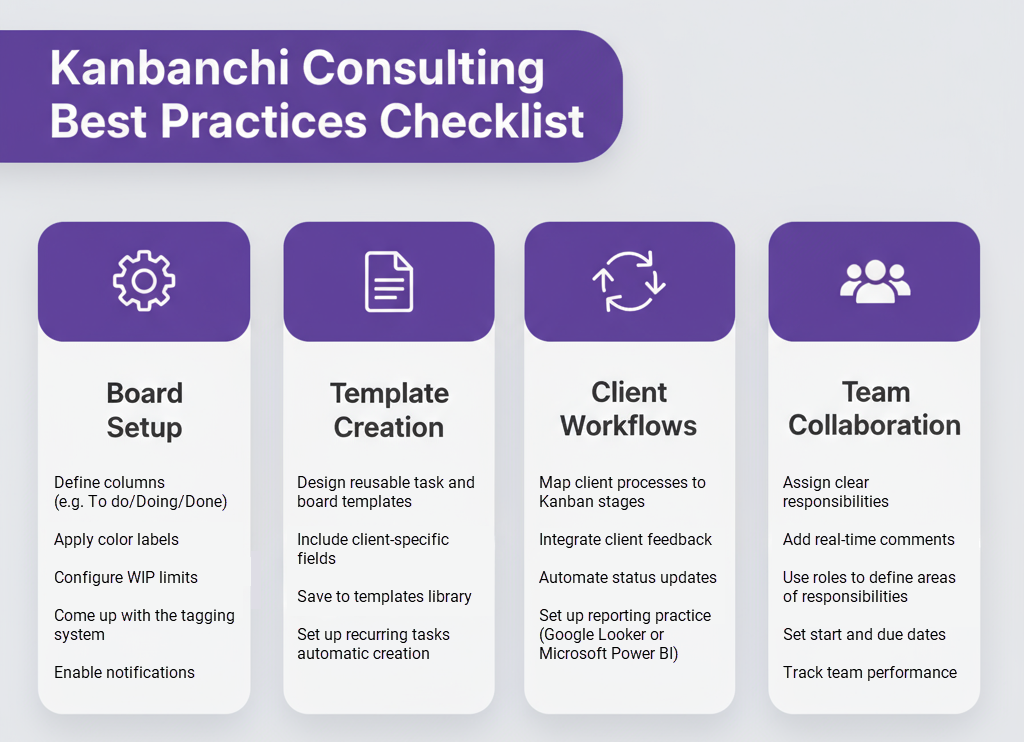
The consulting firm identified several implementation strategies that proved critical for achieving maximum value from Kanbanchi adoption.
This ensures consultants benefit immediately from standardized frameworks rather than building structures from scratch. The firm allocated a decent amount of pilot team time to perfecting engagement templates that captured proven methodologies, creating immediate productivity gains for all subsequent users.
This enables rapid information location across large project portfolios. The firm’s standardized naming system, including client abbreviations, engagement codes, and date stamps, allowed consultants to find relevant boards instantly without searching through dozens of similarly-named projects.
Proposal stages, deliverable types, stakeholder categories, and approval statuses. These specialized labels provided better visibility than generic project management categories, enabling consulting-specific reporting and filtering that aligned with how the firm actually operated.
It helps to incorporate learnings from completed engagements into standardized frameworks. The firm’s quarterly template review meetings ensure continuous improvement of engagement methodologies while maintaining consistency across active projects.
In this case, it was achieved by configuring calendar synchronization, Drive folder structures, and Gmail task creation. These integrations eliminated duplicate data entry and reduced friction between communication, documentation, and project management activities.
It helps consultants discover advanced features and optimization opportunities. The firm established quarterly “Kanbanchi power user” sessions where consultants shared workflow innovations and troubleshooting strategies.
Comprehensive financial analysis demonstrates clear return on investment from implementing consulting project management software like Kanbanchi.
Direct cost savings from reduced administrative overhead totaled approximately $1,270,000 annually for this consulting firm. Revenue enhancement through improved billable utilization generated roughly $2,850,000 in additional annual revenue. Client retention value from improved satisfaction scores contributed to an estimated long-term revenue protection of $4,500,000 based on historical client lifetime values and retention correlation analyses. The firm’s experience demonstrated that a 0.5-point improvement in satisfaction reduced client churn by approximately 12%, thereby preserving relationships that generate significant recurring revenue. Competitive advantage from faster proposal turnaround enabled the firm to win an estimated 3-4 additional engagements annually that would have gone to competitors in time-sensitive procurement situations.
The total annual benefit of approximately $11,820,000 against implementation costs of $5,632,500 (including software licenses, training, and deployment support) in the first year. Subsequent years maintain similar benefit levels while costs decrease to ongoing subscription fees and minimal administrative overhead.
Consulting firms seeking to replicate these outcomes can follow a systematic approach to Kanbanchi evaluation and implementation.
Start with a free trial to evaluate Kanbanchi’s capabilities using real consulting engagement scenarios rather than abstract test cases. Create boards for 2-3 active client projects, configure essential labels and workflows, and involve actual team members who will use the platform daily. This hands-on evaluation reveals how Kanbanchi addresses specific consulting pain points better than feature comparison charts or vendor demonstrations.
Identify pilot team champions who understand both consulting workflows and technology adoption to lead initial implementation efforts. These individuals should possess credibility with colleagues and a willingness to invest time in template development and peer training. Successful pilots typically run 3-4 weeks and involve 4-6 consultants managing diverse engagement types.
Define success metrics before implementation to enable objective assessment of Kanbanchi’s impact on engagement delivery and operational efficiency. Key metrics include deliverable on-time rates, proposal turnaround times, administrative overhead hours, billable utilization percentages, and client satisfaction scores. Baseline measurements before implementation provide comparison points for quantifying improvements.
Develop core templates that reflect proven engagement methodologies for the firm’s primary service offerings. Investment in template quality during pilot phases pays dividends through accelerated adoption and immediate productivity gains for all subsequent users. Templates should capture list structures, standard labels, card templates, and typical milestone sequences for each engagement type.
Plan structured training that emphasizes practical application over feature demonstrations, using real project scenarios that resonate with consulting workflows. Training effectiveness increases dramatically when consultants see immediate relevance to their daily challenges rather than generic project management concepts. Hands-on exercises building actual client boards during training sessions cement learning more effectively than passive presentations.
Monitor adoption metrics during rollout to identify struggling users who need additional support or workflow optimization. Early intervention prevents adoption failures that can undermine organization-wide implementation success. Weekly check-ins during the first month provide opportunities to address questions and share success stories that build momentum.
SIGN UP FOR A FREE TRIAL OF KANBANCHI
Most consultants achieve basic proficiency within 3-5 days of active use, with advanced feature mastery developing over 3-4 weeks. Teams familiar with Kanban methodology or previous project management tools adapt more quickly, while those new to structured workflows may require additional training. Proficiency timelines depend heavily on template quality and training effectiveness rather than inherent platform complexity.
Yes, Kanbanchi operates within Google Workspace’s security infrastructure, inheriting enterprise-grade encryption, authentication, and access controls. Consulting firms can configure board-level permissions to restrict sensitive engagement visibility to authorized team members while enabling broader organizational access to non-confidential projects. Additionally, Kanbanchi has undergone security certifications, such as SOC 2, ISO 27001, and is also GDPR compliant.
Kanbanchi provides comprehensive data export capabilities enabling firms to extract board contents, card details, comments, and attachments in CSV and other portable formats. This export functionality prevents vendor lock-in by ensuring consulting firms maintain control over engagement history and deliverable documentation regardless of platform decisions. Many firms maintain parallel exports during transition periods to new systems.
Yes, Kanbanchi architecture supports unlimited boards and users, enabling scaling from small teams to large consulting organizations without platform limitations. Firms report successful implementations ranging from 5-person boutique consultancies to divisions within global professional service firms. Performance remains consistent as project portfolios expand because the board-based structure distributes data rather than creating monolithic databases. This case study proves that Kanbanchi can scale up to thousands of users.
Kanbanchi provides video tutorials, recorded webinar trainings, and responsive support channels, including email and a dedicated account manager for large companies. Many consulting firms supplement these resources with internal training programs tailored to firm-specific templates and workflows. The platform’s intuitive interface reduces training requirements compared to complex enterprise project management systems.
Strategic consulting firms implementing dedicated consulting project management software like Kanbanchi achieve measurable improvements in engagement delivery, operational efficiency, and client satisfaction. The case study firm’s experience demonstrates that systematic workflow optimization through purpose-built tools delivers quantifiable ROI within months while fundamentally improving consultant work experience and client relationships.
The challenges facing consulting practices – scope creep, poor visibility, resource conflicts, and disconnected tools—require integrated solutions that address the unique characteristics of client engagement work. Generic project management platforms fail to accommodate consulting-specific needs, including billable time tracking, proposal workflows, stakeholder management, and multi-engagement coordination that define professional services delivery.
Ready to streamline your consulting engagements and achieve similar results?
START YOUR FREE KANBANCHI TRIAL TODAY
to experience how systematic engagement management transforms proposal development, deliverable tracking, and client coordination.
Discover why leading consulting firms choose Kanbanchi for project management that enhances rather than complicates the specialized workflows that drive professional services success. Transform scattered consulting chaos into coordinated excellence with proven consulting project management software designed for how consulting teams actually work.
P.S. Later, when the firm fully migrated from Google to the Microsoft environment, Kanbanchi proved to be a great support, because it already had the capability of supporting both platforms. Several thousand user within this company could migrate their data to boards in minutes.
You may also be interested in other Kanbanchi blog articles for business owners; check them out!



In this Article:
Start using Kanbanchi now
Start your free trial