
In this Article:
Try Kanbanchi now
Start your free trial


Current workplace statistics highlight that 91% of business organisations have faced challenges in successful project management. Modern firms, particularly SMEs, need a different approach.
Enter: MOCHA project management.
So, what is MOCHA project management? It’s a model of working that combines multiple roles to promote clarity and efficiency. The acronym stands for Manager, Owner, Consulted, Helper, and Approver.
MOCHA is becoming a natural successor to RACI (Responsible, Accountable, Consulted, Informed), another project management tool that helps clarify roles and responsibilities for tasks within a project by giving each person a title. The two are often compared, but MOCHA performs better in many situations.
RACI has limitations that MOCHA solves. MOCHA offers a more complete approach to delegating tasks, with the introduction of the Helper category, which provides a clearly defined rule that helps team members understand their primary responsibilities. It also adds an extra layer of certainty to decision-making and project sign-off with a dedicated Approver.
In this guide, we’ll explore the MOCHA framework project management and why every small-to-medium enterprise should use it.
MOCHA meaning project management is clear, but each letter represents a specific role involvement. MOCHA stands for:
The idea of MOCHA project management is to involve each role, collating different skillsets and enhancing the efficiency and quality of the work.
We define each role in greater depth below.
Within the MOCHA model for project management, the Manager controls the project’s entire life cycle, from inception to completion.
They need to be on hand to ensure that all project components are in place, delegated, and completed in a timely manner. They’ll also keep project stakeholders in the loop and forge clear channels for communication between everyone.
This team player is the person who drives the project forward. They’re required to assign tasks to the right people and steer work towards completion.
Ultimately, the success of the project relies on the Owner, who is considered to be in the driving seat when it comes to day-to-day decision-making.
The Consulted is another crucial cog in the wheel. While they’re not responsible for helping undertake any of the work, they’ll offer valuable insights, knowledge, and helpful perspectives to steer the project in the right direction.
Essentially, it’s like hiring someone in a senior industry role to offer their expertise in real-time.
Helpers are the worker bees of the MOCHA framework, and they’re the people who carry out all the specific components of the project. They each bring their individual expertise to the table and ‘own’ a chunk of the work.
For instance, you might have a project that requires creative input from a team of designers. A senior design lead would oversee everything as a Helper, and they’ll be in charge of everyone from copywriters to graphics specialists.
Lastly, the Approver has the authority to sign off on all the core components of the work project once it’s completed.
They’ll also assess the quality of the final product. Sometimes, they’re also a Manager or an Owner in the MOCHA process.
Now you understand the roles of each team player and who does what, but what are the key benefits of utilising the MOCHA project management framework for everyone?
How does MOCHA compare with other models like RACI? We’ll outline the similarities and differences and see how they match up.
Lack of specific roles in RACI: MOCHA has roles that are clearly defined. For instance, the Helper role supports the Owner. RACI lacks this, and this can again lead to confusion and a lack of clarity.
| Aspect | MOCHA | RACI |
|---|---|---|
| Clarity | ✔️ | ✔️ |
| Accountability | ✔️ | ✔️ |
| Opportunity to communicate | ✔️ | ✔️ |
| Improved decision-making | ✔️ | ✖️ |
| Clearly defined roles | ✔️ | ✖️ |
What are the key steps for implementing MOCHA for project management roles? You need to ensure that the project is broken down into manageable steps, with everyone having a defined role and an opportunity to review their work regularly.
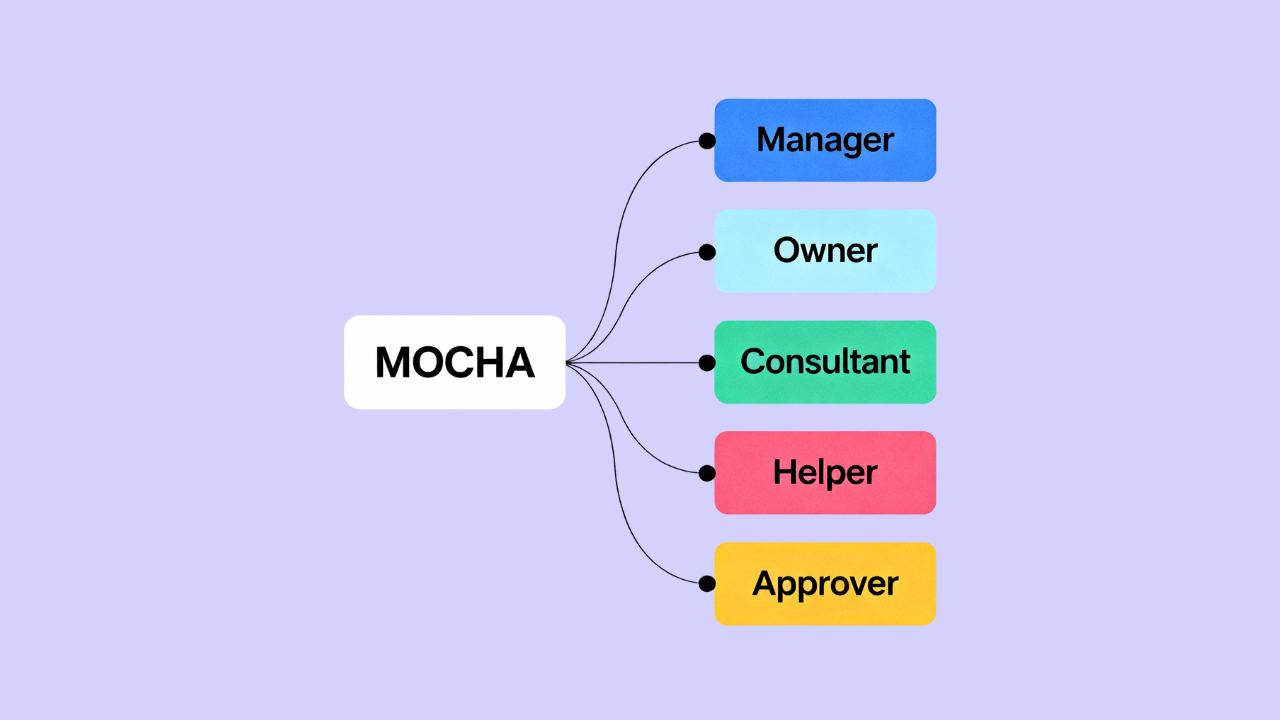
Visual representation of the MOCHA framework, illustrating how Manager, Owner, Consultant, Helper, and Approver collaborate within a project.
What’s the nature of your project? What do you want to achieve? The key is to think about core deliverables and how targets will be met.
Make a list of all the folks involved in the project, then map out how they’ll fit into the overarching framework. A great way of getting a handle on this is to take a look back at past tasks you’ve completed. See who did what, when, and how it might fit into the MOCHA project management plan.
We’re getting to the nitty-gritty of it, considering who does what, when and what the timeframe is. For instance, if you’re considering writing a blog to complement promotional work for the task, you’ll want to hire a copywriter. In this instance, the copywriter is the Helper, as they’ll do all the relevant research and writing for the Owner.
The best way to ensure the best practices for MOCHA project management is to use software such as Kanbanchi, Monday or Teamwork. They all offer a streamlined and consistent approach to project management and provide an excellent overview of all aspects of work and the people who need to be on board to help achieve success.
Implementing a new project management system? The best plan is to review it regularly. That way, you’ll be able to see that it’s performing as expected and meeting the team’s demands and workload.
So let’s put a MOCHA project management plan into action with an example of how it might work.
This MOCHA project management template idea can be adapted to suit your own specific task or plan.
Task: An SEO agency has been tasked with a website rebrand for a cosmetics company.
Manager: Kitty (CEO)
Owner: Manuel (Head of SEO operations)
Consulted: Christopher (SEO Consultant) and Pedro (Creative Design)
Helper: Paulina (Copywriter) Del (Graphic Designer) and Martine (Editor)
Approver: Kitty (CEO) and Manuel (Head of SEO operations)
Kitty the CEO, will oversee Manuel who is the Owner of the project.
It’s up to Manuel to delegate all the tasks to the Consulted team, which consists of Christopher and Pedro. They’re going to be responsible for deciding on the overarching themes of the creative work. This will then be carried out by the team of Helpers, Paulina, Del and Martine.
Now, there might be occasions when Manuel has to liaise with Christopher and Pedro if there are changes to the scope and nature of the writing and design work. They’ll communicate any changes to Paulina, Del, and Martine, who’ll carry them out.
The final draft of the work will be sent to the Approvers, Kitty, and Manuel for ultimate sign-off before it goes to the client for them to launch.
How can MOCHA be applied in various real-life workplace settings? It’s useful for a wide variety of industries, particularly those in the creative sectors or technology. We’ll look at a few different examples below.
A popular company wants to rebrand its merchandise with new logos and has approached a marketing company for help.
The Manager and Approver would be the Creative Director, with the Head of Design as Owner. Helpers would be the Graphic Designers and Junior Copywriters. They’d come up with the copy and designs, which would be sent to the Head of Design for comments, before the Creative Director signs it off.
A software development company has to tweak a new app they’ve recently brought to market, as they’ve had feedback from users that it’s buggy and lags when in use.
In this case, the Manager would be the Head of App Development, and the Helpers would be the Devs, Designers, and UX creators on the team. They’d work together to find a solution, implement it and then present their fixes to the Manager for their sign-off and Approval.
An organisation in this arena could use these techniques to get a small project, such as a social media campaign, off the ground.
You might have the Chief Executive as the Manager, the Head of Creatives as the Owner, and Helpers like the Designer and Copywriter working together on the core deliverables.
Using MOCHA in these different situations shows how everyone has their assigned role, knows where they stand, and avoids any confusion about who undertakes what.
Yes, they can. But in real terms, they shouldn’t be wherever possible, as this can lead to a work overload and create confusion in terms of responsibilities.
MOCHA’s ultimate aim is to try to stop the phenomenon of the one team member who wears too many hats and ends up burned out.
While MOCHA has more benefits than RACI, it’s not necessarily right to say MOCHA project management framework method is better.
These two formats have considerable overlap and are both popular. Work out which project management solution will work best for your team, depending on the projects you undertake.
When we define the MOCHA meaning project management, it’s not necessarily industry or company-specific.
Rather, it’s going to be used by teams undertaking projects who need to gain clarity on their roles and responsibilities.
The MOCHA project management framework offers an adaptable way to streamline effective ways of working when you’re in charge of a project that needs real clarity over roles and responsibilities.
It’s a method that lends itself well to open and honest communication within teams and one that’s easy to mould to a wide range of industries.
If you’re ready to transform the way your team works, then there’s never been a better time to invest in the software that can help you on the way to success.


In this Article:
Start using Kanbanchi now
Start your free trial