
In this Article:
Try Kanbanchi now
Start your free trial


Whatever type of project you’re managing, it’ll rely on two critical components: strong project management and robust project governance. At its core, project management is about doing the work right, whilst project governance is about doing the right work. A subtle but important difference. It’s the often overlooked framework that ensures your projects are:
We can ask two specific questions at this point:
So, governance provides the strategic oversight, decision-making authority, and accountability structure that guides a project from its start to its end. If we don’t have it, even the most talented project managers find their efforts go awry. Why? Because there’s no clear direction for anyone. Coupled with that, you’ll likely lose the trust of business leaders.
If it all sounds a bit complicated, don’t worry. Kanbanchi has put together a guide to demystify the topic. In it, we’ll explore:
We’ll also talk to you about how modern, intuitive project management tools can seamlessly integrate with your governance policies, turning abstract principles into actionable, trackable workflows. Ask yourself a few simple questions about your recent projects. Are they consistently offering value for money? Does everyone understand their role in decision-making? Let’s dive in and explain it all to you.
At its core, project governance is the overarching framework for the three ‘m’s.
It’s a skeleton that’ll provide shape and support. Ensuring the project aligns with organizational strategy and delivers what it’s supposed to. Think about it in terms of a car. If project management is the engine driving it, project governance is the steering wheel, the brakes, and the road map, ensuring the journey is on track and safe.
The Project Management Institute (PMI) defines project governance as the “framework that provides direction and oversight through the life of the project to achieve organizational strategic objectives.”
This distinction is crucial:
We reckon there are three pillars to it. Let’s have a look at them, now:
This defines the roles, responsibilities, and reporting lines. It establishes the hierarchy of decision-making bodies (e.g., a Steering Committee) and individuals (e.g., a Project Sponsor).
This identifies who makes the decisions, who’s responsible for specific actions, and who needs to be consulted or informed. It ensures the right people are involved at the right time.
This involves defining what data is reported, how often, and to whom. Clear, timely, and accurate information is vital for informed decision-making and transparency.
Without a clear governance framework, projects often suffer from:
Governance in project management isn’t about bureaucracy; it’s about reducing risk and optimizing resource allocation. To ensure that every project contributes meaningfully to the organization’s overarching objectives. It transforms uncertainty into clarity and chaos into significant progress.
Read more articles on Project Management here.
A robust project governance structure is the backbone of an organization’s project management. It provides the support and framework needed for effective decision-making, ensuring every project remains aligned with the right goals. The structure doesn’t rely on a single person, but a hierarchy of roles and committees, each with their own rules and regs. Let’s break it down a bit more:
Usually, this is a senior executive; the Project Sponsor is the individual accountable for a project’s success and alignment with business strategy. They are the mentor of the whole thing.
Role: To provide high-level direction, secure resources, remove organizational roadblocks, and act as the ultimate arbiter for major decisions that impact scope, budget, or timeline.
Key Responsibilities:
This group of senior stakeholders provides collective guidance and oversight for the project or portfolio. They ensure the project stays on track strategically, not just operationally.
Role: Provide strategic direction, review project performance against business objectives, manage cross-project tasks, and approve significant project phases or changes.
Key Responsibilities:
While not always present in every organization, a PMO plays a crucial role in establishing and enforcing project governance standards across multiple projects.
Role: Define project management methodologies, processes, and tools. Provide support, training, and guidance to Project Managers. Often responsible for portfolio-level reporting and ensuring consistent governance practices.
Key Responsibilities:
The Project Manager is at the heart of daily project execution and manages the team to deliver the project scope.
Role: Responsible for day-to-day planning, execution, monitoring, and control of the project. They manage tasks, schedules, budgets, and team communications, and escalate critical issues to the Project Sponsor or Steering Committee.
Key Responsibilities:
Taking this structured approach ensures:
Without this kind of hierarchy, project execution waters can quickly become muddied.
Clear governance only works when roles, decisions, and risks are translated into day-to-day execution. In practice, teams often rely on simple, well-known tools to make this happen. Responsibility models like RACI or MOCHA help remove ambiguity by clarifying who does the work, who owns the outcome, who must be consulted, and who provides final approval. This prevents decisions from stalling and ensures accountability is visible rather than assumed. Alongside role clarity, governance also depends on active oversight of risks and issues. Maintaining a RAID log—tracking risks, assumptions, issues, and dependencies—helps leaders spot problems early and address them before they escalate. Used consistently, these tools don’t add bureaucracy; they reinforce governance by aligning authority, accountability, and oversight with how projects actually operate.
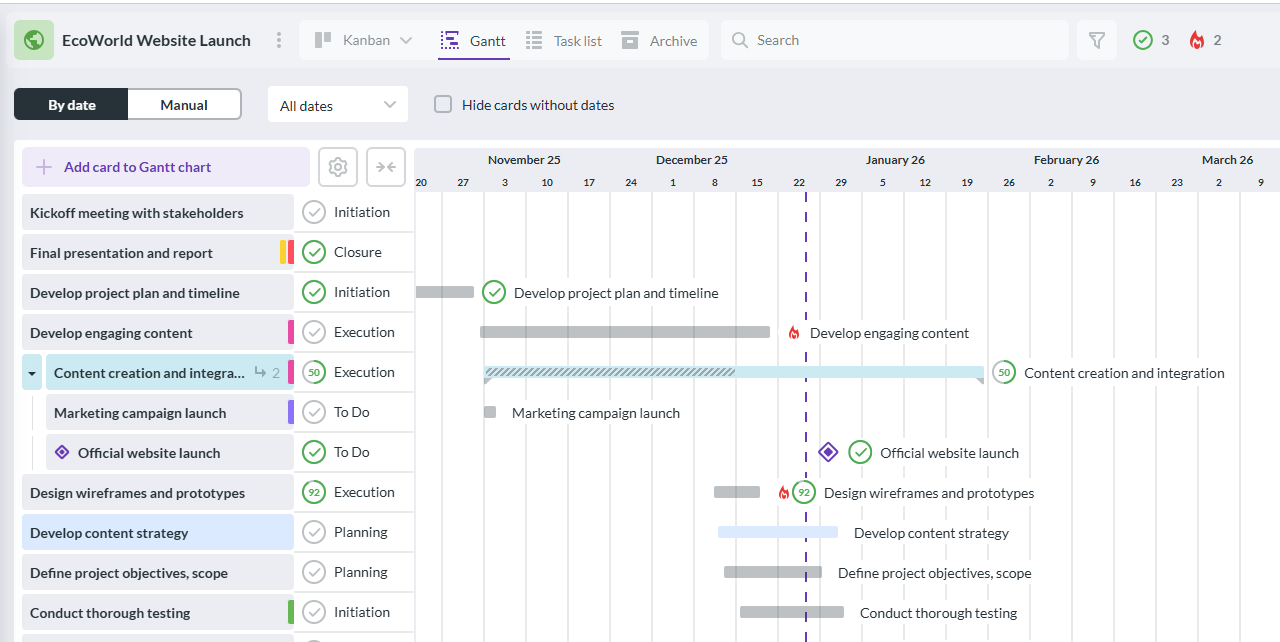
Visual example of a Kanban board supporting structured project governance and oversight.
The best project governance frameworks are only effective when implemented consistently and can be easily tracked. Otherwise, there’s little point in making the time investment. This is where digital tools become indispensable. A program like Kanbanchi provides an ideal platform to bridge the gap between theory and task execution in project governance. Basically, it’ll turn abstract roles into visible, actionable steps.
Visual boards clearly show who owns each task, how work is progressing, and where bottlenecks are forming. By assigning owners, setting due dates, and tracking status in one shared view, teams make accountability explicit.
Governance also requires confidence in timelines and dependencies. Kanbanchi’s Gantt view connects tasks to delivery milestones, helping leaders understand the impact of delays and make informed decisions before issues escalate. Time tracking adds another layer of oversight, giving managers insight into how effort is actually being spent and whether resources are aligned with priorities.
Consistency across projects is another governance challenge. Standardized boards and templates allow organizations to embed review steps, approvals, and compliance checks directly into workflows, ensuring governance practices are applied uniformly. Combined with built-in task history, comments, and document attachments, this creates a clear audit trail that supports transparency and informed decision-making.
Used well, Kanbanchi doesn’t add bureaucracy. It reinforces governance by aligning responsibility, progress tracking, and oversight with the way teams already work, making control clearer without slowing delivery.
Try Kanbanchi Today for project governance solutions that make a real difference
We’ll end our guide with some of the most commonly asked questions on this topic, so we’ve got all your bases covered. Don’t see what you need an answer to? Contact us, and we can help!
Project Governance is the strategic framework that provides oversight, direction, and high-level decision authority for the project.
Project Management is the operational discipline that focuses on executing the work (planning, scheduling, and managing resources) to deliver the project scope.
The Steering Committee typically comprises senior stakeholders, including department heads, key business-unit owners, and executives.
Their role is to represent the business’s interests, approve major changes, and ensure the project remains strategically aligned.
The Project Sponsor usually chairs the committee.
The level of governance should be proportional to the project’s size, risk, and complexity.
A small, internal, low-risk project might require only a Project Sponsor and a Project Manager.
A large, external, high-risk, multi-year project requires a full, multi-tiered governance structure, including a formal Steering Committee and rigorous reporting standards.
Kanbanchi supports governance by providing an essential layer of visualization and reporting. It enables teams to use custom fields to track RACI roles and decision ownership. Manage the RAID log (Risks, Issues) transparently.
The most crucial document is often the Project Charter (which defines the project’s purpose and initial scope) or the Governance Framework Document (which defines the roles, decision-making structure, and reporting frequency). Both ensure alignment before significant work begins.


In this Article:
Start using Kanbanchi now
Start your free trial