
In this Article:
Try Kanbanchi now
Start your free trial

There’s a fact that many SME owners these days don’t always consider. Global supply chains are no longer a set-it-and-forget-it model.
See, in the past, a supply chain manager’s primary goal was simple:
But the world has changed a lot in the last decade or so. We’re seeing:
…Coupled with the rising and rapid demands of e-commerce.
So, the old way of managing logistics, like relying on spreadsheets and fragmented email chains, is somewhat risky to say the least. Today, if you want to survive, you need more than just a supply chain. You need supply chain project management.
So let’s just take some time to think about it:
…is, at its core, a project.
They have a beginning, a middle, an end, and…a high risk of failure if not managed with precision.
This shift from continuous, smooth-running operations to project-based agility is exactly what separates the market leaders from those left waiting at the port.
This guide is designed to help you bridge that gap. We aren’t just talking about moving boxes; we are talking about moving fast.
Whether you’re already a brilliant supply chain project manager or an SME business looking for ways to update and refresh, this 2026 guide will show you how to apply professional project management principles to your logistics.
It’s time to stop waiting for the crises and get on with finding answers!
Are you ready to turn your supply chain into your greatest competitive advantage? We’re glad to hear it. Walk this way, and we’ll start our journey together.
Shall we talk finance for a second? OK, so it’s estimated that by 2030, the supply chain management software industry will reach a value of $22.9 billion. So, for one thing, it’s definitely not a flash in the pan.
But looking at it in terms of business processes, in the logistics world, the term ‘Just-in-Time’ was king for decades. But today? ‘Just-in-Case’ is the new reality for many SME leaders.
Applying project management in the supply chain isn’t just an administrative extra; it is a survival strategy.
Why? Well, without a project-based framework, your supply chain remains a series of disconnected features.
Everyone ends up confused! When you treat your supply chain through the lens of project management, you gain three critical superpowers:
In traditional management, you react when a shipment is late.
In project supply chain management, you identify that delay as a Risk during the planning phase.
You build Plan B before you even need it…
Managing clients shouldn’t feel like a game of chance, chasing them down or arranging meetings at every opportunity.
By using project management principles, you bring suppliers into your workflow.
They aren’t just names on an invoice; they are stakeholders in a shared timeline.
When your supply chain is managed as a project, every milestone is measurable. You stop guessing why lead times are increasing and start seeing the data points on your Gantt chart.
The transition from a linear chain to a dynamic project network is the biggest trend of 2026.
Look at it like this. If your competition is still using Project Management as a buzzword while you’re using it as a blueprint, you’ve already won the race.
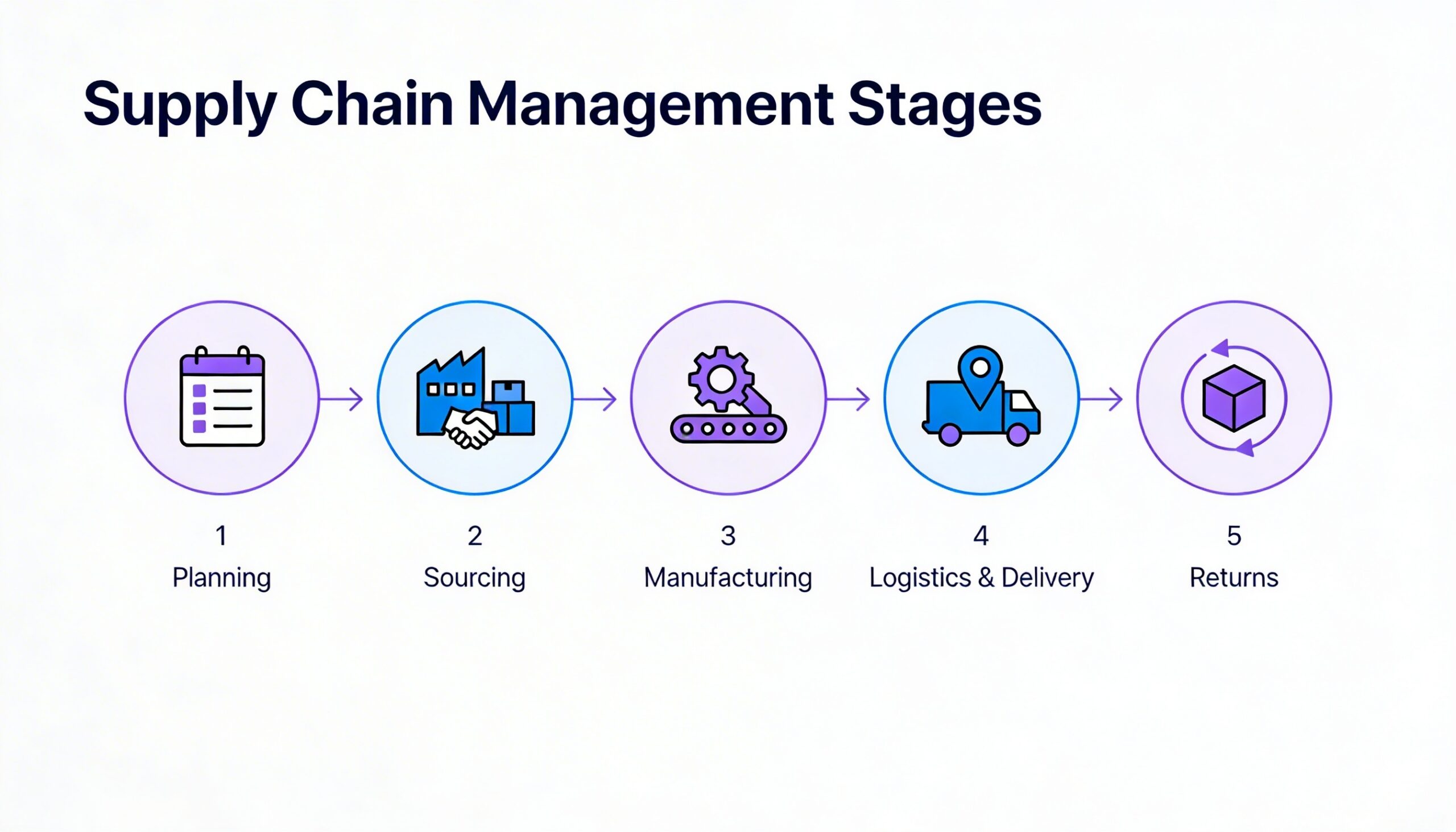
Visual guide to the five essential phases of a supply chain management project.
A successful supply chain management project isn’t a single event; it is a lifecycle. To manage the flow of goods from a raw state to a customer’s front door, you need a repeatable framework.
In 2026, the industry has standardized around five pivotal phases. Understanding these helps you move from firefighting to cool, calm collection in a few stages.
Everything starts with data. In this phase, the supply chain project manager focuses on demand forecasting.
Balance inventory levels so you aren’t sitting on dead stock nor losing sales due to stockouts.
Sourcing is more than just buying; it’s about partnership. This phase involves identifying, evaluating, and contracting with suppliers.
Diversify your supplier base so you’re not always relying on a single source.
Secure high-quality materials at competitive prices while ensuring ethical and sustainable standards.
This is where raw materials become finished goods. Whether you handle production in-house or via a partner, visibility is key.
Maximize throughput and minimize waste using Lean principles.
Once the product exists, it has to move. This phase encompasses warehousing, transportation, and final fulfillment.
Ensure the right product reaches the right customer at the right time, every time.
Often overlooked, Reverse Logistics is a critical component of supply chain management projects. A smooth return process builds customer trust.
Create a clear process for returning defective or unwanted goods.
Recoup value from returns while maintaining high customer satisfaction.
These stages are key, but what about common issues for these sorts of supply chain projects? How can those be dealt with?
If managing a supply chain were easy, everyone would have a perfect Amazon-like delivery record.
In reality, a supply chain project manager spends most of their time navigating a minefield of unpredictable variables. In 2026, this complexity has only intensified.
To succeed, you must move beyond the ‘if it ain’t broke, don’t fix it’ mindset. You need to identify four common hurdles before they turn into project-killing bottlenecks.
The #1 enemy of supply chain and project management is disconnected data.
When the procurement team lives in a spreadsheet, the warehouse works off a whiteboard, and logistics uses a standalone portal, visibility dies.
Net Result: You make decisions based on yesterday’s information, leading to costly overstocking or panicked last-minute orders that push your costs up further.
Whether it’s a sudden port closure due to labor disputes or a weather event disrupting a major shipping lane, business as usual is a thing of the past.
Your Challenge: How do you maintain a supply chain in project management when the literal ground is shifting beneath your feet? You need real-time contingency planning, not a static PDF plan that sits in a drawer.
Many projects fail because clients aren’t treated as team members. If your supplier is only reachable via sporadic emails, you lose the ability to pivot.
Your Solution: You need a shared software system, where the client (and everyone else) can see the timeline and update their status without a three-hour meeting.
Growth is great until your manual processes can’t keep up. As a supply chain management project grows from 100 SKUs to 10,000, the human effort required to track every moving part becomes unsustainable.
There’s a common theme across these challenges: A lack of a unified visual workspace. This is exactly where the right technology shifts from being an ‘it’d be nice to have that’ to a strategic necessity.
What can an SME do to keep on top of everything? We’ve got the solution.
Check out some of our real case studies
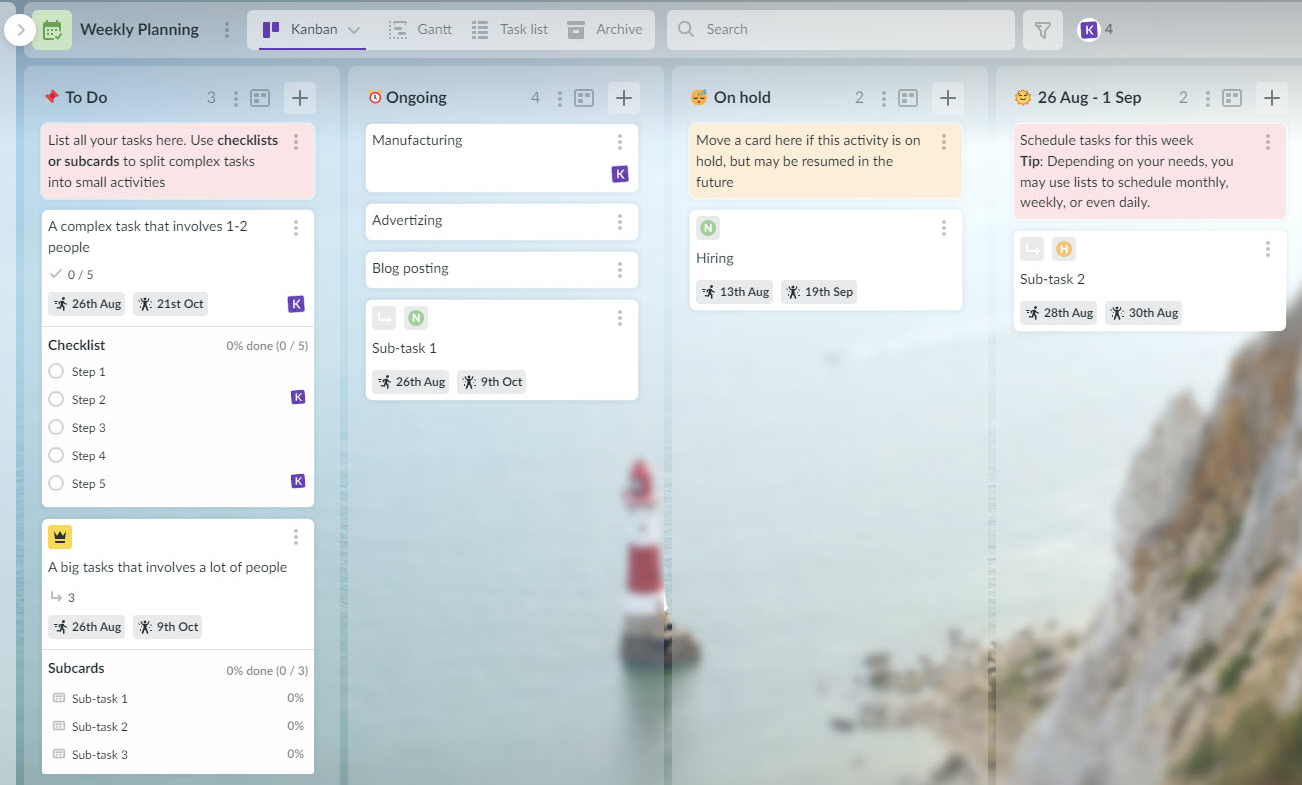
Example of a Kanbanchi project management board interface.
When you’re managing a global supply chain, you don’t have time to fight with your software. You need a tool that feels like a natural extension of your brain and your existing workspace.
If your team lives in Google Workspace, most project management tools feel like islands. You have to
Kanbanchi changes that. It is the only professional-grade project management solution built natively for the Google ecosystem.
Kanbanchi doesn’t just integrate with Google; it lives there.
So, what can it do? Well…
Supply chains are complex, but your dashboard shouldn’t be.
Kanbanchi offers two powerhouse views that are essential for any supply chain management project:
Visualize your procurement or onboarding process. See exactly where a shipment is, whether it’s
…by simply glancing at the board.
Switch to the Gantt view to see the big picture. Plan your entire yearly supply schedule, set dependencies (e.g., We can’t start manufacturing until the raw materials arrive), and identify your critical path.
Kanbanchi turns the chaos of project management in the supply chain into a structured, visual, and highly collaborative workflow. It’s the bridge between a static spreadsheet and a world-class operation. Let’s take a look at how this might work.
Start your free trial with Kanbanchi now
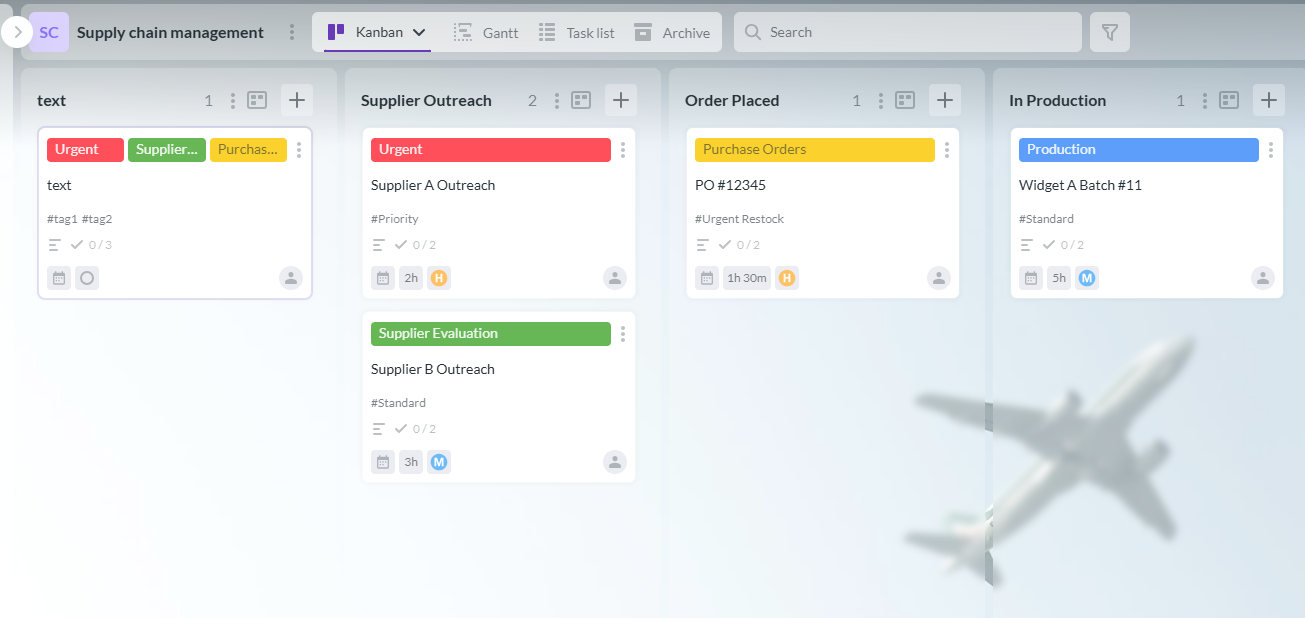
Visual representation of a supply chain project management board.
Setting up a supply chain management project in Kanbanchi is about moving from nebulous ideas to a real time operation.
Because it integrates natively with Google Workspace, you don’t need to rebuild your data; you just need to visualize it.
Here is how to build your supply chain command center in four simple steps:
Don’t settle for To Do and Done. Your columns should reflect the actual physical movement of your goods.
Your Setup: Create columns for Supplier Outreach, Order Placed, In Production, In Transit, and Received/QC.
Anyone looking at the board should instantly know the status of any SKU or purchase order without asking a single question.
Each card in Kanbanchi represents a specific work item, be it a client onboarding request or a container shipment.
Your Task: Populate cards with essential metadata: due dates, tags (e.g., Urgent Restock), and weight/quantity info.
Attach the specific Bill of Lading (BoL) or invoice directly from Google Drive to the card so the logistics team has the paperwork they need immediately.
If you are managing multiple product lines or geographic regions, a single list of cards will quickly become messy.
Your Setup: Use Swimlanes to categorize your board horizontally. You can have one lane for Domestic Suppliers and another for International Logistics.
This provides a real-time view, allowing you to see both the project stage (columns) and the work category (lanes) simultaneously.
A supply chain is only as fast as its slowest link. If your Quality Check column is overflowing with 50 cards, adding more orders won’t help.
Your Task: Use Work-in-Progress (WIP) Limits to cap the number of cards allowed in a column.
This forces the team to resolve existing delays before pulling in new work, ensuring a steady, predictable flow.
The best supply chain project management tool for 2026 is one that can bring everyone together with a shared purpose and perspective. No matter what department your team member belongs to, they’ll be able to instantly access all the information they need and understand it. With the click of a mouse.
Start your free trial with Kanbanchi now
Here are just a few of the most frequently asked questions about supply chain management software. If you’ve got anything else you’d like to ask about what Kanbanchi can offer, get in touch with us.
Traditional supply chain management focuses on the continuous, repetitive flow of goods and services.
Project management in supply chain, however, focuses on specific, time-bound initiatives, such as launching a new product line, onboarding a complex international vendor, or digitizing a warehouse.
One is about the status quo; the other is about strategic change.
For team-level execution and visual coordination, Kanbanchi is the preferred choice for Google Workspace users.
Other popular agile tools include Jira (for technical workflows) and Monday.com (for general task tracking).
The secret is contingency mapping. Use project management software to build if-then scenarios.
If a primary port closes, your project board should already have a pre-vetted secondary logistics partner ready.
Diversifying your supplier base and maintaining buffer stock are no longer just ideas – they are tasks that should be tracked and assigned on your board.
Beyond logistical expertise, you need:


In this Article:
Start using Kanbanchi now
Start your free trial