-  views

Signs of Micromanagement: How to Recognize it and Rebuild Trust on Your Team

Try Kanbanchi now

Start your free trial

 

Team manager leading an engaged meeting with five colleagues around a conference table with laptops and notebooks

Micromanagement not only slows work down, but it also teaches people not to trust their manager’s judgment and their own, too. When a team starts second-guessing every move, even the manager’s good intentions can feel controlling, and trust begins to erode.

This article shows how team management differs from micromanagement in practice, then outlines the exact shifts that rebuild trust without giving up accountability. It is built for team managers who need clear, repeatable behaviors across small business teams, enterprise groups, remote teams, and project-based environments.

Where Team Management Becomes Micromanagement

Healthy team management sets direction, then gets out of the way. Micromanagement steps in when trust starts to crack, and control rushes in to fill the gap. It often comes from anxiety, not evil intent, but the impact on the team is the same regardless of the intention behind it.

It is also worth saying: some people are more naturally inclined toward micromanaging than others. It is partly a personality type. Delegators tend to feel comfortable with ambiguity and trust that the outcome will be handled. Controllers feel comfortable only when they can see every step. Neither is a character flaw, but if you lean toward control, the habits in this article will require more active effort to build. That is fine. Knowing which type you are is already half the work.

1. Trust Signals That Are Breaking Down

You know trust is slipping when you notice:

  • You assume delays mean people are slacking, not blocked
  • You feel uneasy unless you see progress every few hours
  • You redo work “to be safe” instead of coaching people
  • You focus on how people work, not what outcomes they deliver
  • You quietly believe “no one can do this as well as I can”
  • You find yourself asking for updates when you could look at the project board

Research on micromanagement as a trust issue links it to doubts about a team’s consistency, credibility, or competence. When one of those feels shaky, managers grab the wheel. If you do not trust how work is tracked, you will try to control how work is done.

2. What Micromanagement Looks Like in Real Teams

This is where normal management crosses the line:

  • Startups. Daily standups turn into 45-minute sessions. The manager changes priorities three times a day and asks to be cc’d on every client email. People stop taking initiative and wait for the next ping.
  • Enterprises. A project manager demands status updates in three tools plus email. They rewrite slide decks at midnight instead of fixing the brief. The team spends more time reporting than producing.
  • Remote teams. A manager pings people constantly to ask “where are you on this?”, not because the deadline is at risk, but because they cannot see the progress. The team starts padding estimates to buy themselves a buffer from the next check-in.
  • Schools and universities. Department heads insist on approving every lesson tweak. Teachers stop trying new formats because they expect pushback on every small change.

Notice the pattern: work still gets done, but autonomy drops, risk-taking dies, and progress depends entirely on the manager’s attention span.

How to Stop Micromanaging Without Losing Accountability

You want work done right without breathing down everyone’s neck. That balance is the whole game.

Micromanagement usually comes from fear: fear of missed details, missed deadlines, or your own boss. The fix is not to care less. It is to redesign how you set goals, track progress, and share decisions, so accountability lives in the system, not in your Slack pings.

If you can make the three shifts below, you will keep high standards and give your team real room to work.

1. Set Outcome-Based Goals Instead of Task-by-Task Control

Stop telling people how to do the work. Tell them what a win looks like.

Outcome-based goals should answer:

  • What result must exist by the deadline?
  • How will we measure it?
  • Why does it matter?

Use simple language. “Increase qualified demo requests by 15 percent this quarter” is clear. “Push harder on marketing” is not.

Then let the team design their own tasks. You give feedback on the plan, not on every keystroke. A tool like Kanbanchi helps here: set the outcome as the top-level card, then let the team break it into subtasks themselves.
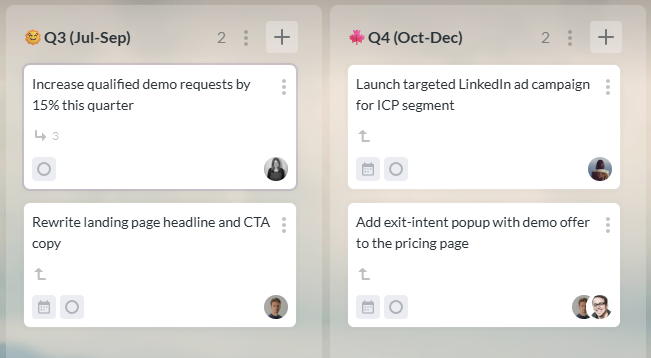
Kanbanchi board showing a top-level outcome card with subtasks broken down by quarter
A Kanbanchi board screenshot with two columns organized by quarter, showing an outcome-based parent card and team-designed subtasks assigned to individual owners

Your job is to check that their plan still leads to the goal, not to rewrite the plan every day. If you want to micromanage less, move your energy from task lists into outcome clarity.

2. Replace Constant Checking With Predictable Check-ins

Micromanagement feels like this: random pings, surprise calls, “quick” edits that take an hour. Swap that for a simple rhythm:

  • One weekly team check-in
  • One short 1:1 for anyone on critical work
  • Async updates in between

You want people to think “I will share this at Thursday’s check-in”, not “they might message me any minute.” But I also want to add that, even if you get the message, you can build a culture where an employee feels safe responding within the set timeframe. Read one of my recent thoughts on async communication standardization and task trends if you want to learn more.

Keep check-ins tight with a basic template:

  • What have you finished since the last time?
  • What are you doing next?
  • Any risks or blockers?

Leadership advice for breaking micromanagement habits is to set clear goals and schedule regular, planned check-ins instead of constant monitoring.

At Kanbanchi, this is literally how we work. If something is not clear from looking at the board, a quick message asking someone to update their card is usually all it takes. The information needs to be up to date. That single habit of keeping cards up to date removes most of the anxiety that drives micromanagement in the first place.

In practice, you can use a Kanban board as a live meeting agenda, filter by “Due this week”, and add comments instead of side-channel DMs. That keeps accountability visible but not suffocating. If you keep interrupting work to “get an update”, you are causing the very delays that scare you.

3. Use Decision Boundaries to Protect Autonomy

You do not need to approve everything. You do need guardrails. Decision boundaries answer three questions:

  • What can people decide on their own?
  • What must they consult you on?
  • What needs your final approval?

For example:

  • Full autonomy: Email copy, ticket responses under XXX dollars, design details within brand rules
  • Consult first: Discounts over XX percent, changes to scope, public statements
  • Approval required: Budget changes, legal risk, strategy shifts

Write this down, even if it is a simple one-page document. Then, when someone asks, “Do you need to review this?”, you point to the rules instead of pulling the decision back to yourself.

In Kanbanchi, for example, you can tag cards by decision type or create a separate list for the tasks that need review. That way, you see where your input is actually needed and stop clogging everything else. If every card needs your review, you do not have high standards. You have a trust problem.
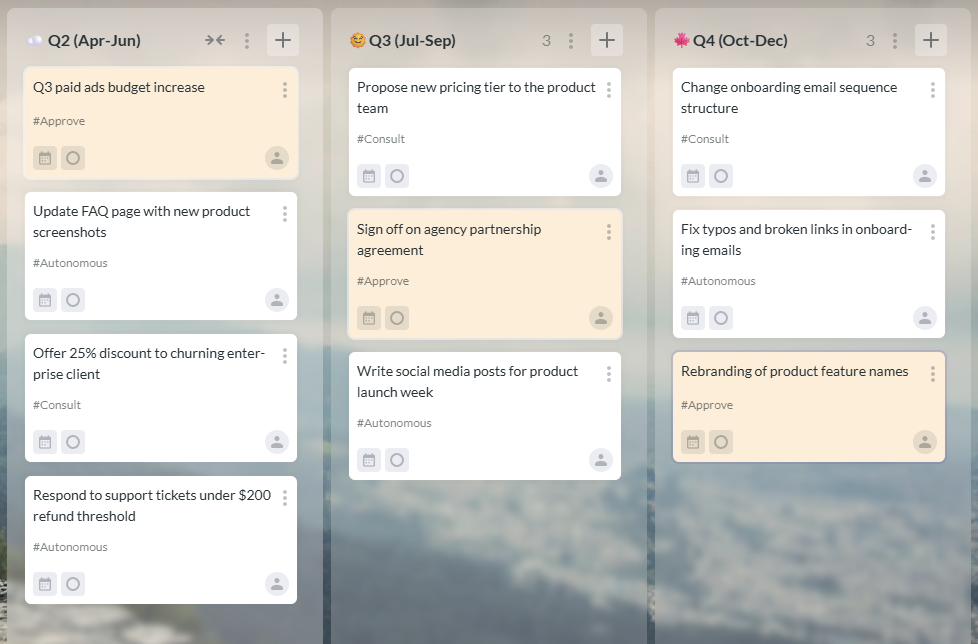
Kanbanchi board showing task cards tagged by decision type: Autonomous, Consult, and Approve, with approval cards highlighted in color
Kanbanchi example: each card is tagged by the decision type, and approval-required cards are also color-coded so they stand out immediately. At a glance, you see exactly where your input is needed and where it is not.

Start free trial of Kanbanchi today

Rebuild Trust With a Consistent Management Rhythm

Micromanagement is what you do when you do not trust the system. So fix the system first.

A simple rhythm beats random check-ins every time. Predictable communication and clear ownership rebuild confidence faster than one-off gestures, because people know when and how updates will happen instead of guessing every day.

1. Use Transparency to Reduce Suspicion

Set a weekly team check-in with a standard agenda and a shared dashboard that everyone can see before the meeting starts. Review priorities for the week, what has moved since last time, and blockers with named owners.

Keep the project board as the single source of truth. If it is not on the board, it is not a priority. This one rule removes a surprising amount of managerial anxiety, because you can check the board yourself at any time instead of pinging someone.

2. Make Room for Judgment and Ownership

Stop using meetings to ask “What are you doing right now?” Use them instead to confirm outcomes, ask about trade-offs the person is navigating, and let the owner choose their own approach.

The manager provides the goal and the guardrails. The team member chooses the path. That distinction sounds simple, but it changes the entire dynamic of a check-in.

3. Name It When You Slip

Even managers who are naturally inclined toward delegation will have tough moments: a high-pressure quarter, a new hire they are unsure about, a client breathing down their neck. The urge to control creeps back in. When that happens, name it. In a retrospective, in a 1:1, or even in a quick message.

I think I have been too deep in the weeds on this one. I am going to step back.

That kind of honesty lands harder than any policy document. It tells your team that you are aware, that you are working on it, and that their autonomy is not an accident, but a deliberate choice.

4. Make Work Visible So You Do Not Have to Ask

Much of what drives micromanagement is invisible work. When you cannot see what is happening, the brain fills the gap with worst-case assumptions. The simplest fix is a shared board where tasks, owners, due dates, and blockers are always up to date.

When work is visible, the need to hover drops significantly. You stop asking because you already know. And when you do need to ask, because something is unclear or a deadline is at risk, it is a specific, useful question rather than a general check-in that feels like surveillance.

Practical Examples

1. A team member keeps missing small deadlines

Before reaching for a daily check-in, ask whether it is a clarity, capacity, or skill issue. Missing deadlines is a symptom, not the cause. Have one direct conversation, agree on a realistic timeline, make the deadline visible on the board, and check back on the due date, not every day in between.

2. You inherited a team that was previously micromanaged

Expect some friction. Teams that have been over-controlled often stop making decisions independently. It is not because they can’t, but because they have learned that initiative gets overruled anyway. Rebuild slowly: return small decisions to individuals publicly, resist the urge to weigh in unless asked, and be explicit that you want them to own their work.

3. You are under pressure from above to show results

This is the most common trigger for micromanagement. The anxiety flows downhill. The practical fix is to make your team’s progress visible upward: a shared board, a weekly summary, a dashboard your own manager can access. You will stop being the only channel of information. When your manager can see results directly, you no longer need to extract them from your team.

4. A remote team where you cannot see who is working

Stop trying to see who is working. Start tracking whether work is moving. A card that was “In Progress” last week and is still “In Progress” with no comment is a signal worth a message. A card that moved to “Done” tells you everything you need to know.

Also, check out: How to Effectively Manage Remote Employees

Frequently Asked Questions

How do I know if I am micromanaging instead of managing?

Watch for these signals: people wait for your approval before moving, hide mistakes, or stop proposing ideas. You rewrite work instead of coaching. You are making decisions that your team should be making. If you vanished for a week and progress would stall completely, not because of a genuine dependency, but because people would not know what to do without your input, you are probably micromanaging.

My team seems to want more guidance, not less. How do I tell the difference between micromanaging and just supporting people who need structure?

The difference is who initiates. If your team is coming to you with questions because expectations are unclear, that is a clarity problem. Fix the goal, not the check-in frequency. If you are the one initiating oversight because you cannot let go of the outcome, that is micromanagement. Support looks like answering questions and removing blockers. Micromanagement looks like asking questions and creating bottlenecks.

I used to micromanage, and I want to change. Where do I start?

Start with one visible change, not a full reset. Pick one project and explicitly hand over a decision that you would normally make yourself. Tell the person directly: “This is yours to decide. I want your recommendation, not my approval.” Then follow through and do not reverse the decision afterward. One kept promise of autonomy is worth more than ten conversations about trust.

Conclusion and the First Step

Trust comes back when you manage, not chase. The signs of micromanagement are worth knowing about, not to judge yourself harshly, but to catch the pattern early, before it settles into the culture. Team management protects ownership. Micromanagement drains it.

Rebuild with clear goals, predictable rhythms, and real decision rights. Make work visible so you do not have to ask. Change the repeated behaviors first. The trust will follow.

Kanbanchi helps remote and in-office teams keep work visible without the overhead of constant check-ins. Your first step could be to try it with your team.


Try Kanbanchi today

    MultipleAuthors\Classes\Objects\Author Object
    (
        [term_id] => 973
        [term:MultipleAuthors\Classes\Objects\Author:private] => 
        [metaCache:MultipleAuthors\Classes\Objects\Author:private] => Array
            (
                [user_email] => olga.alekseeva@kanbanchi.com
                [user_id] => 20
                [first_name] => Olga Alekseeva
                [last_name] => 
                [job_title] => Growth hacking expert with over 10 years of experience with Kanbanchi
                [description] => Olga wears multiple hats across marketing, sales, product, and ops after 10+ years in the SaaS world. She is passionate about helping teams streamline their workflows with Kanbanchi and Google Workspace or Microsoft 365. "When I'm not optimizing processes or writing guides, I'm probably tweaking our product roadmap or diving into the latest productivity tools".
                [user_url] => https://linkedin.com/in/olgksv
            )
    
        [userObject:MultipleAuthors\Classes\Objects\Author:private] => WP_User Object
            (
                [data] => stdClass Object
                    (
                        [ID] => 20
                        [user_login] => olga.alekseeva
                        [user_pass] => $wp$2y$10$WuiuvYMj7CDnLrRbWchEkuBwKzmbBakK64Uk5c68bDY3qA46MFam6
                        [user_nicename] => olga-alekseeva
                        [user_email] => olga.alekseeva@kanbanchi.com
                        [user_url] => https://linkedin.com/in/olgksv
                        [user_registered] => 2025-09-03 15:47:58
                        [user_activation_key] => 
                        [user_status] => 0
                        [display_name] => Olga Alekseeva
                    )
    
                [ID] => 20
                [caps] => Array
                    (
                        [editor] => 1
                        [author] => 1
                        [contributor] => 1
                        [wpseo_editor] => 1
                        [wpseo_manager] => 1
                        [administrator] => 1
                    )
    
                [cap_key] => wp_capabilities
                [roles] => Array
                    (
                        [0] => editor
                        [1] => author
                        [2] => contributor
                        [3] => wpseo_editor
                        [4] => wpseo_manager
                        [5] => administrator
                    )
    
                [allcaps] => Array
                    (
                        [moderate_comments] => 1
                        [manage_categories] => 1
                        [manage_links] => 1
                        [upload_files] => 1
                        [unfiltered_html] => 1
                        [edit_posts] => 1
                        [edit_others_posts] => 1
                        [edit_published_posts] => 1
                        [publish_posts] => 1
                        [edit_pages] => 1
                        [read] => 1
                        [level_7] => 1
                        [level_6] => 1
                        [level_5] => 1
                        [level_4] => 1
                        [level_3] => 1
                        [level_2] => 1
                        [level_1] => 1
                        [level_0] => 1
                        [edit_others_pages] => 1
                        [edit_published_pages] => 1
                        [publish_pages] => 1
                        [delete_pages] => 1
                        [delete_others_pages] => 1
                        [delete_published_pages] => 1
                        [delete_posts] => 1
                        [delete_others_posts] => 1
                        [delete_published_posts] => 1
                        [delete_private_posts] => 1
                        [edit_private_posts] => 1
                        [read_private_posts] => 1
                        [delete_private_pages] => 1
                        [edit_private_pages] => 1
                        [read_private_pages] => 1
                        [wpseo_bulk_edit] => 1
                        [copy_posts] => 1
                        [ppma_edit_post_authors] => 1
                        [ppma_edit_own_profile] => 1
                        [wpseo_edit_advanced_metadata] => 1
                        [wpseo_manage_options] => 1
                        [view_site_health_checks] => 1
                        [switch_themes] => 1
                        [edit_themes] => 1
                        [activate_plugins] => 1
                        [edit_plugins] => 1
                        [edit_users] => 1
                        [edit_files] => 1
                        [manage_options] => 1
                        [import] => 1
                        [level_10] => 1
                        [level_9] => 1
                        [level_8] => 1
                        [delete_users] => 1
                        [create_users] => 1
                        [unfiltered_upload] => 1
                        [edit_dashboard] => 1
                        [update_plugins] => 1
                        [delete_plugins] => 1
                        [install_plugins] => 1
                        [update_themes] => 1
                        [install_themes] => 1
                        [update_core] => 1
                        [list_users] => 1
                        [remove_users] => 1
                        [promote_users] => 1
                        [edit_theme_options] => 1
                        [delete_themes] => 1
                        [export] => 1
                        [bcn_manage_options] => 1
                        [manage_security] => 1
                        [restrict_content] => 1
                        [list_roles] => 1
                        [create_roles] => 1
                        [delete_roles] => 1
                        [edit_roles] => 1
                        [cfdb7_access] => 1
                        [ppma_manage_authors] => 1
                        [ppma_manage_layouts] => 1
                        [ppma_manage_custom_fields] => 1
                        [ppma_manage_author_categories] => 1
                        [iwc_read_posts] => 1
                        [iwc_create_posts] => 1
                        [iwc_edit_posts] => 1
                        [iwc_delete_posts] => 1
                        [iwc_read_users] => 1
                        [iwc_create_users] => 1
                        [iwc_edit_users] => 1
                        [iwc_delete_users] => 1
                        [iwc_read_comments] => 1
                        [iwc_create_comments] => 1
                        [iwc_edit_comments] => 1
                        [iwc_delete_comments] => 1
                        [iwc_upload_files] => 1
                        [iwc_read_media] => 1
                        [iwc_edit_media] => 1
                        [iwc_delete_media] => 1
                        [iwc_read_terms] => 1
                        [iwc_create_terms] => 1
                        [iwc_edit_terms] => 1
                        [iwc_delete_terms] => 1
                        [editor] => 1
                        [author] => 1
                        [contributor] => 1
                        [wpseo_editor] => 1
                        [wpseo_manager] => 1
                        [administrator] => 1
                    )
    
                [filter] => 
                [site_id:WP_User:private] => 1
            )
    
        [hasCustomAvatar:MultipleAuthors\Classes\Objects\Author:private] => 1
        [customAvatarUrl:MultipleAuthors\Classes\Objects\Author:private] => Array
            (
                [url] => https://www.kanbanchi.com/wp-content/uploads/2025/09/photo_2024-04-10_17-25-16.jpg
                [url2x] => https://www.kanbanchi.com/wp-content/uploads/2025/09/photo_2024-04-10_17-25-16.jpg
            )
    
        [avatarUrl:MultipleAuthors\Classes\Objects\Author:private] => 
        [avatarBySize:MultipleAuthors\Classes\Objects\Author:private] => Array
            (
                [96] => 
                [80] => 
                [50] => 
            )
    
    )
    
  • Growth hacking expert with over 10 years of experience with Kanbanchi

    Olga wears multiple hats across marketing, sales, product, and ops after 10+ years in the SaaS world. She is passionate about helping teams streamline their workflows with Kanbanchi and Google Workspace or Microsoft 365. "When I'm not optimizing processes or writing guides, I'm probably tweaking our product roadmap or diving into the latest productivity tools".

    All articles
Share

Try Kanbanchi now

  • Collaborate seamlessly
    with your team
  • Integrate Kanbanchi
    with Google or Microsoft
  • Manage all your work in one place
Start for free

Start using Kanbanchi now

Start your free trial