 Kanbanchi
Famous project failures, and the board that could have saved them
Twelve project failure examples: six real projects that went famously wrong, six fictional ones that went wrong in style, and the warning sign every one of them missed. For each, you get what happened, what went wrong in plain project management terms, and the Kanbanchi feature that would have put the problem on the board while there was still time to fix it.
The short version
Why famous projects fail (it’s rarely bad luck)
I’ve sat through enough post-mortems to notice that the cause of death is almost never a surprise. Somebody saw it coming. They said so in a meeting, wrote it in a report, or mentioned it at the coffee machine, and then the warning went nowhere, because it had no owner, no date and no place where everyone could see it.
That’s the thread running through every story below, from a royal warship that sank about 1,300 meters into its maiden voyage to a battle station with a weak spot its own engineers knew about. The details differ, but the failure patterns repeat: nobody clearly in charge, a dependency nobody drew, scope that grew faster than the plan, a spec that got lost on the way from one team to another.
A project management app can’t write your policy, test your rocket or stop a fraudster. What it can do is make those patterns visible early, while fixing them still costs a meeting rather than a decade. So for each story, I’ve kept it honest: what happened, what went wrong in project terms, and the specific Kanbanchi feature that would have helped.
Real project failures: six true stories
These all happened. Every number on these cards comes from the official report or news source linked under it: government watchdogs, NASA, ESA, regulators, prosecutors and a national museum. Where a story is more complicated than a project management lesson, I say so. Each card links to a full story with the timeline, the lessons and the sources.
Looking for HealthCare.gov, Berlin Brandenburg Airport or the Sydney Opera House? They’re in our Great Projects series, rebuilt as Gantt charts of planned versus actual cost and schedule.
The Vasa warship
The shortest maiden voyage in history? About 1,300 meters.
What happened
In 1625 King Gustav II Adolf of Sweden ordered a new warship, Vasa, meant to be the most powerful in the Baltic. Its master shipwright, Henrik Hybertsson, fell ill during construction and handed the work to his assistant; he died about a year later. Before the ship sailed, its captain ran a stability test: thirty men ran back and forth across the deck, and the ship rolled so badly that the admiral stopped the test. On August 10, 1628, Vasa set off on its maiden voyage, heeled over in a gust about 1,300 meters out, took in water through its open gunports and sank within minutes.
What went wrong
Ownership of the design changed hands halfway through, and the inquest that followed shows nobody holding the whole picture: the builders said they built what the king approved, and the experts blamed a designer who was already dead. The one test that showed the problem was stopped, and under pressure from the king to get the ship to sea, the admiral ordered it to sail anyway. A clear warning met a fixed date, and the date won.
What Kanbanchi would have changed
Give the design card one named owner and make the hand-over visible: when the assignee changes, the card’s comments and checklist go with it. Make “Stability test passed” a card with Critical priority, and on a Gantt chart make it a predecessor of “Maiden voyage,” so the voyage can’t quietly start while the test card is still open. A board can’t overrule a king, but it makes the trade-off visible to everyone in the room.
Sources: Vasa Museum, Timeline; Vasa Museum, The Disaster; Vasa Museum, Facts about Vasa
Denver International Airport’s baggage system
The airport that waited on its luggage carts.
What happened
Denver’s new airport was meant to open in October 1993 with a highly automated, airport-wide baggage system. According to the US Government Accountability Office (GAO), software and hardware problems, plus major changes to the design, led to four delays, and the opening moved to February 1995. The baggage system’s cost rose from about $195 million to more than $290 million.
What went wrong
The GAO says the city was advised early that an automated system this big was a high risk for the October 1993 date, and went ahead anyway. Then the design kept changing on the one piece the whole airport waited on. Every change request landed on the critical path.
What Kanbanchi would have changed
Draw the dependency: “Baggage system tested” comes before “Airport opens,” so every slip shows on the timeline at once. Send change requests to their own list with a card limit. When the count turns red, the next change has to wait or replace something, and that trade-off becomes visible instead of quietly piling up.
Sources: GAO, RCED-95-241FS (1995); GAO, RCED-95-35BR (1994)
Read the full story: Denver International Airport’s baggage systemPlanned vs actual schedule in Great Projects
Ariane 5 Flight 501
Thousands of corrections, and the one test that mattered wasn’t on the list.
What happened
On June 4, 1996, the first Ariane 5 rocket veered off course about 40 seconds after the start of its flight sequence, broke up and exploded. The independent inquiry board found that guidance and attitude information was lost completely 37 seconds after main engine ignition, because of specification and design errors in the software of the inertial reference system. An alignment function that only served a purpose before lift-off kept running after launch.
What went wrong
The program ran extensive reviews and tests and made thousands of corrections, which looks like progress on any status report. But according to the inquiry board, those reviews and tests did not include adequate analysis and testing of the inertial reference system or the complete flight control system, and the test setups weren’t representative of the real launcher. The team measured how much testing was done, not whether the tests covered the flight the rocket would actually fly.
What Kanbanchi would have changed
Break the flight control system into subcards, one per component, and give each a test card with a checklist item such as “Tested with real equipment on the real trajectory,” assigned to a person. Save that checklist as a card template so every component gets it. Then the question in the weekly review changes from “How many tests ran?” to “Which components still have an unchecked item?” An app doesn’t write your test plan, but it shows the gaps in it.
Sources: ESA, Ariane 501 Inquiry Board report, press release No. 33-1996 (July 1996)
Mars Climate Orbiter
Lost in space, and in unit conversion.
What happened
In September 1999, NASA lost the Mars Climate Orbiter as it arrived at Mars. NASA’s investigation board found that ground software produced results in English units (pound-force seconds) when the interface specification called for metric units (newton-seconds). The error, a factor of about 4.45, put the spacecraft roughly 170 km lower than planned.
What went wrong
Two teams handed numbers to each other, and one check was missing: do the units match the spec? The board also pointed to inadequate end-to-end verification and inconsistent communication between teams. The spec existed. Nobody owned the check against it.
What Kanbanchi would have changed
Attach the interface spec to the hand-off card straight from Google Drive, so both teams work from the same file. Add a checklist item, “Units match the interface spec,” assigned to a named person, and save it in a card template so every hand-off gets it. When numbers look odd, @mention the other team in the card’s comments, where the question stays on record.
Sources: NASA, Mars Climate Orbiter Mishap Investigation Board Phase I report (1999); NASA press release (November 10, 1999)
Knight Capital’s trading glitch
97 emails said something was wrong. The market opened anyway.
What happened
On August 1, 2012, in the first 45 minutes after the US stock market opened, Knight Capital’s automated order router sent more than 4 million orders into the market while trying to fill just 212 customer orders. The firm traded more than 397 million shares and lost more than $460 million. The SEC later fined Knight $12 million under its market access rule.
What went wrong
According to the SEC, Knight had left an old, unused function in the router since 2005, then deployed new code to the same router incorrectly in late July 2012. Before the market opened on August 1, an internal system sent 97 automated emails to a group of staff, referencing the router and identifying an error. Nobody acted on them. The SEC also found Knight had no adequate procedures for code deployment and testing, and none to guide staff through a serious incident.
What Kanbanchi would have changed
Treat a release as a card with a deployment checklist, every step assigned to one person, including “Remove the retired function” and “Confirm the new code is on every server.” When an alert arrives, someone makes it a card with Critical priority and @mentions the owner of the router in a comment, so it reaches a named person instead of a group inbox. No board stops a runaway algorithm in real time, but an owned alert is a lot harder to ignore than 97 unread emails.
Sources: US Securities and Exchange Commission, press release 2013-222 (October 2013)
Fyre Festival
Promised: jet-setting and champagne. Delivered: a federal case.
What happened
Fyre Festival was a music festival planned for two weekends in the Bahamas. It was canceled. Its founder, Billy McFarland, was sentenced to six years in prison in 2018 after pleading guilty to wire fraud, including schemes to defraud festival investors and a ticket vendor. The US Attorney said his schemes cost investors and customers more than $26 million, and summed up the promises as “jet-setting, champagne, and extravagant parties.”
What went wrong
This one is mainly fraud, and no project tool fixes that. According to prosecutors, investors were given false financial information and told they would have rights to payouts from event cancellation insurance, when no such policy had been executed. The PM lesson is narrower but real: the promises ran far ahead of what was actually done, and the gap stayed hidden until the guests arrived.
What Kanbanchi would have changed
On an honest board, cards such as “Insurance signed,” “Housing booked” and “Water on site” show their real status to everyone. Card aging makes a card that hasn’t moved fade on the board, and notifications before the due date warn the owner in advance. If “Insurance signed” is still in To do two weeks before the gates open, nobody can pretend otherwise.
Sources: US Attorney’s Office, Southern District of New York (October 2018)
Fictional project failures: six stories from film and TV
Nothing in this section happened, which is a relief for the people of Whoville and the visitors to Jurassic Park. These are made-up projects, so there are no sources to check, only plots. Each card links to a longer breakdown. But they fail in exactly the same ways real projects do, and they’re a lot easier to talk about in a retrospective than your own last launch.
The Death Star
A moon-sized battle station with a very small, very known problem.
What happened
The Empire builds a moon-sized battle station. In Rogue One, we learn the engineer who designed it hid a weakness in it on purpose. In A New Hope, the rebels get the plans, find a small thermal exhaust port, and destroy the whole station with one well-aimed shot.
What went wrong
A critical risk was built in, the plans leaked, and nobody on the project owned the question, “What happens if someone fires into that port?” Then the Empire built a second one. Same pattern, bigger budget.
What Kanbanchi would have changed
Add “Cover the exhaust port” to a Risks list with Critical priority and a named assignee. Turn on Card aging, and a risk card that sits untouched for weeks starts to fade in front of the whole team. Even a Sith Lord would notice that.
Jurassic Park
They spared no expense. Except on a second programmer.
What happened
John Hammond’s theme park runs almost entirely on one computer system, built and understood by one programmer, Dennis Nedry. Nedry switches off the security systems to steal dinosaur embryos for a rival. With him gone, nobody else can get the park back online, and the dinosaurs take over.
What went wrong
A single point of failure. One person held all the knowledge, all the access and, by the film’s account, a serious grudge. Nobody watched how much depended on him.
What Kanbanchi would have changed
Team Workload view shows when one name sits on every critical card, and that’s your cue to spread the work. Split big jobs into subcards with different assignees, and keep decisions in card comments so the knowledge isn’t only in one person’s head. The dinosaurs, sadly, are out of scope.
Wile E. Coyote’s Road Runner program
Decades of effort, a lot of ACME orders, zero roadrunners.
What happened
Wile E. Coyote has been trying to catch the Road Runner for decades. He orders rockets, magnets, giant slingshots and anvils from the ACME company, and every plan ends with him at the bottom of a canyon.
What went wrong
No testing before launch, and no retrospective after. Every plan is brand new, every failure repeats the last one, and he keeps measuring effort (another ACME order) instead of results.
What Kanbanchi would have changed
Put a checklist on every plan card, starting with “Test it on a small rock first,” and save it as a card template so the next plan gets it too. The cumulative flow diagram would show the sad truth: lots of plans started, very few finished.
Read the full breakdown: Wile E. Coyote’s Road Runner program
The Grinch’s Christmas heist
Flawless delivery. Wrong goal.
What happened
The Grinch plans to stop Christmas in Whoville. In one night, he takes the presents, the trees and the roast beast. Every task on his list gets done. The next morning, the Whos sing anyway. Christmas comes without any of it.
What went wrong
He measured outputs (presents removed) instead of the outcome (no Christmas), and never checked what the stakeholders actually valued. A textbook case of a project that delivered everything on the list and still missed the point.
What Kanbanchi would have changed
Write the goal on the top card and hang every task under it as a subcard, so each one gets checked against the goal. Share the board and invite comments from the people the project is for. One comment from a Who would have saved him a very cold night on Mount Crumpit.
Dunder Mifflin Infinity
A digital transformation, launched with a party nobody needed.
What happened
Ryan Howard, the new corporate wunderkind, launches Dunder Mifflin Infinity, a website meant to bring the paper company online. The sales team that’s supposed to use it barely gets a say. By the end of the season, Ryan is arrested for fraud for counting the same sales twice.
What went wrong
A top-down launch with no buy-in from the people doing the work, and success numbers that nobody checked against reality.
What Kanbanchi would have changed
Track the real work on the board, then let the Team performance report show what was done on time, done late, or is still overdue. Premium’s Activity feed shows who changed what and when, which makes creative accounting a lot less creative.
Spinal Tap’s Stonehenge
The Mars Climate Orbiter of rock and roll.
What happened
The band wants a giant Stonehenge monument for the stage show. The sketch is drawn on a napkin and marked 18 inches instead of 18 feet. The prop that arrives is 18 inches tall, and a pair of dancers has to perform around it.
What went wrong
The spec lived on a napkin, the units were ambiguous, and nobody checked the drawing before it went to the maker. The same failure as the Mars Climate Orbiter, at a much smaller scale.
What Kanbanchi would have changed
Attach the real drawing to the card from Google Drive and add a checklist item, “Units confirmed: feet, not inches,” with a name on it. Nobody gets a napkin.
The six failure patterns behind all 12 stories
Put the real and fictional stories side by side, and the same six patterns keep showing up. Each one has an early warning sign you can spot on an ordinary Tuesday, long before anyone writes a report about it. Here’s the cheat sheet I keep for project reviews.
| Pattern | Seen in | Early warning sign | What helps in Kanbanchi |
|---|---|---|---|
| No clear owner | Real The Vasa warship Fictional Jurassic Park | “Who owns this?” gets three answers, or the same name every time | Assignees, My tasks, Team Workload view (Professional) |
| Warnings that go nowhere | Real Knight Capital, Fyre Festival Fictional The Death Star | A risk raised in a meeting and never written down | Card priority, Card aging, notifications before due date (Professional) |
| Hidden dependencies | Real Denver airport, the Vasa warship | One late task quietly moves every date after it | Gantt chart and task dependencies (Professional) |
| Scope that keeps growing | Real Denver airport | An estimate given before the work is broken down | Subcards (Premium), Limit card number, burn down chart |
| Specs lost in hand-off | Real Mars Climate Orbiter Fictional Spinal Tap’s Stonehenge | The spec lives in someone’s inbox, or on a napkin | Drive attachments, checklists, card templates (Premium) |
| Measuring the wrong thing | Real Ariane 5 Flight 501 Fictional The Grinch, Dunder Mifflin Infinity, Wile E. Coyote | Everyone’s busy, the status is green, and the outcome still isn’t happening | Team performance report, cumulative flow diagram |
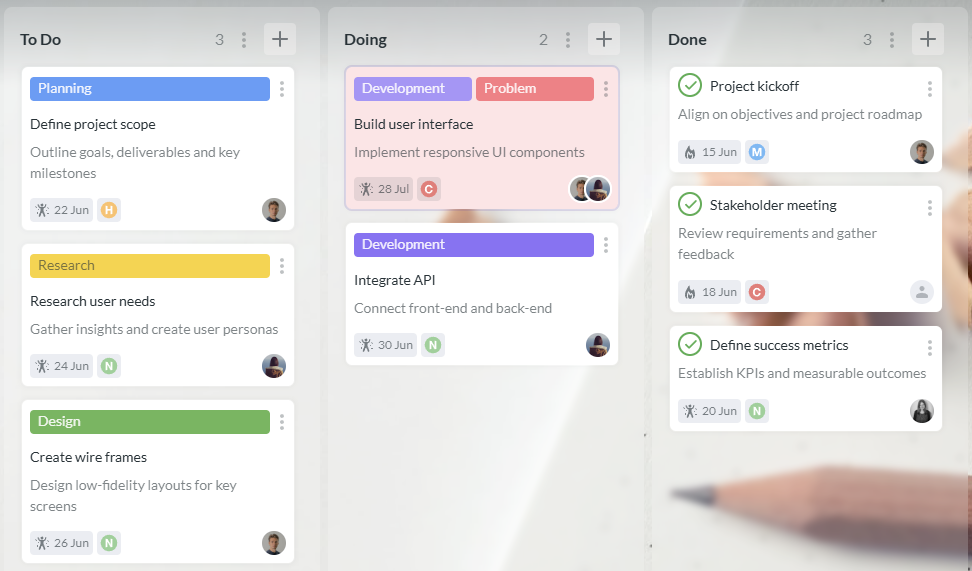
If I had to pick one fix that covers most of the table, it’s the most boring one: every piece of work is a card, every card has one owner and a due date, and everyone looks at the same board. That alone would have given Knight Capital’s 97 emails, Fyre’s insurance and the Death Star’s exhaust port a name and a date.
 View full size
A quick test for your project: pick the three cards that would stop your launch if they slipped. Does each have exactly one owner, a due date, and a link to whatever it waits on? If not, you’ve found this week’s job.
Which famous failure is your project closest to?
Two quick questions, and you’ll get the failure pattern your project is drifting toward, the story to learn from, and the Kanbanchi features I’d set up first.
Still possible
- Where does your project hurt first? Scope keeps growing: your pattern is scope that keeps growing (see Denver’s baggage system). Details get lost between teams: specs lost in hand-off (see the Mars Climate Orbiter). People: go to question 2a. Dates: go to question 2b.
- 2a. Nobody is sure who owns a task: no clear owner (see the Vasa warship). Tasks get done, but the project isn’t moving: measuring the wrong thing (see Ariane 5 Flight 501).
- 2b. One piece waited on another: hidden dependencies (see Denver’s baggage system). Someone flagged the problem weeks ago: warnings that go nowhere (see the Death Star).
Why Kanbanchi for projects that can’t afford to fail
Every feature on the cards above is something I use on real projects. Here’s where Kanbanchi is strong, what other teams say about it, and the few things worth knowing before you move a project onto it.
Where it’s strong
It lives where your team already works
Sign in with your Google or Microsoft account. Specs attach straight from Google Drive, and due dates can go to Google Calendar.
Good fit if your specs live in Drive and your warnings arrive by email.
Warning signs show up on the board
A list over its card limit turns red, and Card aging can fade cards that haven’t moved.
Good fit if problems tend to hide in plain sight.
Reports are built in
Open a board’s Reports for a team performance chart, a burn down chart or a cumulative flow diagram.
Good fit if someone asks you for an honest status every Friday.
The board becomes a plan
Professional adds the Gantt chart, task dependencies, the time tracker and the Team Workload view, all on the same cards.
Good fit if one late task can hold up everything after it.
Support that answers
Capterra reviewers rate Kanbanchi’s customer service 4.7 out of 5.
Good fit if you’d rather ask a person than read a manual.
Worth knowing
It shows problems; it doesn’t solve them
A red counter still needs someone to act on it. Agree in advance who does.
The planning tools are on Professional
Gantt chart, dependencies and notifications before due date need the Professional plan or higher.
Per-seat pricing adds up
For a big team, run your numbers in the price calculator first.
“I love being able to assign the cards… I used to forget who I assigned tasks to, but no more!”
Carmel Dekel Wiseman, in a review shown on kanbanchi.comMy take: most of the failures on this page started with a problem that someone could see and nobody owned. Kanbanchi is good at exactly that part: putting the problem on a card, with a name and a date, where the whole team can see it.
What it costs to keep your project off this page
Boards, cards, checklists, Drive attachments and Google Calendar dates come with every plan. Premium adds subcards, card templates, roles and the Activity feed. Professional adds the Gantt chart, task dependencies, notifications before due date, the time tracker and the Team Workload view. Set your team size, tick what you need, and the calculator picks the cheapest plan that has it.
Billing
25% off Premium, Professional and Enterprise with yearly billing. Kanbanchi applies it after you send their education or non-profit form; it isn't automatic.
What you need
The 7-day free trial includes every feature, and your boards stay when it ends.
Project failure examples: FAQ
What are the most famous project failures?
Lists differ, but a few come up again and again: NASA’s Mars Climate Orbiter, lost in 1999 over mixed-up units; Denver International Airport’s automated baggage system; Knight Capital’s 2012 trading glitch, which cost more than $460 million in 45 minutes; the first Ariane 5 rocket; and Sweden’s Vasa warship, which sank on its maiden voyage in 1628. This page covers all five, plus Fyre Festival and six fictional ones. HealthCare.gov, Berlin Brandenburg Airport and the Sydney Opera House are covered in our Great Projects series.
Why do projects fail?
In the stories on this page, the same six patterns keep coming back: no clear owner, warnings that go nowhere, hidden dependencies, scope that keeps growing, specs lost in hand-offs, and measuring the wrong thing. Bad luck plays a part sometimes, but the official reports mostly describe problems that people saw coming and didn’t act on in time.
Could a project management app really have saved these projects?
Not on its own, and anyone who says otherwise is selling something. An app can’t fix fraud, add server capacity or engineer a building. What it can do is make the warning signs visible early: a task with no owner, a list over its limit, a risk card nobody has touched for weeks, a dependency that moves the launch date. Seeing the problem early is what gives a team the time to fix it.
What can everyday teams learn from the Mars Climate Orbiter?
Check every hand-off against the spec. NASA’s investigation board found that one piece of ground software produced results in pound-force seconds while the interface specification called for newton-seconds. On an ordinary team, the same mistake looks like a wrong currency, a wrong time zone or a wrong file version. Put the spec on the card and give the check a named owner.
Which Kanbanchi plan has the Gantt chart and task dependencies?
Professional, and Enterprise, which includes everything in Professional. Professional also adds swimlanes, notifications before due date, the time tracker and the Team Workload view. Use the price calculator to see what it costs for your team size.
How can I spot a failing project early?
Watch for cards that stop moving, lists that stay over their limit, and due dates that keep slipping. In Kanbanchi, Card aging fades cards with no recent activity, the card limit turns a list’s counter red, and the Team performance report shows what was done on time, done late, or is overdue.
Is there a free trial?
Yes. Kanbanchi has a 7-day free trial with every feature. After it, your boards and data stay on a free plan limited to 36 cards per board; boards over the limit become read-only. Paid plans, Essential included, have unlimited boards and cards.
Does Kanbanchi work with Google Workspace and Microsoft 365?
Yes. You sign in with your Google or Microsoft account at app.kanbanchi.com, with nothing to install. Attachments stay in your own Google Drive, and the security page explains how your data is stored.
Don’t become the next famous project failure
Give every task an owner, every risk a card and every dependency a line on the timeline. Start this week, in the Google or Microsoft tools your team already uses.
Start your free trial