
In this Article:
Try Kanbanchi now
Start your free trial

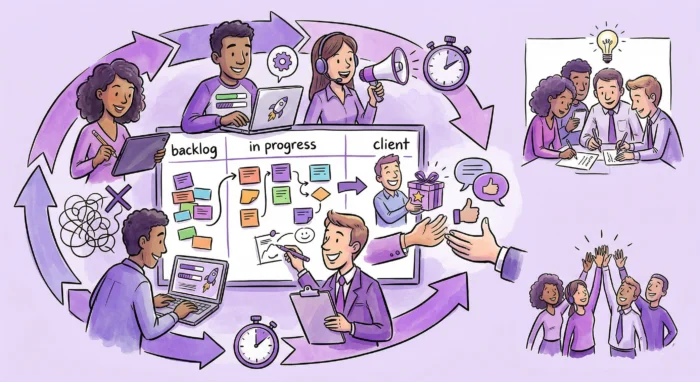
We’ve all been there. Monday morning, fresh coffee in hand, you open your laptop with the best intentions. The plan is simple: finish that project proposal, align with two colleagues, and wrap up the day feeling like a functional human being. But then reality walks in, uninvited, as always.
A stakeholder drops an urgent request halfway through your Sprint. A developer is blocked waiting on a designer who’s waiting on a copywriter who’s waiting on… nobody actually knows.
Your team has been “almost done” for two weeks straight. And somewhere in a meeting room, someone is drawing a very detailed Gantt chart that will be completely irrelevant by Thursday. By Wednesday, the original plan isn’t a plan anymore. It’s a cautionary tale.
Does this sound familiar? Well, you’re not alone. For a long time, I believed this experience came from a lack of organization. But I was wrong. We were lacking a shared set of principles to fall back on when things get messy. And things always get messy.
That’s why I’ve proposed to incorporate the 12 Agile principles into our way of working. Born from the Agile Manifesto, a document written in 2001 by seventeen software developers. They were fed up with rigid, bloated project methods. They came up with 12 principles and 4 values that should be integrated through all the veins of the organisation. These principles aren’t just theory. They’re practical orientations that help teams make better decisions when the rulebook runs out.
Whether you’re running Scrum sprints, experimenting with Kanban, or simply trying to get your team to stop working in silos, the 12 Agile principles are your compass. In this article, I will guide you through each one with clear explanations and real-world examples, so you can start applying them before your next stand-up.
The 12 Agile principles form the foundation of the Agile Manifesto. They were designed to guide teams in delivering value quickly, responding to change, and continuously improving how they work together. Below, we’ll explore each principle individually.
The first principle is to deliver value continuously. This applies to both the client and the end user. Don’t wait until the end to find out if you built the right thing. A school that rolls out a new curriculum without ever consulting its students will spend an entire year learning the wrong lesson.
Moreover, don’t wait until the deadline before delivering something usable. A product can already deliver value when some of its features or attributes are functioning, built with this intention.
Scope changes. Ignoring that doesn’t make it go away; it just makes it more expensive. Agile teams embrace this fact. They evaluate each change on its merits. Does it add real value? If yes, it goes on the backlog. If not, it gets respectfully declined.
This principle goes hand in hand with the previous one. When you deliver valuable products during the process, the product will be tested and insightful to your customer. Valuable change requests will follow, which in turn enable you to deliver valuable products to your customers.
The longer you wait to show something real, the longer you wait to find out you’re heading in the wrong direction. Release early, gather feedback, and improve incrementally. Short cycles reduce risk and keep the work grounded in reality.
Silos create miscommunication and delays. Build teams that can pick up and complete work without constantly depending on others. A marketer, designer, and copywriter working side by side will outpace three separate departments every time.
Trust is one of the most powerful forces in a team. When people feel trusted, they take ownership. When they don’t, they disengage and start updating their CV.
Ownership empowers your employees to use their full potential. This way, your team will reach its highest potential performance. So give your team the autonomy to make decisions within their domain.
The further you move from in-person to video, phone, or email, the more you lose. Body language, tone, and spontaneous ideas all erode. The rule of thumb is: for the conversations that matter most, be in the same room.
Status updates and progress bars are reassuring, but they’re not the same as something you can actually see and use. If a developer has been working on a feature for a month and still can’t show anything, that’s not progress. That’s a risk hiding in plain sight.
If you want to live up to the promise of principle 1, building with the intention to always deliver a working product is an absolute necessity. This doesn’t mean that you need to work harder or make longer days; it means prioritizing smarter.
Frantic sprints followed by long silences are a sign of dysfunction, not ambition. Establish a steady rhythm, like a fixed Sprint cadence, so the work gets done consistently without burning people out.
Every shortcut today is a problem you’ll solve twice tomorrow. Quality isn’t something you check at the end; it’s a standard you maintain throughout. Build it into your workflow, not onto it.
Complexity is just waste in disguise. Regularly ask: Does this step actually add value? If not, remove it. The goal isn’t to cut corners; it’s to eliminate friction so value can flow freely. You can only live up to the previous 9 principles if you strip your work of any absolute redundancies.
The people doing the work understand it best. A manager who dictates every detail without hands-on expertise doesn’t add value; they remove it. Give your team ownership of both the planning and the execution. Those who are hands-deep in it every day know best how to solve their problems.
This is your Retrospective. Make time to ask what’s working, what isn’t, and what you’ll do differently. In my experience, these reflections work best if you reward honesty and vulnerability even when the truth is harsh. Write the outcomes down. Then actually act on it. Teams will only maintain their engagement if they feel they are being taken seriously.
Finally, no framework makes a team great on its own, so reflect continuously, preferably after every sprint.
Agile was born in software but transcends its origins. Whether you’re leading marketing, operations, HR, or product, the underlying challenges remain the same. It is important to note that the 12 principles don’t prescribe how to work but function more as a shared language. In my experience, this helps especially in hard moments when no playbook exists.
I worked with a telecommunications company, transforming its operations team. In this instance, principles 1 and 7 were especially neglected. This became noticeable when we shifted from counting tickets processed to solving actual customer problems. When I first sat down with the back office, front office, administration, and technical support staff, they were measuring success by volume. I discovered they were moving customer issues along without resolving them.
One multidisciplinary team I coached found that customers were opening repeat tickets for identical issues within weeks. When we refocused on true resolution, we reduced repeat contacts by 34% in the first quarter. It turned out that the problems the teams thought were minor kept frustrating customers repeatedly.
There are various training agencies that help business teams practice these principles. The author of this article represents Agile Scrum Group – one of the leading sources on Agile for non-IT teams in the Netherlands. In other countries, you will also find different organizations that can provide help.
Regular retrospectives revealed problems invisible in daily work. In an organization that one of my colleagues coached, the operations team discovered they’d created redundant documentation for three years because nobody questioned the process. In my experience, the Retrospectives are the bread and butter of your team’s psychological safety. I was working with a team for 6 months, and the team was fractured.
Members were resisting change; others were uncommunicative. During the meetings, when it was brought up, no one spoke up. Once we started doing retrospectives and I led the conversation from a position of vulnerability and insecurity, something changed. When no one responded judgmentally but actually supportively, people started to feel safe.
Others started to open up, and this significantly changed our team dynamic. Once people felt genuinely safe to bring up unresolved tensions in the team, people started taking ownership, and we transitioned into a self-organising team.
I worked with a company that introduced Agile in operations but kept management traditional. The operations teams could collaborate and move fast, but every decision needed approval from managers who didn’t understand Agile. What took one day to decide in a retrospective took three weeks to get approved.
I watched another organization train frontline teams, but excluded finance and HR. Operations teams wanted to experiment and learn from customers, but finance still operated on annual planning cycles. One Product Owner told me she felt like swimming upstream constantly.
I believe that business teams are especially vulnerable to this fragmentation because they already work across silos. A back office person, a front office person, and an administrator have never naturally collaborated before Agile. When only some of them embrace the principles while others cling to old hierarchies, the team risks falling apart. I’ve seen multidisciplinary teams that had genuine momentum lose it because their finance counterpart or their manager wasn’t part of the transformation. The diversity that makes business teams powerful only works when everyone shares the same operating system.
But I also want to nuance that there are plenty of organizations where a small part works Agile while the rest doesn’t. Yes, the Agile teams then do risk not being understood by the rest of the organization, and this can come with difficulties. But it is understandable that not an entire organization enters into an Agile transformation right at once. Especially in the beginning, it can also be logical to start with a singular team and increase the agile efforts gradually.
You may also be interested in checking out these blogs:
Best Agile Project Management Software: Top 15 Tools for 2026
18 Best Strategic Planning Tools for Agile Growth in 2026
Share these principles with your team. Use your next Retrospective to ask honestly: which ones are we already living, and where is there room to grow? Discuss how, as a team, you can improve on these principles and agree on a method to action them.
The 12 principles won’t solve every problem, but they’ll foster a culture and work ethic that is more resilient in the face of change and difficulty.
It’s even better when teams adopt tools that support the same principles and make their implementation easier. Kanbanchi is one such tool that your team can use.
Start a free Kanbanchi trial now



In this Article:
Start using Kanbanchi now
Start your free trial