-  views

Marketing Plan for Software Company: 2026 Strategy and Samples

Try Kanbanchi now

Start your free trial

 

An illustration of a professional woman at a purple desk organizing a marketing plan for software company using modern tools

After more than a decade working with a software development team and with our clients, I’ve seen one thing over and over again: building a solid product is only part of the job. You can have clean code, a thoughtful UI, and a solution that genuinely helps people, but none of that guarantees growth.

The reality is that we’re operating in a crowded market where attention is limited, and competition is everywhere. It’s not enough to ship something good and hope the right people discover it. If you don’t have a clear marketing plan, you’re not really scaling; you’re just guessing and hoping something clicks. We’ve been there 🙈

Marketing software is very different from marketing most other products. You’re not just selling features. You’re communicating value, solving real operational problems, and often asking people to change how they work (you can imagine how hard this part is). That takes more than marketing campaigns; it takes structure, consistency, and a deep understanding of your audience.

In this article, I’ll walk through what has actually worked in practice. We’ll cover the core elements of a software marketing strategy, look at a practical example of a software company’s marketing plan, and break down how to execute it using tools many teams already rely on.

By the end of reading, you should have a system you can adapt and use with your own team.

Check out some of the other Kanbanchi’s IT and development-related blogs.

Why Software Companies Fail Without a Strategic Plan

Let’s start with why so many software companies struggle with marketing in the first place. Why do 90% of startups fail? It’s rarely because the developers weren’t talented enough, or there weren’t enough staff to make it succeed. Usually, it’s because the marketing campaign consisted of a few random LinkedIn posts, and maybe a prayer… and a team wondering why it’s all flailing around them when they felt they’d done everything right. 

Random Acts of Marketing Don’t Work! 

When you operate without a cohesive marketing plan for software company success, you fall victim to the “ooh, look at the shiny object” syndrome.

  • You might spend £1,000 on Google Ads before your landing page is optimized.
  • You may write ten blog posts that no one reads because you didn’t do keyword research.
  • You try to target everyone and end up reaching no one.

If there’s no structure or plan in place for a killer marketing campaign, then you’ll fail at the first hurdle and struggle as you try to gain some momentum. 

Once you begin to put some thought into how you’ll show off your product to the right people at the right time, you’ll see how quickly ideas flow and how everything falls into place.

Find The Bridge Between Product and Market

You need a strategic plan that acts as the connective tissue between your development roadmap and your customer’s reality. You need to ensure that when your dev team ships a new feature, your marketing team knows exactly which customer pain point it solves and how to communicate that value.

Mind the Financial Guardrails

Marketing can be an expensive black hole if you aren’t careful. A structured plan provides:

  1. Budget Accountability. No more guessing what your costings for everything and your overall outlay for the project should be.
  2. Resource Allocation. Knowing whether to hire a content writer or an SEO specialist based on data, not gut feelings. Then being able to act decisively on it. 
  3. Measurable ROI. Moving from “I think this is working” to “We generated 40 demo requests this month.”

Without a plan, you are a ship without a rudder. With one, you’re rowing towards success with no obstacles in the way. Bearing all this in mind, what are the key factors to consider when coming up with a brilliant, successful software marketing campaign?

Core Components of a Software Marketing Strategy

A successful marketing plan for software company growth isn’t a 50-page PDF manifesto full of rules that mustn’t be broken! It’s a lean, actionable framework. If your team can’t explain the strategy in five minutes, it’s too complex to execute, and it’ll be a drain on time and company morale. These five essential pillars will help you.

1. The Deep Dive: Market Research and SWOT techniques

Before you write a single line of copy, you must understand who you’re addressing.

  • Strengths: What makes your code superior? (e.g., Native Google Workspace integration).
  • Weaknesses: Where do you lag? (e.g., is there a functioning mobile app?).
  • Opportunities: Is a competitor failing their users?
  • Threats: Is another big player entering your niche?

Find your target audience and research what appeals to them, what they want to see from a product (that they may not be getting from their current setup), and how you can address it. 

2. Figure Out Your Ideal Customer Profile vs. User Personas

In software, the person who buys the product is rarely the person using the tool.

  • The Buyer: Usually, the CEO or manager cares about ROI, security, and integration.
  • The User: Usually, the employee cares about ease of use, speed, and reducing busy work.

Therefore, when you’re getting your campaign ready, your messaging must speak to both groups equally. It can be a tough line to tread, but if you think about the same principles outlined above in our SWOT techniques, it can help. 

3. Value Proposition: The “So What”?

“We are a project management tool” is a category, not a value proposition. “We help Google Workspace and Microsoft 365 teams save 5 hours a week by eliminating tab-switching.” is a value proposition. 

Focus on outcomes, not features. What will your tool do for the audience that no other tool on the market can? Talk about it and the ways it can improve your users’ experience, rather than just stating what it is. 

4. SMART Goals and KPIs

Stop tracking vanity metrics like page views. Focus on what moves the needle:

  • MQLs (Marketing Qualified Leads): People who downloaded your whitepaper.
  • SQLs (Sales Qualified Leads): People who booked a demo.

Then take a look at the following factors: 

  • CAC (Customer Acquisition Cost): What financial value will new customers offer? 
  • LTV (Lifetime Value): What is the overall value of the software’s life cycle to your clients? 

Get an idea of these, and you’ll be able to focus on your SMART goals and key performance indicators with much greater clarity. 

5. The Content and Channel Strategy

Where does your audience hang out? 

  • If you’re a B2B Enterprise, it’s LinkedIn and industry webinars. 
  • If you’re a dev tool, it’s GitHub, Stack Overflow, and technical documentation.

See where your core clients gather and make headway in targeting those hotspots. As you gain more connections, you can spread your wings further. 

Thinking this through clearly will give you the best starting point for an overall plan. Next, we’re going to consider this in more detail and share a sample plan you can adapt to fit your team’s needs.

Sample Marketing Plan for New Software Development Company

Starting from scratch? We feel your pain! This is known as the Zero-to-One phase, and it’s the most dangerous time for a startup. You don’t have brand authority, and your budget is likely tight. This sample marketing plan for a new software development company team focuses on building a foundation of trust.

Phase 1: The Authority Foundation (Months 1-2)

Task 1: Build a high-converting landing pageIt must load in under 2 seconds and have one clear Call to Action (CTA)
Task 2: Create The Pillar PieceWrite one exhaustive, 2,500-word guide (like this one!) that solves a major problem for your target audience.
Task 3: Set up your Founder BrandThese days, people buy from people. The CEO should be posting daily insights on LinkedIn.

Phase 2: The Early Adopter Push (Months 3-4)

Task 1: Launch a Beta programOffer the software for free or at a 90% discount in exchange for detailed video testimonials.
Task 2: Cold Outreach (ABM)Identify 50 Dream Clients and send personalized Loom videos showing exactly how your software fixes their specific workflow.
Task 3: Product Hunt LaunchCoordinate a 24-hour blitz to get featured as the #1 Product of the Day.

Phase 3: The Scale Engine (Months 5-6)

Task 1: Retargeting AdsShow ads only to people who have already visited your pricing page. This is the highest ROI you can achieve with ad spend.
Task 2: Integration PartnershipsIf your software works with Google Workspace, get listed in the Workspace Marketplace.
Task 3: Referral LoopsIncentivize current users to invite their colleagues in exchange for Pro features.

Choosing Your Marketing Mix: Inbound vs. Outbound

In the software world, your marketing mix isn’t just about where you post; it’s about how you balance long-term authority with short-term lead generation. For a marketing plan for a software company’s success, you need a hybrid approach.

Inbound: The Magnets (Long-Term ROI)

Inbound is about being found when your customer is actively looking for a solution.

  1. SEO and Content

Ranking for terms like “best project management software for Google Workspace” brings in high-intent traffic.

  1. Documentation and Tutorials

In tech, your documentation is your best sales tool. If a dev can see how it works, they’ll trust it.

  1. Webinars

Educational sessions that solve a problem (e.g., How to Sync Google Calendar with Kanban Boards).

Outbound: The Megaphones (Short-Term Speed)

Outbound is about interrupting the noise to grab attention.

  1. LinkedIn Ads

Highly targeted by job title (e.g., CEO) and company size, offering a showcase of your product and the specific benefits it can bring. 

  1. Account-Based Marketing (ABM)

Creating a custom sample marketing plan for a software development company, targeting specific high-value companies you want to attract. 

  1. Cold Outreach

Personalized, value-first emails or LinkedIn messages to key stakeholders who you think may have an interest in the product you’re developing. 

See more of our marketing blogs right here.

Executing Your Plan with Kanbanchi

Kanbanchi lives within your Google Workspace or Microsoft environment, so your marketing plan and your actual work stay in the same ecosystem. With Kanbanchi, you can turn your marketing plan into a visual roadmap.

Create a board for your Launch. Use columns for Backlog, In Progress, Ready for Review, and Live. Use the Gantt view to see how these tasks overlap and identify bottlenecks before they happen.
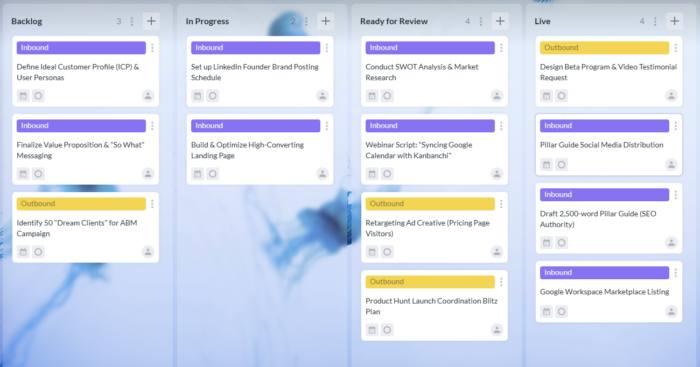
A Kanbanchi board illustrating a marketing plan for software company with tasks categorized by Inbound and Outbound labels across Backlog, In Progress, Ready for Review, and Live columns
This Kanban board view transforms your high-level marketing plan for a software company into a visual roadmap, allowing the team to track the real-time status of diverse inbound and outbound campaigns in a single workspace

Collaboration Without Context-Switching

Marketing is highly collaborative. Designers, writers, and managers need to be on the same page.

Google Drive, OneDrive, or SharePoint Integration

Attach your marketing plan supporting documents from Google Drive or OneDrive/SharePoint directly to a Kanbanchi card. No more searching through folders.

Task Ownership

Assign specific Content Creation tasks to your writers and Ad Setup to your growth lead.

Real-Time Feedback

Use the comments section on a card to give feedback on a creative asset. This keeps the conversation linked to the task rather than buried in an email thread.

Try Kanbanchi today

Frequently Asked Questions on Software Marketing Planning

We’re going to end our round-up, as we always do, by tackling some of the most commonly asked questions about software marketing planning in the industry. If we’ve missed anything out, then please get in touch, and we’d love to chat with you.

How do I create a marketing plan for a software company? 

Start by defining your Ideal Customer Profile (ICP) and its specific pain points. 

Conduct a SWOT analysis, set SMART goals (like acquire 500 trial users in Q2), and select 2-3 primary channels (e.g., SEO and LinkedIn). 

Finally, move these goals into a project management tool like Kanbanchi to turn high-level strategy into daily tasks.

What should be in a software marketing plan? 

A comprehensive marketing plan for a software company’s growth must include:

  • Executive Summary: High-level goals.
  • Target Audience: Detailed buyer and user personas.
  • Competitive Analysis: How you differ from the “big players.”
  • Pricing Strategy: Freemium, tiered, or enterprise models.
  • Distribution Channels: Content, Paid Ads, and Partnerships.
  • Budget & KPIs: How you measure success.
What is the difference between a software product marketing plan and a service-based plan? 

A product plan (SaaS) focuses on scalability, self-service onboarding, and recurring revenue (MRR). 

A sample marketing plan for a software development company’s services (custom dev) focuses on authority, case studies, and high-touch relationship building, as the product is actually the expertise of the team.

How much should a software startup spend on marketing?

How much a software startup should spend on marketing depends on stage, revenue, and growth goals, but there are reliable benchmarks you can use. Here’s a practical breakdown of the industry benchmarks:

  1. Early-Stage / Pre-Revenue SaaS: 30–50% of projected revenue
  2. Growth-Stage SaaS (Scaling): 20–40% of annual revenue
  3. Established / Profitable SaaS: 10–20% of revenue
What is the best channel for B2B software?

There isn’t one single best channel for B2B software; it depends heavily on deal size, target audience, and sales cycle.

  1. LinkedIn (For Most B2B): For many B2B software companies, LinkedIn is the strongest channel. Why it works: Offers precise job title & industry targeting
  2. SEO & Content Marketing (Best Long-Term ROI): If your buyers search for solutions, SEO can become your most profitable channel. Why it works: captures high-intent traffic
  3. Outbound (Cold Email and Sales Outreach): Still extremely effective for B2B. Why it works: immediate pipeline generation
  4. Partnerships and Integrations: Often underrated, but powerful. Works best for: Niche vertical SaaS
  5. Events and Webinars: Especially strong for enterprise software. Webinars build authority. Industry conferences build credibility. Great for complex products
    MultipleAuthors\Classes\Objects\Author Object
    (
        [term_id] => 973
        [term:MultipleAuthors\Classes\Objects\Author:private] => 
        [metaCache:MultipleAuthors\Classes\Objects\Author:private] => Array
            (
                [user_email] => olga.alekseeva@kanbanchi.com
                [user_id] => 20
                [first_name] => Olga Alekseeva
                [last_name] => 
                [job_title] => Growth hacking expert with over 10 years of experience with Kanbanchi
                [description] => Olga wears multiple hats across marketing, sales, product, and ops after 10+ years in the SaaS world. She is passionate about helping teams streamline their workflows with Kanbanchi and Google Workspace or Microsoft 365. "When I'm not optimizing processes or writing guides, I'm probably tweaking our product roadmap or diving into the latest productivity tools".
                [user_url] => https://linkedin.com/in/olgksv
            )
    
        [userObject:MultipleAuthors\Classes\Objects\Author:private] => WP_User Object
            (
                [data] => stdClass Object
                    (
                        [ID] => 20
                        [user_login] => olga.alekseeva
                        [user_pass] => $wp$2y$10$WuiuvYMj7CDnLrRbWchEkuBwKzmbBakK64Uk5c68bDY3qA46MFam6
                        [user_nicename] => olga-alekseeva
                        [user_email] => olga.alekseeva@kanbanchi.com
                        [user_url] => https://linkedin.com/in/olgksv
                        [user_registered] => 2025-09-03 15:47:58
                        [user_activation_key] => 
                        [user_status] => 0
                        [display_name] => Olga Alekseeva
                    )
    
                [ID] => 20
                [caps] => Array
                    (
                        [editor] => 1
                        [author] => 1
                        [contributor] => 1
                        [wpseo_editor] => 1
                        [wpseo_manager] => 1
                        [administrator] => 1
                    )
    
                [cap_key] => wp_capabilities
                [roles] => Array
                    (
                        [0] => editor
                        [1] => author
                        [2] => contributor
                        [3] => wpseo_editor
                        [4] => wpseo_manager
                        [5] => administrator
                    )
    
                [allcaps] => Array
                    (
                        [moderate_comments] => 1
                        [manage_categories] => 1
                        [manage_links] => 1
                        [upload_files] => 1
                        [unfiltered_html] => 1
                        [edit_posts] => 1
                        [edit_others_posts] => 1
                        [edit_published_posts] => 1
                        [publish_posts] => 1
                        [edit_pages] => 1
                        [read] => 1
                        [level_7] => 1
                        [level_6] => 1
                        [level_5] => 1
                        [level_4] => 1
                        [level_3] => 1
                        [level_2] => 1
                        [level_1] => 1
                        [level_0] => 1
                        [edit_others_pages] => 1
                        [edit_published_pages] => 1
                        [publish_pages] => 1
                        [delete_pages] => 1
                        [delete_others_pages] => 1
                        [delete_published_pages] => 1
                        [delete_posts] => 1
                        [delete_others_posts] => 1
                        [delete_published_posts] => 1
                        [delete_private_posts] => 1
                        [edit_private_posts] => 1
                        [read_private_posts] => 1
                        [delete_private_pages] => 1
                        [edit_private_pages] => 1
                        [read_private_pages] => 1
                        [wpseo_bulk_edit] => 1
                        [copy_posts] => 1
                        [ppma_edit_post_authors] => 1
                        [ppma_edit_own_profile] => 1
                        [wpseo_edit_advanced_metadata] => 1
                        [wpseo_manage_options] => 1
                        [view_site_health_checks] => 1
                        [switch_themes] => 1
                        [edit_themes] => 1
                        [activate_plugins] => 1
                        [edit_plugins] => 1
                        [edit_users] => 1
                        [edit_files] => 1
                        [manage_options] => 1
                        [import] => 1
                        [level_10] => 1
                        [level_9] => 1
                        [level_8] => 1
                        [delete_users] => 1
                        [create_users] => 1
                        [unfiltered_upload] => 1
                        [edit_dashboard] => 1
                        [update_plugins] => 1
                        [delete_plugins] => 1
                        [install_plugins] => 1
                        [update_themes] => 1
                        [install_themes] => 1
                        [update_core] => 1
                        [list_users] => 1
                        [remove_users] => 1
                        [promote_users] => 1
                        [edit_theme_options] => 1
                        [delete_themes] => 1
                        [export] => 1
                        [bcn_manage_options] => 1
                        [manage_security] => 1
                        [restrict_content] => 1
                        [list_roles] => 1
                        [create_roles] => 1
                        [delete_roles] => 1
                        [edit_roles] => 1
                        [cfdb7_access] => 1
                        [ppma_manage_authors] => 1
                        [ppma_manage_layouts] => 1
                        [ppma_manage_custom_fields] => 1
                        [ppma_manage_author_categories] => 1
                        [iwc_read_posts] => 1
                        [iwc_create_posts] => 1
                        [iwc_edit_posts] => 1
                        [iwc_delete_posts] => 1
                        [iwc_read_users] => 1
                        [iwc_create_users] => 1
                        [iwc_edit_users] => 1
                        [iwc_delete_users] => 1
                        [iwc_read_comments] => 1
                        [iwc_create_comments] => 1
                        [iwc_edit_comments] => 1
                        [iwc_delete_comments] => 1
                        [iwc_upload_files] => 1
                        [iwc_read_media] => 1
                        [iwc_edit_media] => 1
                        [iwc_delete_media] => 1
                        [iwc_read_terms] => 1
                        [iwc_create_terms] => 1
                        [iwc_edit_terms] => 1
                        [iwc_delete_terms] => 1
                        [editor] => 1
                        [author] => 1
                        [contributor] => 1
                        [wpseo_editor] => 1
                        [wpseo_manager] => 1
                        [administrator] => 1
                    )
    
                [filter] => 
                [site_id:WP_User:private] => 1
            )
    
        [hasCustomAvatar:MultipleAuthors\Classes\Objects\Author:private] => 1
        [customAvatarUrl:MultipleAuthors\Classes\Objects\Author:private] => Array
            (
                [url] => https://www.kanbanchi.com/wp-content/uploads/2025/09/photo_2024-04-10_17-25-16.jpg
                [url2x] => https://www.kanbanchi.com/wp-content/uploads/2025/09/photo_2024-04-10_17-25-16.jpg
            )
    
        [avatarUrl:MultipleAuthors\Classes\Objects\Author:private] => 
        [avatarBySize:MultipleAuthors\Classes\Objects\Author:private] => Array
            (
                [96] => 
                [80] => 
                [50] => 
            )
    
    )
    
  • Growth hacking expert with over 10 years of experience with Kanbanchi

    Olga wears multiple hats across marketing, sales, product, and ops after 10+ years in the SaaS world. She is passionate about helping teams streamline their workflows with Kanbanchi and Google Workspace or Microsoft 365. "When I'm not optimizing processes or writing guides, I'm probably tweaking our product roadmap or diving into the latest productivity tools".

    All articles
Share

Try Kanbanchi now

  • Collaborate seamlessly
    with your team
  • Integrate Kanbanchi
    with Google or Microsoft
  • Manage all your work in one place
Start for free

Start using Kanbanchi now

Start your free trial