
In this Article:
Try Kanbanchi now
Start your free trial

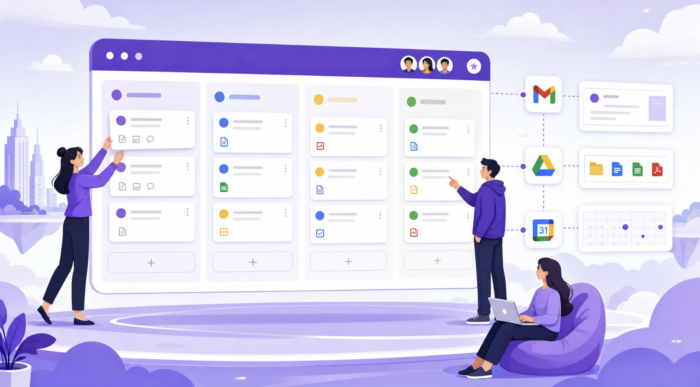
If you searched for “Does Google have a kanban board”, the practical answer is: not as a native, full-featured Google Workspace app. Google gives teams excellent collaboration tools, including Gmail, Drive, Docs, Sheets, Calendar, Chat, and Tasks. But Google Workspace does not include a dedicated Kanban board for teams to manage cards, columns, assignments, timelines, files, and progress in a single visual project workspace.
That does not mean Google Workspace teams are stuck with spreadsheets or disconnected task lists. You can build a simple Kanban-style setup in Google Sheets, or use a purpose-built app that runs directly in your Google environment. For business teams that need more than a basic task list, Kanbanchi fills that gap with Kanban boards, Gantt charts, time tracking, and deep Google Workspace integration.
Google Workspace is designed for communication, content creation, meetings, file storage, and collaboration. It is not a complete project management suite out of the box. That is why many teams using Google Workspace still ask whether Google has a Kanban board, a project tracker, or a visual task manager.
The answer depends on what you mean by Kanban board:
For a broader context, Kanbanchi also explains why “Does Google Workspace Have A Project Management Tool?“ is such a common question among teams that already rely on Google apps every day.
A Kanban board is a visual way to manage work as it moves through stages. Most boards start with a simple workflow such as To Do, In Progress, and Done. Each task becomes a card. Team members move cards from one list to the next as work progresses.
Kanban is popular because it makes work visible. Instead of asking for status updates in meetings or searching through email threads, everyone can see what is planned, what is blocked, what is in progress, and what has been completed.
For managers and team leads, this visibility is especially valuable. A shared Kanban board helps answer practical questions quickly: Who owns this task? What is delayed? Which project stage has too much work? What should the team prioritize next?
A useful Kanban board for business teams usually goes beyond cards and columns. It should support ownership, deadlines, file sharing, comments, notifications, priorities, and reporting. As teams grow, they often also need timelines, time tracking, templates, and permission management. That is where a simple Google Sheets workaround often becomes too limited.

Yes, you can create a lightweight Kanban-style system using existing Google Workspace apps. The important distinction is that this is a workaround, not a native Google Kanban board.
Google Sheets is the most common option for teams trying to create a Google Kanban board manually. You can set up columns for workflow stages, use rows or cells as tasks, add color coding, and create filters.
This can work for a small personal task list or a simple internal process. But when projects grow, Sheets often become difficult to maintain. Cards are not true task objects, comments can become hard to follow, file attachments are not part of the workflow, and moving work between stages can feel manual.
Google Tasks is useful for personal to-dos and reminders. Google Keep can help capture quick notes and simple checklists. Both tools are helpful for individual productivity, but they are not designed to run complex team workflows as Kanban boards.
A team lead usually needs more than a list of tasks. They need ownership, shared visibility, deadlines, workload awareness, file context, and a reliable way to track progress across multiple people or departments.
Google Calendar helps teams schedule meetings and deadlines. Google Chat can support conversations and collaboration. However, neither tool replaces a Kanban board. The calendar shows time, not workflow. Chat captures discussion, not structured task progress.
The best project setup usually connects these tools rather than forcing one of them to do everything.
The right option depends on your team size, project complexity, and how much visibility you need.
| Option | Best for | Main limitation |
|---|---|---|
| Google Sheets | Simple task tracking and custom tables | Manual setup, limited workflow structure, harder to scale |
| Google Tasks | Personal to-do lists and reminders | Not a full shared Kanban board for teams |
| Google Keep | Quick notes and lightweight checklists | Limited project management functionality |
| Google Calendar | Deadlines, events, and meetings | Does not visualize task flow |
| Google Chat | Team communication | Conversations are not a project board |
| Google Workspace Marketplace apps | Teams that need dedicated workflows inside Google Workspace | Requires choosing and adopting an additional app |
The Google Workspace Marketplace is where teams can find apps that extend Google Workspace. For Kanban-based project management, the best fit is usually a tool built specifically around visual task management and Google integration.
Kanbanchi is designed for teams that already work in Google Workspace and want a project management tool that feels connected to that environment. It combines Kanban boards with timeline planning, time tracking, collaboration, and file integration.
Instead of forcing teams to manage tasks in one place and files in another, Kanbanchi connects project work with Google Drive and other Google Workspace apps.
In Kanbanchi, teams can create and share project boards and cards. Boards can be created as files in Google Drive, and Enterprise users can create boards in Shared Drives. Teams can attach files from Google Drive and Shared Drives, keeping project context close to the task itself.
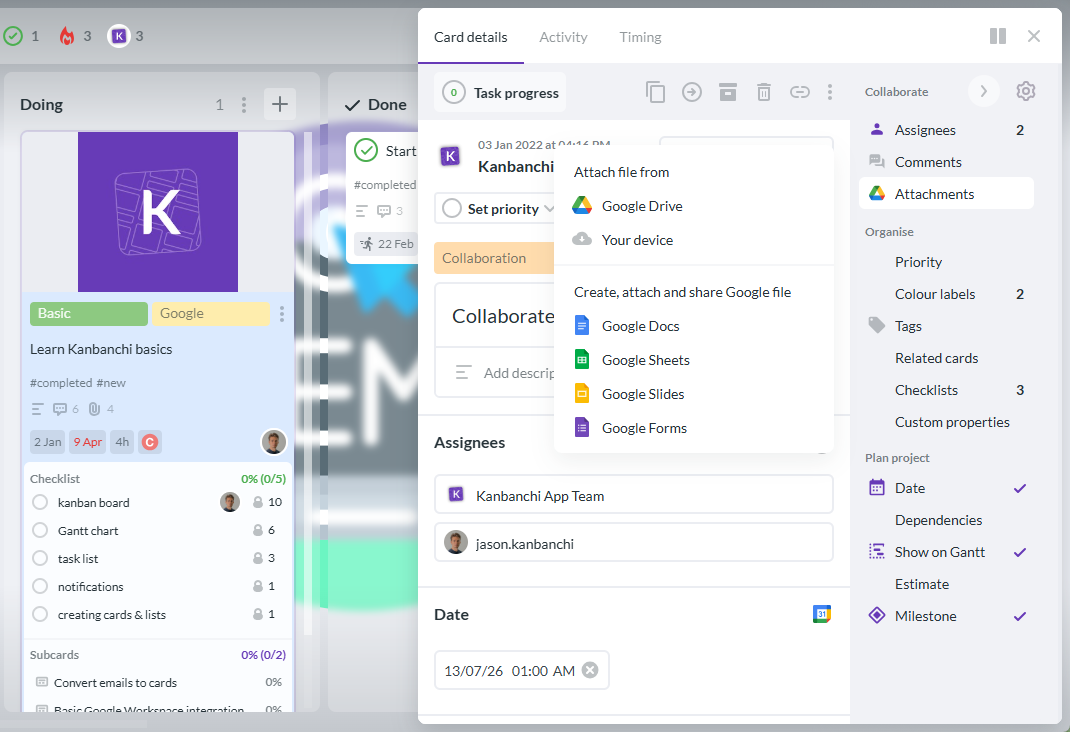
This is especially useful for Google Workspace organizations because it supports familiar sharing behavior. Teams can collaborate internally and externally in accordance with company policies.
You can learn more about this connection in our FAQ:
Does Kanbanchi have Google integration?
Kanbanchi also supports common Google Workspace workflows. Teams can create cards from Gmail, add events to Google Calendar, and export board data to Google Sheets. For project tracking and reporting, data can be extracted and connected to reporting dashboards such as Google Looker Studio.
This matters because many tasks start in email, many deadlines belong on calendars, and many managers still need spreadsheet exports for reporting or stakeholder updates.
Kanban is excellent for visualizing flow, but some projects also need scheduling. Kanbanchi lets teams convert a board into a Gantt chart, so project managers can see tasks on a timeline and plan schedules visually.
If you are also asking whether Google has a native timeline-planning tool, Kanbanchi covers that in Does Google have a Gantt chart?
Kanbanchi also includes a time tracker. Team members can track time directly on cards, and managers can monitor time data in the Timing tab. This is valuable for service teams, agencies, operations departments, and any business that needs to understand how work effort is distributed.
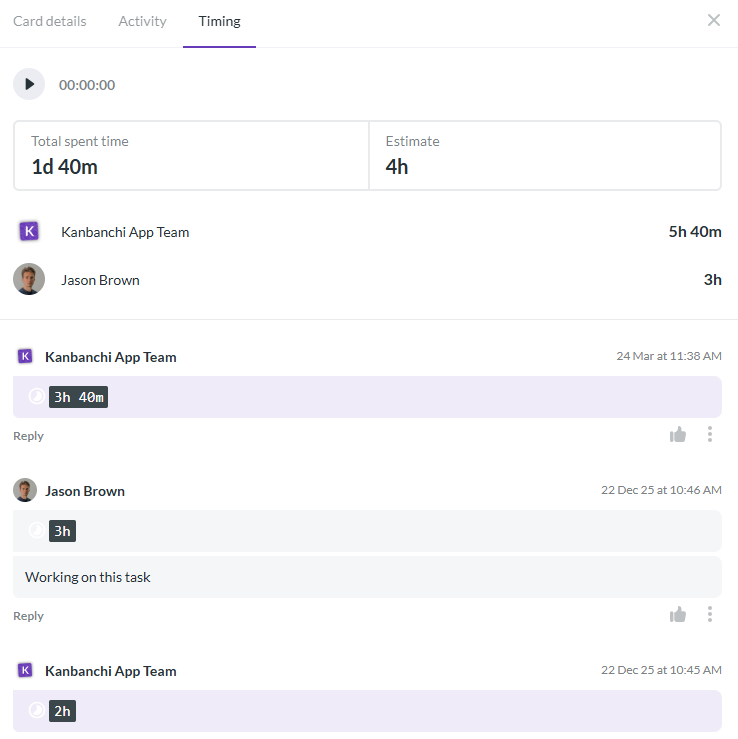
Teams often need more than a board. A connected Kanban, Gantt, and time tracking setup helps managers see both workflow and schedule.
Sign up for a free trial of Kanbanchi today
A spreadsheet can be enough when the work is simple, the team is small, and tasks do not require much collaboration. For example, a three-person team tracking a short checklist may be fine with columns in Google Sheets.
A basic Sheets board may work if your team does not need task-level file attachments, comments, timeline planning, workload visibility, or automation. It can also be a good temporary step while your team defines its workflow.
But if you are managing recurring projects, cross-functional work, client deliverables, or multiple teams, a dedicated Kanban board will usually save time and reduce confusion.
You have probably outgrown a manual Google setup if work is spread across emails, spreadsheets, chats, and meetings. The warning signs are usually easy to recognize: managers ask for the same updates repeatedly, team members are unsure what is most important, files are difficult to find, and deadlines are missed because tasks are not connected to a schedule.
A dedicated Kanban board is a better fit when your team needs:
Before choosing a tool, map the way your team already works. A good Kanban board should support your process, not force unnecessary complexity.
List the main stages your work passes through. A marketing team might use Backlog, Drafting, Review, Approved, and Published. An operations team might use Request, Scheduled, In progress, Waiting, and Complete. A software or IT team may need stages such as Ready, Development, Testing, Review, and Release. The best board structure is the one your team can understand immediately.
For business use, each card should usually answer a few basic questions: what needs to be done, who owns it, when it is due, what priority it has, and which files or discussions are relevant.
Kanbanchi supports rich task cards with details such as assignments, dates, descriptions, checklists, comments, tags, colors, priorities, subcards, and attached Google Drive files.
Not every workflow needs a Gantt chart. But if your team works with milestones, launches, client deadlines, dependencies, or multi-phase projects, a timeline view can prevent unrealistic schedules.
One of the advantages of Kanbanchi is that teams can use a Kanban board for daily execution and switch to a Gantt chart when they need schedule visibility.
A Kanban board only works if the team actually uses it. Start with a small workflow, agree on what each column means, and make updating cards part of the normal work routine. Once the board becomes the team’s shared source of truth, you can add more advanced features such as swimlanes, templates, reporting, or time tracking.
Google Workspace does not have a native Kanban board. It has excellent building blocks for collaboration, but not a complete visual project management board built into the core Workspace apps.
For individuals and very small teams, Google Sheets or Tasks may be enough for simple tracking. For business teams that need visibility, accountability, files, deadlines, timelines, and reporting, a dedicated Kanban solution is the better choice.
Kanbanchi gives Google Workspace teams a practical answer: a visual Kanban board connected to the tools they already use, with Gantt chart planning, time tracking, Google Drive attachments, Gmail card creation, Google Calendar sync, and export options for reporting.
No. Google Workspace does not include a native, full-featured Kanban board. Teams can create simple Kanban-style layouts in Google Sheets, but for real project management, they usually need an integrated app such as Kanbanchi.
Yes, you can create columns in Google Sheets to represent workflow stages and move tasks manually. This works for simple tracking, but it becomes limited when you need task cards, assignments, comments, file attachments, notifications, timelines, or time tracking.
The best option is one that fits your workflow and integrates with the Google apps your team already uses. Kanbanchi is built for Google Workspace and supports Kanban boards, Google Drive attachments, Gmail card creation, Google Calendar sync, Gantt charts, and time tracking.
Kanbanchi boards can be created as files in Google Drive, and Enterprise users can create boards in Shared Drives. Teams can also attach files from Google Drive and Shared Drives to cards.
Yes. In Kanbanchi, teams can add events to Google Calendar from cards. This helps connect task management with scheduling, so deadlines and important project dates are easier to see.
If your team has outgrown spreadsheets, task lists, or scattered email updates, Kanbanchi can help you manage work visually without leaving the Google Workspace environment your organization already uses.

Create boards, organize cards, attach Google Drive files, plan timelines with Gantt charts, track time, and keep your team aligned in one connected workspace. Start with Kanbanchi and see how a Google Workspace Kanban board can make project work easier to manage.


In this Article:
Start using Kanbanchi now
Start your free trial