
In this Article:
Try Kanbanchi now
Start your free trial


Operations doesn’t have one kind of work. It has three, and each one breaks differently.
There is work that repeats on a schedule. There is work that arrives from someone else. And there is work that only exists because something went wrong. Most operations teams buy a tool for the first kind, improvise the second, and handle the third in a group chat at eleven at night.
This guide is organized by those three process types rather than by tool category, because that is how operations work actually splits. For the wider picture across every category, see our guide to productivity apps.
Month-end reporting. Vendor reviews. Access audits. Renewal checks. The defining feature of recurring work is that nobody notices it until it doesn’t happen.
Process Street is built for exactly this shape. You write the procedure once as a checklist, set it to run on a schedule, and each run becomes its own instance with its own owner and its own record of what got ticked. Conditional logic means the checklist adapts to the case in front of it, so the extra legal step only appears when the contract value crosses the threshold.
What to watch: it is strong at the individual procedure and weaker at showing you twenty procedures in flight at once. Teams running a lot in parallel usually want a board on top of it.
Kanbanchi covers the parallel view. Recurring cards recreate a task on a rule, so the month-end board rebuilds itself on the first without anyone remembering to set it up. Board templates keep one canonical version of a process that you copy per cycle or per client, rather than eleven slightly diverging versions in eleven people’s Drive folders. Because boards are stored as files in Google Drive, sharing follows the permissions you already set, and the board you ran in March is still sitting where March’s files are. Enterprise teams can put boards in Shared Drives so they survive the person who created them leaving.
What to watch: it will not write your SOP for you. It tracks that the step happened, not what the step says. Detailed procedures still need somewhere to live.
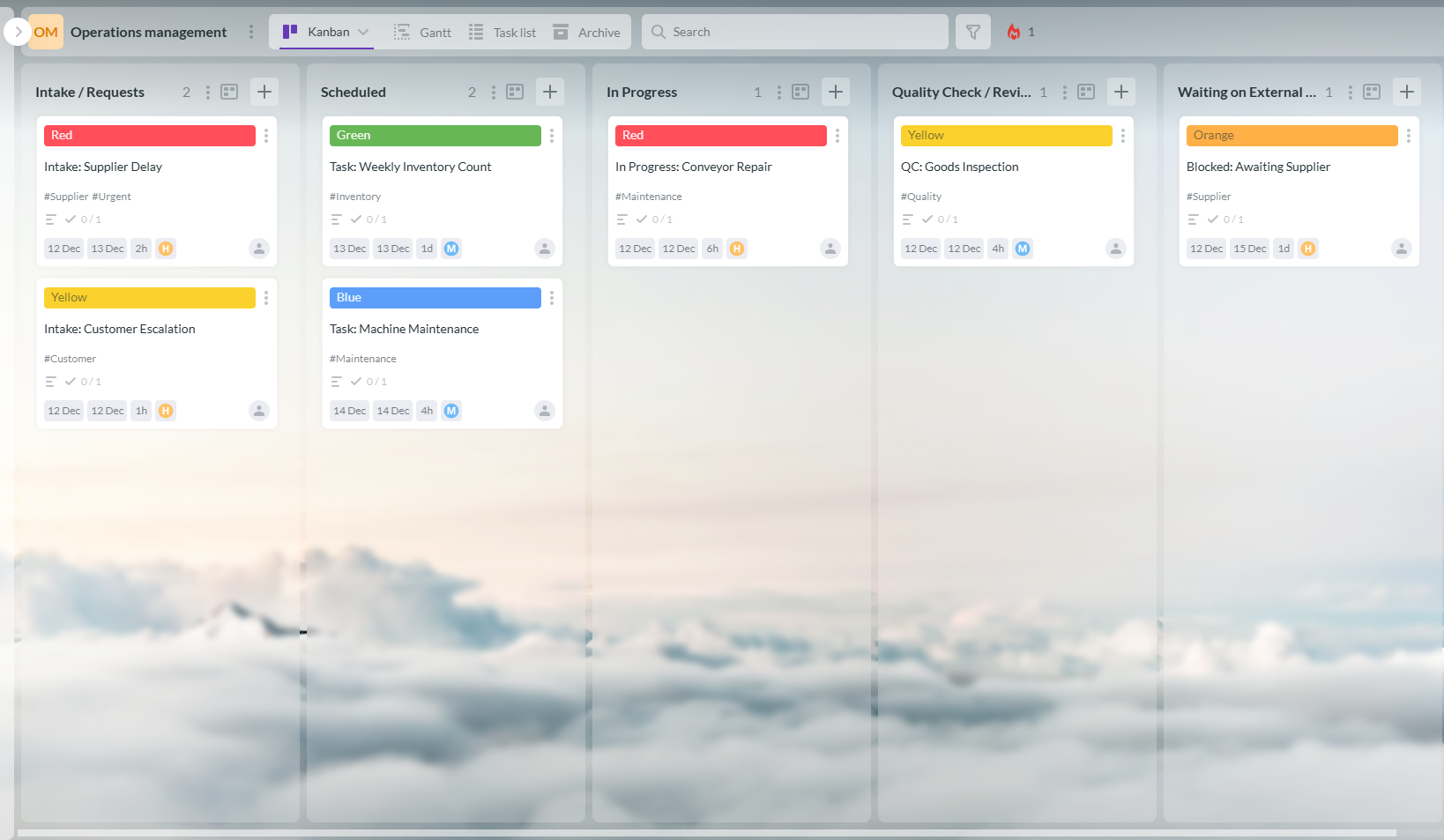
Kanbanchi board used as operations management software, highlighting columns for intake, scheduling, in-progress tasks, quality checks, and completed items to streamline operational workflows
Operations is a queue that other departments feed. Access requests, equipment, supplier onboarding, data pulls, the thing finance needs by Thursday. The failure mode is not volume. It is that requests arrive by six different routes and three of them are direct messages.
Typeform solves the front door. One form, required fields, conditional questions, so the request arrives complete rather than arriving as “hey quick one” followed by four rounds of clarification. The completion rates are good because the format is one question at a time, which matters when the people filling it in are doing you a favor.
What to watch: a form is only a front door if you close the other doors. If direct messages still work, people will use them.
The other half is what happens after submit. A board email address turns any incoming email into a card, subject as title and body as description, which means the requests that refuse to go through the form still land in the same queue instead of a personal inbox.
Exceptions are where operations teams lose their evenings. The work is unplanned by definition, so you cannot template it, and it usually spans three systems.
Zapier is the connective tissue. Its real value in operations is not automating the happy path (the happy path is already fine) but catching the exception and routing it somewhere visible. Payment fails, ticket ages past a threshold, stock drops below a floor, and a card appears on a board with the details attached rather than an alert appearing in a channel nobody reads at weekends.
What to watch: Zapier bills on task volume, and operations teams generate a lot of tasks. Check what your actual monthly run rate would be before building forty zaps, not after.
Airtable is the answer when a spreadsheet has outgrown itself, but a database is too much. Suppliers, assets, locations, contracts, inventory. Structured records with relationships between them, views per audience, and an interface layer so the person who needs to update one field doesn’t have to see the whole base.
What to watch: it is genuinely easy to build in, which is how organizations end up with nine bases owned by people who have left. Decide who owns the schema before you build the second one.
Four rules, and they matter more than which tools you pick.
Do not buy four tools. Do it in this order.
Plan, prioritize, and manage your projects effortlessly with Kanbanchi - the all-in-one project management tool built for Google Workspace users.
Get a free trialFour things, in this order: a single intake route, a way to make recurring processes recreate themselves, a structured place for reference data, and automation that catches exceptions. Most teams buy the automation first and the intake route last, which is backward. Tool count is usually the wrong question. A team of six running three tools well outperforms a team of six running eight badly.
Make the official route faster than the unofficial one, then close the unofficial one. A form that takes ninety seconds and produces a visible ticket with an owner beats a message, but only if the message stops working. Teams that keep both routes open keep both routes busy.
Operations work is mostly recurring and request-driven, so the tooling is built around processes that repeat and queues that refill. Project work has a start, an end, and a delivery date, so the tooling is built around dependencies and timelines. Most operations teams need both, and they are usually the same board seen two different ways. If your question is specifically about running projects rather than running processes, our guide to project management apps is the better starting point.
More in this series: Productivity apps is the full guide by category.
Also in the series: productivity apps for sales and marketing teams, and productivity software for professional services firms.


In this Article:
Start using Kanbanchi now
Start your free trial