
In this Article:
Try Kanbanchi now
Start your free trial


Marketing teams don’t have a productivity problem. They have a parallel work problem. A campaign launches on the 14th. Copy is being written, design is in progress, legal is reviewing, and a developer is building a landing page, all at once, all independently, all due before the same date. The launch happens when the last one finishes, and the last one is usually the one nobody was watching.
That shape is what makes marketing tooling specific. This isn’t a list of the most popular apps; it’s the four that solve marketing’s actual bottlenecks, organized by campaign stage.
For the broader landscape across every category, see our guide to productivity apps.
The planning problem in marketing isn’t ideas. It’s that a campaign gets agreed in a meeting and then exists in four people’s heads with slightly different dates.
Kanbanchi works well here because campaign production is stage-based by nature. A board with Brief, Drafting, Design, Review, Approved and Scheduled matches how the work actually moves, and each card carries the brief, the assets and the approval trail. Switching the same board to a timeline shows whether the parallel tracks will converge before the launch date, which is the question marketing planning keeps getting wrong. For teams on Google Workspace, briefs stay in Drive and campaign dates land in the shared calendar without anyone copying them across.
What to watch: it’s a work management tool, not a marketing platform. It won’t schedule your social posts or send your emails. The tools mentioned below do that.
Canva earns its place because it removes the smallest and most annoying blocker in marketing: a social image that needs to exist in ten minutes. Brand kits and templates mean a marketer produces on-brand assets without a designer’s queue, and the designer keeps their time for work that needs them.
What to watch: it’s not a replacement for a design team. Templates produce consistency, not distinctiveness, and every competitor has access to the same ones.
Buffer handles the scheduling layer. Queue posts across channels, see the week in one view, and stop maintaining a content calendar in a spreadsheet that’s always one edit behind reality.
What to watch: scheduling tools are commodity now, and the platforms keep changing what third-party apps can post. Check current API support for the channels you actually care about before committing.
Mailchimp covers email, which remains the channel marketing teams own outright rather than rent from an algorithm. Lists, automations, templates, and reporting in one place.
What to watch: pricing scales with list size, and it climbs faster than most teams budget for. If your list is growing quickly, model the cost at twice its current size before you commit.
Semrush or Ahrefs can both help answer questions that outlast a campaign: which keywords you rank for, what competitors are doing, and where content is losing ground. Marketing’s slowest feedback loop is organic search, and it’s the one most often left unmeasured because the tooling is expensive.
What to watch: it’s the priciest tool on this list and the easiest to underuse. If nobody on the team owns SEO, the subscription becomes a dashboard nobody opens.
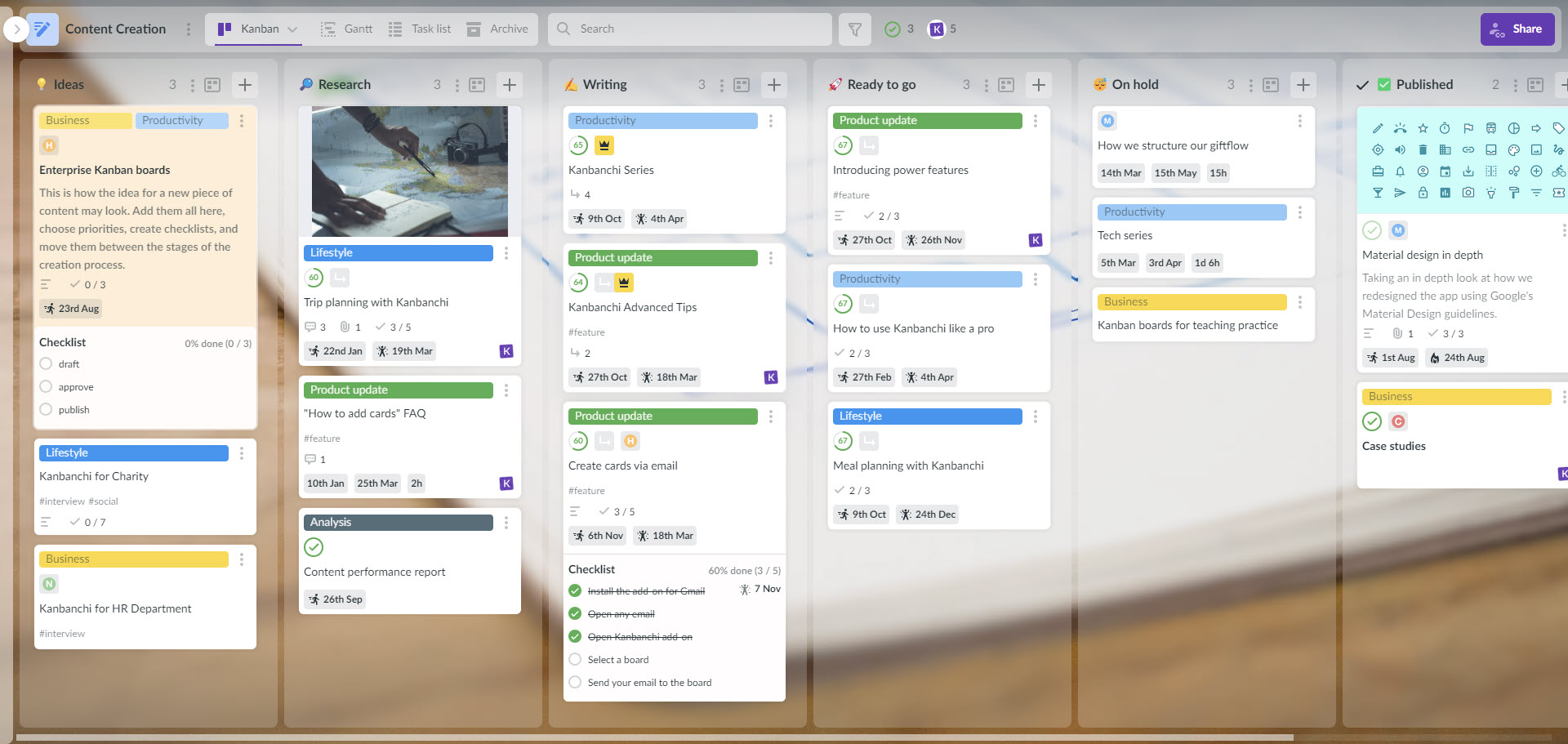
A template “Content creation” Kanbanchi board that marketing teams can start using immediately after sign-up: all stages defined, just need to fill the template with the real data
Four good tools don’t make a productive marketing team. Three rules do.
Two to five people. Kanbanchi and Canva, plus whatever email tool you already have. Anything more is overhead.
Six to fifteen. Add Buffer and Mailchimp properly, with one owner each. This is the size where campaign status stops fitting in anyone’s head.
Fifteen and up. Add Semrush and a real approvals process. At this size, the bottleneck is almost always review, not production.
Plan, prioritize, and manage your projects effortlessly with Kanbanchi - the all-in-one project management tool built for Google Workspace users.
Get a free trialIt depends on whether your work is campaign-based or continuous. Campaign work benefits from stage-based boards plus a timeline view, because parallel tracks need to converge on a launch date. Continuous work such as content production, social and community suits a board alone. We compare options in detail in Best project management software for marketing teams.
Fewer than most have. One place for campaign status, one for creative production, one for distribution, one for measurement. Four categories, not fourteen apps. The test is whether a new hire could find current campaign status without asking anyone.
Treating approvals as messages rather than as a stage of work. Legal review, client sign-off, and brand approval are steps in the process with owners and durations. When they live in email threads, nobody can see how long they take, and campaigns slip for reasons that were visible three weeks earlier.
More in this series: Productivity apps is the full guide by category.
Also in the series: productivity apps for remote teams, product teams, and sales teams.


In this Article:
Start using Kanbanchi now
Start your free trial