
In this Article:
Try Kanbanchi now
Start your free trial

Product teams do not have a task problem. They have an evidence problem.
Everyone knows what is being built this sprint. The hard questions are the ones underneath: why this and not the other thing, who asked for it, whether the last release changed anything, and what happens to the fourteen requests that did not make the cut. Those questions have answers. The answers are usually in someone’s notes.
This guide is organized by the question the team is trying to answer rather than by tool category. For the wider picture across every category, see our guide to productivity apps.
Linear is the execution layer, and the reason it earns its place over the general-purpose alternatives is speed of use rather than depth of feature. Issues, cycles, projects, keyboard-driven, opinionated about how work moves. Opinionated is the point. Tools that let a team configure anything produce teams that spend meetings configuring things.
What to watch: the opinion is engineering-shaped. Teams that need heavy customization, or non-engineering functions living in the same tool, tend to push against it.
Productboard is where the requests go before they become issues. Feedback from sales, support, and users lands in one place, gets attached to features, and the prioritization becomes something you can show someone rather than something you defend in a meeting.
What to watch: it is only as good as the feedback flowing into it. Set up the integrations that pull from support and sales on day one, or you have bought an expensive roadmap slide.
Dovetail is the research repository. Interviews, transcripts, notes, tagged and searchable, so the findings from the study in March are findable in November by someone who was not in the room.
The problem it solves is specific. Research that lives in individual documents effectively expires when the person who ran it moves on. Research in a repository accumulates.
What to watch: repositories reward discipline in tagging and punish the absence of it. One person needs to own the taxonomy, or you get four tags meaning the same thing and a search that returns a quarter of what exists.
Maze closes the loop before launch rather than after. Test a prototype with real users, get quantitative results in days, and find out that the flow is confusing while changing it is still cheap.
What to watch: unmoderated testing tells you what people did, not why. It is a complement to interviews, not a replacement for them.
There is a category of product work that is nobody’s ticket. The launch checklist. The sales enablement doc. Support training. The pricing page update. Legal review. The webinar. None of it is code; all of it has a date, and all of it blocks the release just as effectively as a bug does.
Kanbanchi is useful here specifically because it is not the issue tracker. A launch board with the non-engineering work on it, one card per commitment, one owner per card, and a timeline view showing whether the fourteen things converge before the date you announced. For teams on Google Workspace, the launch docs stay in Drive and the dates land in the shared calendar, so the marketer and the support lead can see the plan without a seat in the engineering tool.
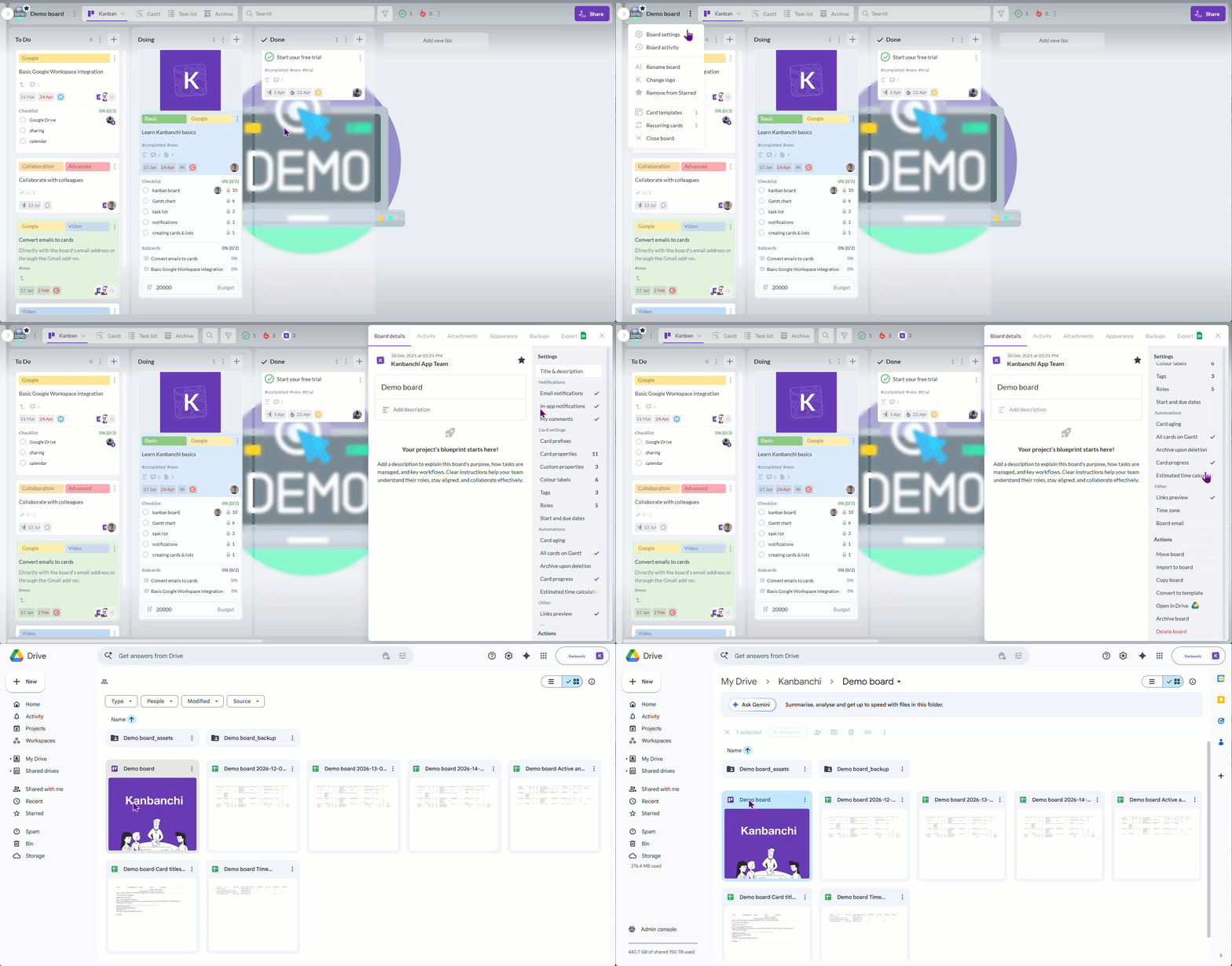
Kanbanchi works directly within Google Drive, making it easier to manage tasks, collaborate on projects, and keep work connected across your Google Workspace tools
Product teams accumulate tools faster than most functions, partly because trying new software is a professional interest rather than a chore. Three that are usually skippable.
Four categories, and most product managers touch three of them daily: an issue tracker for execution, a feedback and prioritization tool for deciding what matters, a research repository for user evidence, and a testing tool for validation. The number of tools is less important than whether the connection between them exists. A feature in the tracker that cannot be traced back to the request that prompted it is a feature nobody can defend when it slips.
Engineering tooling is built around code and the systems that ship it. Product tooling is built around evidence and the decisions that come from it, which is a different kind of artifact with a much longer useful life. The overlap is the issue tracker, which is why both teams argue about it. The practical split is that engineering owns how work is executed and product owns why it was chosen.
For the engineering work, no, the issue tracker covers it. For everything around a launch, usually yes, because launch work spans marketing, support, sales, and legal, and none of those people are in the issue tracker. That is a coordination problem rather than a development problem, and it wants a different tool. If you are evaluating dedicated tools for that, our guide to team task management is the relevant one.
More in this series: productivity apps is the full guide by category.
Also in the series: productivity software for operations teams, productivity apps for marketing teams, and sales teams.

In this Article:
Start using Kanbanchi now
Start your free trial