
In this Article:
Try Kanbanchi now
Start your free trial


HR software is mostly built around records. Who works here, what they are paid, when they took leave. Records are necessary, and they are not where the work is.
The work is in the transitions. Someone joins, someone changes role, someone leaves, and each of those events sets off fifteen tasks across four departments with a deadline attached to a human being’s first day. HR teams usually don’t fail at record-keeping. They fail in week one, when the laptop doesn’t arrive.
This guide follows the employee lifecycle: hire, onboard, develop, offboard. For the wider picture across every category, see our guide to productivity apps.
Greenhouse is the applicant tracking system, and it is worth paying for over a spreadsheet because it supports structured interviewing rather than pipeline management. Scorecards, defined interview kits, and a record of what each interviewer was actually assessing. That is what makes hiring decisions defensible and comparable rather than a conversation about who everyone liked.
What to watch: the structure only helps if hiring managers use it. An ATS full of blank scorecards is a very expensive email folder.
Onboarding is the most template-shaped process in any company, and the one most often run from memory. The same twenty tasks, the same four departments, the same first day, and yet every new starter’s experience depends on how busy their manager was that week.
Kanbanchi fits here better than it fits most places, because onboarding is a repeatable sequence of dated tasks owned by different people. Build the board once as a template: pre-start (equipment, accounts, contract), day one, week one, month one, month three. Copy it per new starter. Cards carry the owner, the deadline, and the document, and every task has a name against it rather than being IT’s problem in general.
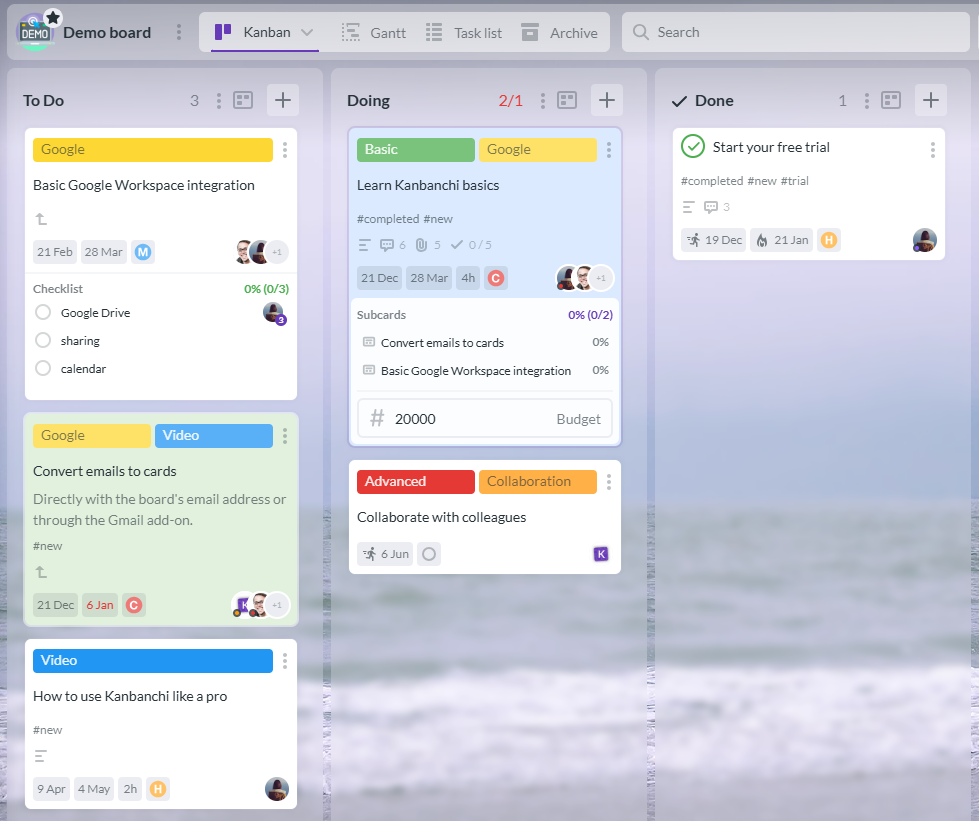
Example of the board introducing Kanbanchi and its capabilities
The Google Workspace fit matters more here than in most functions. Boards are Drive files, so a starter’s board inherits the sharing rules of the folder it sits in, and access ends the way Drive access ends rather than requiring someone to remember a separate system. Start dates sync to the calendar, so the manager sees the check-in without HR chasing. Recurring cards handle the reviews that are supposed to happen at month three and usually happen at month seven.
What to watch: onboarding boards contain personal information. Decide who can see a board before you create it, and use Shared Drives rather than a personal Drive so the board does not disappear with the person who built it.
Sign up for a free Kanbanchi trial
Culture Amp runs engagement surveys, performance reviews and development plans, and its useful property is that it benchmarks. A score of 7.2 means nothing on its own. A score of 7.2 against comparable companies means something.
What to watch: surveys create an expectation of action. Running one and doing nothing visible is measurably worse than not running one.
BambooHR holds the system of record for smaller and mid-sized companies: people, roles, leave, documents, reporting. It does what an HRIS should do without the implementation timeline of an enterprise platform.
What to watch: it overlaps with the ATS on hiring and with performance tools on reviews. Decide which system is authoritative for each before you turn features on, or you will maintain the same data twice.
Deel is the answer when the people are in different countries. Employment, contracts, and payment across jurisdictions, without opening an entity in each one.
What to watch: the compliance picture changes by country and by year, and worker classification rules in particular keep moving. Verify the current position for the specific countries you hire in rather than assuming a platform handles it.
Offboarding is onboarding in reverse and gets a fraction of the attention, which is why access to systems outlives employment so often. It is the same board template, run backward, with one addition: a documented list of what the person owned and who has it now.
The one where each task has a named owner and a date, and where people outside HR can see their own tasks. That rules out documents and spreadsheets, which have neither property. A board with a reusable template is usually enough, and the test is simple: on a new starter’s first day, can the hiring manager see what is outstanding without asking HR?
Usually yes, because they solve different problems. The HRIS is the record: who works here, what they earn, how much leave they have taken. The task tool is the process: the fifteen things that must happen before Monday. Some HRIS platforms include onboarding checklists, and they are worth trying first, but they tend to be HR-facing rather than open to the IT and finance staff who own most of the tasks.
The same process, with two changes: everything with a physical dependency moves earlier, and every document exchange gets a defined route. Equipment shipping is the single most common cause of a bad remote first day, and it is the one task that cannot be recovered by working late. Give it a card, an owner, and a date two weeks before the start date.
More in this series: productivity apps is the full guide by category.
Also in the series: productivity software for operations teams, productivity apps for marketing teams, and nonprofits.
In this Article:
Start using Kanbanchi now
Start your free trial